Related Research Articles

A missile is an airborne ranged weapon capable of self-propelled flight aided usually by a propellant, jet engine or rocket motor.
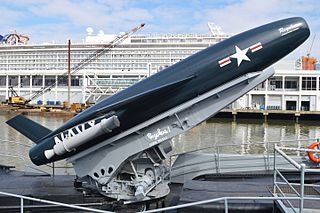
The SSM-N-8A Regulus or the Regulus I was a United States Navy-developed ship-and-submarine-launched, nuclear-capable turbojet-powered second generation cruise missile, deployed from 1955 to 1964. Its development was an outgrowth of U.S. Navy tests conducted with the German V-1 missile at Naval Air Station Point Mugu in California. Its barrel-shaped fuselage resembled that of numerous fighter aircraft designs of the era, but without a cockpit. Test articles of the Regulus were equipped with landing gear and could take off and land like an airplane. When the missiles were deployed they were launched from a rail launcher, and equipped with a pair of Aerojet JATO bottles on the aft end of the fuselage.

A booster is a rocket used either in the first stage of a multistage launch vehicle or in parallel with longer-burning sustainer rockets to augment the space vehicle's takeoff thrust and payload capability. Boosters are traditionally necessary to launch spacecraft into low Earth orbit, and are especially important for a space vehicle to go beyond Earth orbit. The booster is dropped to fall back to Earth once its fuel is expended, a point known as booster engine cut-off (BECO).

MKB Raduga is a Russian aerospace company, concerned with the production of various missile-systems and related technologies. It is headquartered in Dubna, Moscow Oblast. Formerly a division of the Mikoyan-Gurevich design bureau, it was spun off as a separate OKB in March 1957.
The Poseidon, previously known by Russian codename Status-6, is an autonomous, nuclear-powered unmanned underwater vehicle reportedly in production by Rubin Design Bureau, capable of delivering both conventional and nuclear warheads.
The Islamic Republic of Iran Navy or Iranian Navy, officially abbreviated NEDAJA, is the naval warfare service branch of Iran's regular military, the Islamic Republic of Iran Army (Artesh). It is one of Iran's two maritime military branches, alongside the Navy of the Islamic Revolutionary Guard Corps (IRGC).

A flying submarine, submersible aircraft or aerosub is a combination of a seaplane and a submarine. It is supposed to be able both to fly and to travel under water. Taking-off from the surface of water is also intended.

The UUM-125 Sea Lance, known early in development as the Common ASW Standoff Weapon, was to be an American standoff anti-submarine missile, initially intended to carry a W89 thermonuclear warhead. It was conceived in 1980 as a successor to both the UUM-44 SUBROC and RUR-5 ASROC anti-submarine missiles. The Sea Lance was to be available in two versions, known as UUM-125A and RUM-125A. The former would be a submarine-launched version, the latter surface-launched. It was cancelled in 1990 as its importance was obviated by the collapse of the Soviet Union.
The Rocket U-boat was a series of military projects undertaken by Nazi Germany during the Second World War. The projects, which were undertaken at Peenemünde Army Research Center, aimed to develop submarine-launched rockets, flying bombs and missiles. The Kriegsmarine did not use submarine-launched rockets or missiles from U-boats against targets at sea or ashore. These projects never reached combat readiness before the war ended.

The four De Zeven Provinciën-class frigates are air-defence and command frigates in service with the Royal Netherlands Navy. This class of ships is also known as "LCF". The ships are similar to the German Sachsen-class frigates in role and mission.

The Main Missile and Artillery Directorate of the Ministry of Defense of the Russian Federation, commonly referred to by its transliterated Russian acronym GRAU (ГРАУ), is a department of the Russian Ministry of Defense. It is subordinate to the Chief of Armament and Munition of the Russian Armed Forces, a vice-minister of defense.

The Cormorant was a tailsitter project under development at Lockheed Martin's Skunk Works research facility until 2008 when its contract for development was cancelled. It is named after a species of diving bird in reference to its intended role as a submarine-launched UAV. It was hoped that it could provide all- weather ISR&T, bomb/battle damage assessment, armed reconnaissance, and special operation forces mission support.
The CY-1 is a Chinese anti-submarine rocket carried on a variety of surface platforms, including the Luda class missile destroyers and Jiangwei class missile frigates. A series of CY ASW missiles have been developed based on CY-1. To date only a small number of CY-1 is known to have been produced and deployed on trial basis, despite the fact that it had first appeared on the defense exhibitions held in China in the late 1980s.
The YJ-82 is a Chinese subsonic anti-ship cruise missile. It is manufactured by the China Aerospace Science and Industry Corporation Third Academy.
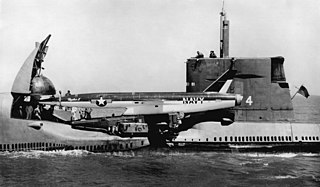
The SSM-N-9 Regulus II cruise missile is a supersonic guided missile armed with a nuclear warhead, intended for launching from surface ships and submarines of the U.S. Navy (USN).
LIG Nex1 Co., Ltd., formerly known as NEX1 Future is a South Korean aerospace manufacturer and arms manufacturer. It was established in 1976 as Goldstar Precision. LIG Nex1 was previously owned by LIG Holdings Company, which in turn was owned by the LIG Group. In 2013, a consortium led by South Korea private equity firm STIC Investments acquired 49 percent stake in LIG Nex1 for 420 billion Korean won.
K-4 or Kalam-4 is a nuclear capable intermediate-range submarine-launched ballistic missile developed by the Defence Research and Development Organisation of India to arm its Arihant-class submarines. The missile has a maximum range of about 4000 km which offers greater operational flexibility compared to its predecessor K-15 having a limited shore-bounding range. On deployment, the missile will be the first to operationalise India's sea-based nuclear triad and can accommodate the demand of credible second-strike capability of its nuclear doctrine.

The Indian Navy has been focusing on developing indigenous platforms, systems, sensors and weapons as part of the nation's modernisation and expansion of its maritime forces. As of November 2023, the Indian Navy had 67 vessels of various types under construction including destroyers, frigates, corvettes, conventional-powered and nuclear-powered submarines and various other ships. It plans to build up to a total of 200 vessels and 500 aircraft by 2050. According to the Chief of the Naval Staff's statement in December 2020, India has transformed from a buyer's navy to a builder's navy.
The Khabarovsk class, or Project 09851 is a class of nuclear submarines under construction for the Russian Navy.
References
- ↑ "DSEI 2023: SpearUAV rolls out drone launcher system for submarines". Shepherd Media. 19 September 2024. Retrieved 8 November 2024.
- ↑ "SSBN Triomphant Class". Naval Technology. 3 May 2001. Retrieved 8 November 2024.
 | This article relating to missiles is a stub. You can help Wikipedia by expanding it. |