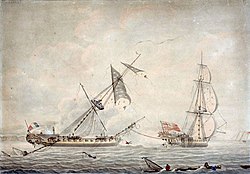
The law of prize is the branch of international law and admiralty law that governs the prize of war, specifically, capture of ships, cargoes and other property at sea during armed conflict and the legal process for deciding whether those captures are lawful.[1][2]
The expression "law of prize" is the formal term, rooted in early modern legal writing and the classical tradition of The Law of Nations. It appears consistently in foundational works by jurists such as Hugo Grotius, Cornelius van Bynkershoek, René Valin, Joseph Story and Henry Wheaton, whose treatises shaped the principles of naval warfare and neutral country rights. The phrase is also standard in British Admiralty jurisprudence, nineteenth century naval manuals and the prize court decisions that defined the doctrine during the great Age of Sail. In formal historical and doctrinal discussions, particularly those dealing with naval warfare, maritime capture and prize courts, the phrase “law of prize” has long been the conventional and authoritative formulation.
When precision of tone and context matters, especially in connection with the Napoleonic Wars and the War of 1812, vice-admiralty courts, privateering and the historical regulation of maritime capture "law of prize" is the most accurate and stylistically appropriate term. It emphasizes that this field was understood not merely as a technical subset of admiralty practice, but as a recognized branch of The Law of Nations, governing belligerent rights, neutral commerce and judicial oversight of naval war.
In practical terms, the law of prize sets out the rules for when a warship, or historically, a licensed privateer, may seize a vessel, what may be taken, how the capture must be conducted and what happens afterward. It requires that captured ships called prizes be brought before a prize court, which examines the circumstances of the seizure.[3] The court determines issues such as the nationality of the ship and cargo, whether the vessel was enemy or neutral, whether it was carrying contraband, attempting to break a blockade, or otherwise acting in a way that made it subject to capture. Only if the court condemns the vessel does the capture become legally valid, allowing the ship and cargo to be confiscated and disposed. Historically, often sold with the proceeds distributed as prize money.
Development
The law of prize developed mainly between the seventeenth and nineteenth centuries, when naval warfare and commerce raiding were central features of conflict. It draws on the broader The Law of Nations, domestic statutes, naval regulations and centuries of court decisions from countries such as Britain, France and the United States. In addition, it incorporates well known maritime practices such as visit and search, blockade enforcement, contraband rules, recapture and neutral rights.
Unlike general admiralty law, which deals with commercial shipping disputes in peacetime, the law of prize applies specifically to wartime captures and blends military necessity with legal restraint. Its core purpose has always been twofold: to legitimize the taking of enemy property at sea and to protect neutral shipping from unlawful interference.
Modern times
In modern times, although large-scale prize litigation is rare, the law of prize[4] still exists in the legal systems of maritime states and remains part of the modern law of naval warfare.[5]
This page is based on this Wikipedia article Text is available under the CC BY-SA 4.0 license; additional terms may apply. Images, videos and audio are available under their respective licenses.