
The Battle of Gettysburg was a three-day battle in the American Civil War fought between Union and Confederate forces between July 1 and July 3, 1863, in and around Gettysburg, Pennsylvania. The battle, which was won by the Union, is widely considered the Civil War's turning point, ending the Confederacy's aspirations to establish an independent nation. It was the Civil War's bloodiest battle, claiming over 50,000 combined casualties over three days.

Thomas Jonathan "Stonewall" Jackson was a Confederate general and military officer who served during the American Civil War. He played a prominent role in nearly all military engagements in the eastern theater of the war until his death. Military historians regard him as one of the most gifted tactical commanders in U.S. history.

The Battle of Chancellorsville, April 30 – May 6, 1863, was a major battle of the American Civil War (1861–1865), and the principal engagement of the Chancellorsville campaign.

The Army of Northern Virginia was the primary military force of the Confederate States of America in the Eastern Theater of the American Civil War. It was also the primary command structure of the Department of Northern Virginia. It was most often arrayed against the Union Army of the Potomac.
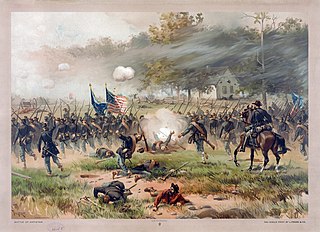
The Battle of Antietam, also called the Battle of Sharpsburg, particularly in the Southern United States, took place during the American Civil War on September 17, 1862, between Confederate General Robert E. Lee's Army of Northern Virginia and Union Major General George B. McClellan's Army of the Potomac near Sharpsburg, Maryland, and Antietam Creek. Part of the Maryland Campaign, it was the first field army–level engagement in the Eastern Theater of the American Civil War to take place on Union soil. It remains the bloodiest day in American history, with a tally of 22,727 dead, wounded, or missing on both sides. Although the Union Army suffered heavier casualties than the Confederates, the battle was a major turning point in the Union's favor.

George Brinton McClellan was an American military officer and politician who served as the 24th governor of New Jersey and as Commanding General of the United States Army from November 1861 to March 1862. He was also an engineer, and was chief engineer and vice president of the Illinois Central Railroad, and later president of the Ohio and Mississippi Railroad in 1860.

George Gordon Meade was a United States Army Major General who commanded the Army of the Potomac during the American Civil War from 1863 to 1865. He fought in many of the key battles of the Eastern theater and defeated the Confederate Army of Northern Virginia led by General Robert E. Lee at the Battle of Gettysburg.

Joseph Hooker was an American Civil War general for the Union, chiefly remembered for his decisive defeat by Confederate General Robert E. Lee at the Battle of Chancellorsville in 1863.
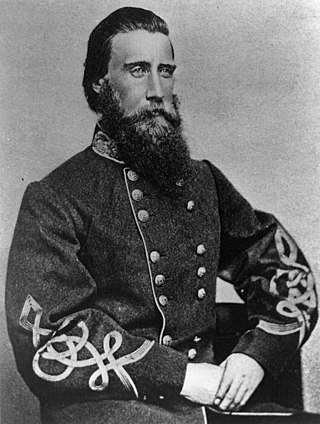
John Bell Hood was a Confederate general during the American Civil War. Hood's impetuosity led to high losses among his troops as he moved up in rank. Bruce Catton wrote that "the decision to replace Johnston with Hood was probably the single largest mistake that either government made during the war." Hood's education at the United States Military Academy led to a career as a junior officer in the infantry and cavalry of the antebellum U.S. Army in California and Texas. At the start of the Civil War, he offered his services to his adopted state of Texas. He achieved his reputation for aggressive leadership as a brigade commander in the army of Robert E. Lee during the Seven Days Battles in 1862, after which he was promoted to division command. He led a division under James Longstreet in the campaigns of 1862–63. At the Battle of Gettysburg, he was severely wounded, rendering his left arm mostly useless for the rest of his life. Transferred with many of Longstreet's troops to the Western Theater, Hood led a massive assault into a gap in the Union line at the Battle of Chickamauga but was wounded again, requiring the amputation of his right leg.
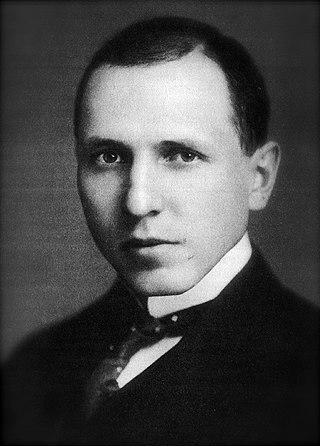
Douglas Southall Freeman was an American historian, biographer, newspaper editor, radio commentator, and author. He is best known for his multi-volume biographies of Robert E. Lee and George Washington, for both of which he was awarded Pulitzer Prizes.
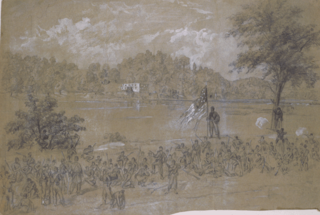
The Battle of Shepherdstown, also known as the Battle of Boteler's Ford, took place September 19–20, 1862, at Boteler's Ford along the Potomac River, during the Maryland campaign of the American Civil War. After the Battle of Antietam on September 17, General Robert E. Lee and the Confederate Army of Northern Virginia withdrew across the Potomac. Lee left a rearguard commanded by Brigadier General William N. Pendleton at Boteler's Ford. On September 19, elements of the Union V Corps dueled with Pendleton's artillery before pushing a short distance across the river at dusk. Pendleton inaccurately informed Lee that all of the artillery of the rearguard had been captured. On the morning of September 20, the Confederates counterattacked with A. P. Hill's Light Division, forcing the Union units back across the Potomac. One Union unit, the 118th Pennsylvania Infantry Regiment, did not withdraw at the same time as the others and suffered heavy losses. Lee's army continued its retreat into the Shenandoah Valley after the battle.

The Gettysburg campaign was a military invasion of Pennsylvania by the main Confederate army under General Robert E. Lee in summer 1863. It was the first time during the war the Confederate Army attempted a full-scale invasion of a free state. The Union won a decisive victory at Gettysburg, July 1–3, with heavy casualties on both sides. Lee managed to escape back to Virginia with most of his army. It was a turning point in the American Civil War, with Lee increasingly pushed back toward Richmond until his surrender in April 1865. The Union Army of the Potomac was commanded by Maj. Gen. Joseph Hooker and then by Maj. Gen. George G. Meade.
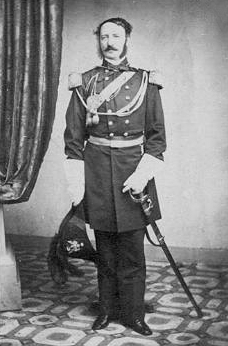
John Bankhead Magruder often referred to as "Prince John Magruder", was an American and Confederate military officer. A graduate of West Point, Magruder served with distinction during the Mexican–American War (1846–1848) and was a prominent Confederate Army general during the American Civil War (1861–1865). As a major general, he received recognition for delaying the advance of Maj. Gen. George B. McClellan's Army of the Potomac, during the 1862 Peninsula Campaign, as well as recapturing Galveston, Texas the following year.

Alfred Iverson Jr. was a lawyer, an officer in the Mexican–American War, a U.S. Army cavalry officer, and a Confederate general in the American Civil War. He served in the 1862–63 campaigns of the Army of Northern Virginia as a regimental and later brigade commander. His career was fatally damaged by a disastrous infantry assault at the first day of the Battle of Gettysburg. General Robert E. Lee removed Iverson from his army and sent him to cavalry duty in Georgia. During the Atlanta Campaign, he achieved a notable success in a cavalry action near Macon, Georgia, capturing Union Army Maj. Gen. George Stoneman and hundreds of his men.
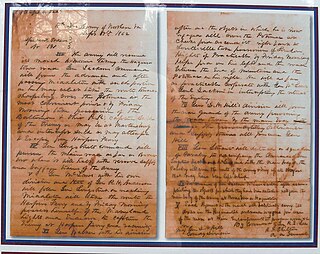
Special Order 191, also known as the "Lost Dispatch" and the "Lost Order", was a general movement order issued by Confederate Army General Robert E. Lee on about September 9, 1862, during the Maryland Campaign of the American Civil War. A lost copy of this order was recovered on September 13 by Union Army troops in Frederick County, Maryland, and the subsequent military intelligence gained by the Union played an important role in the Battle of South Mountain and Battle of Antietam.
The following Confederate States Army units and commanders fought in Virginia's Battle of Chancellorsville, which lasted from April 30 to May 6, 1863, during the American Civil War. The Union order of battle is listed separately. Order of battle has been compiled from the army organization during the campaign, the casualty returns and the reports.

Robert Hall Chilton was an officer in the U.S. Army and then a brigadier general in the Confederate States Army during the American Civil War. He served as chief of staff for the Army of Northern Virginia under Robert E. Lee for much of the war.

Albert Jesse Bowley Sr. was a Lieutenant General in the United States Army. He was the son of First Lieutenant Freeman S. Bowley, who served in the Civil War with the 30th United States Colored Infantry.

The Battle of Malvern Hill, also known as the Battle of Poindexter's Farm, was fought on July 1, 1862, between the Confederate Army of Northern Virginia, led by Gen. Robert E. Lee, and the Union Army of the Potomac under Maj. Gen. George B. McClellan. It was the final battle of the Seven Days Battles during the American Civil War, taking place on a 130-foot (40 m) elevation of land known as Malvern Hill, near the Confederate capital of Richmond, Virginia and just one mile (1.6 km) from the James River. Including inactive reserves, more than fifty thousand soldiers from each side took part, using more than two hundred pieces of artillery and three warships.

The 43rd Regiment, Pennsylvania Infantry Militia was a militia infantry regiment called out by Pennsylvania Governor Andrew Curtin for home defense service in the Union Army during the American Civil War from July 6, 1863, to 1865 August 13, 1863.


