
The Hubble sequence is a morphological classification scheme for galaxies published by Edwin Hubble in 1926. It is often colloquially known as the Hubble tuning-fork diagram because the shape in which it is traditionally represented resembles a tuning fork. It was invented by John Henry Reynolds and Sir James Jeans

A lenticular galaxy is a type of galaxy intermediate between an elliptical and a spiral galaxy in galaxy morphological classification schemes. It contains a large-scale disc but does not have large-scale spiral arms. Lenticular galaxies are disc galaxies that have used up or lost most of their interstellar matter and therefore have very little ongoing star formation. They may, however, retain significant dust in their disks. As a result, they consist mainly of aging stars. Despite the morphological differences, lenticular and elliptical galaxies share common properties like spectral features and scaling relations. Both can be considered early-type galaxies that are passively evolving, at least in the local part of the Universe. Connecting the E galaxies with the S0 galaxies are the ES galaxies with intermediate-scale discs.

A truss is an assembly of members such as beams, connected by nodes, that creates a rigid structure.

Lenticular clouds are stationary clouds that form mostly in the troposphere, typically in parallel alignment to the wind direction. They are often comparable in appearance to a lens or saucer. Nacreous clouds that form in the lower stratosphere sometimes have lenticular shapes.
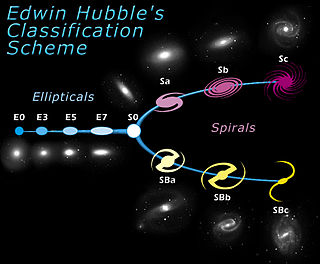
Galaxy morphological classification is a system used by astronomers to divide galaxies into groups based on their visual appearance. There are several schemes in use by which galaxies can be classified according to their morphologies, the most famous being the Hubble sequence, devised by Edwin Hubble and later expanded by Gérard de Vaucouleurs and Allan Sandage. However, galaxy classification and morphology are now largely done using computational methods and physical morphology.
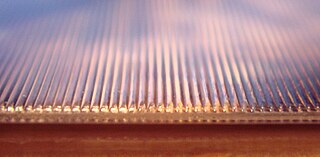
Lenticular printing is a technology in which lenticular lenses are used to produce printed images with an illusion of depth, or the ability to change or move as they are viewed from different angles.
A truss bridge is a bridge whose load-bearing superstructure is composed of a truss, a structure of connected elements, usually forming triangular units. The connected elements may be stressed from tension, compression, or sometimes both in response to dynamic loads. The basic types of truss bridges shown in this article have simple designs which could be easily analyzed by 19th and early 20th-century engineers. A truss bridge is economical to construct because it uses materials efficiently.
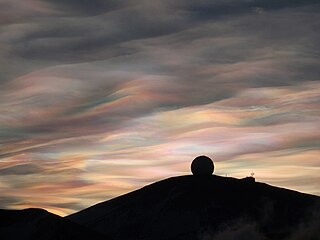
Polar stratospheric clouds (PSCs) are clouds in the winter polar stratosphere at altitudes of 15,000–25,000 m (49,000–82,000 ft). They are best observed during civil twilight, when the Sun is between 1 and 6 degrees below the horizon, as well as in winter and in more northerly latitudes. One main type of PSC is made up mostly of supercooled droplets of water and nitric acid and is implicated in the formation of ozone holes. The other main type consists only of ice crystals which are not harmful. This type of PSC is also referred to as nacreous.

The lentiform nucleus, or lenticular nucleus, comprises the putamen and the globus pallidus within the basal ganglia. With the caudate nucleus, it forms the dorsal striatum. It is a large, lens-shaped mass of gray matter just lateral to the internal capsule.

A lenticular lens is an array of lenses, designed so that when viewed from slightly different angles, different parts of the image underneath are shown. The most common example is the lenses used in lenticular printing, where the technology is used to give an illusion of depth, or to make images that appear to change or move as the image is viewed from different angles.
In geology, a lens or lentil is a body of ore or rock that is thick in the middle and thin at the edges, resembling a convex lens in cross-section.

The Bardwell's Ferry Bridge, built in 1882, is a historic lenticular truss bridge spanning the Deerfield River between the towns of Shelburne and Conway in Franklin County, Massachusetts. The bridge is listed on the National Register of Historic Places and is designated as a Massachusetts Historic Civil Engineering Landmark by the American Society of Civil Engineers.

NGC 1553 is a prototypical lenticular galaxy in the constellation Dorado. It is the second brightest member of the Dorado Group of galaxies. British astronomer John Herschel discovered NGC 1553 on December 5, 1834 using an 18.7 inch reflector.
The type-cD galaxy is a galaxy morphology classification, a subtype of type-D giant elliptical galaxy. Characterized by a large halo of stars, they can be found near the centres of some rich galaxy clusters. They are also known as supergiant ellipticals or central dominant galaxies.

The Turn-of-River Bridge, also known as Old North Stamford Road Bridge, is a single-span lenticular pony truss bridge built by the Berlin Iron Bridge Company in 1892. It was listed on the National Register of Historic Places in 1987. It formerly brought the Old Stamford Road across the Rippowam River, but is now open only to pedestrian traffic, as the road ends shortly before the bridge.

Gaunless Bridge was a railway bridge on the Stockton and Darlington Railway. It was completed in 1823 and is one of the first railway bridges to be constructed of iron and the first to use an iron truss. It is also of an unusual lenticular truss design.

A lenticular fabric is a lattice-like arrangement of lens-shaped materials formed into a thin layer. When the surface of the fabric is smooth, it often has a reflective and light-distorting appearance.

NGC 4203 is the New General Catalogue identifier for a lenticular galaxy in the northern constellation of Coma Berenices. It was discovered on March 20, 1787 by English astronomer William Herschel, and is situated 5.5° to the northwest of the 4th magnitude star Gamma Comae Berenices and can be viewed with a small telescope. The morphological classification of NGC 4203 is SAB0−, indicating that it has a lenticular form with tightly wound spiral arms and a weak bar structure at the nucleus.
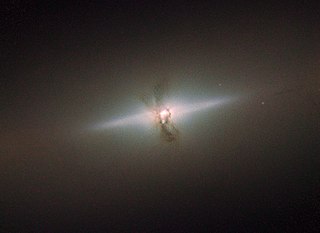
NGC 4111 is a lenticular galaxy in the constellation Canes Venatici. It is located at a distance of circa 50 million light-years from Earth, which, given its apparent dimensions, means that NGC 4111 is about 55,000 light-years across. It was discovered by William Herschel in 1788. NGC 4111 possesses both thin and thick discs.

