Related Research Articles

Lichen planus (LP) is a chronic inflammatory and immune-mediated disease that affects the skin, nails, hair, and mucous membranes. It is not an actual lichen, but is named for its appearance. It is characterized by polygonal, flat-topped, violaceous papules and plaques with overlying, reticulated, fine white scale, commonly affecting dorsal hands, flexural wrists and forearms, trunk, anterior lower legs and oral mucosa. The hue may be gray-brown in people with darker skin. Although there is a broad clinical range of LP manifestations, the skin and oral cavity remain as the major sites of involvement. The cause is unknown, but it is thought to be the result of an autoimmune process with an unknown initial trigger. There is no cure, but many different medications and procedures have been used in efforts to control the symptoms.

A seborrheic keratosis is a non-cancerous (benign) skin tumour that originates from cells, namely keratinocytes, in the outer layer of the skin called the epidermis. Like liver spots, seborrheic keratoses are seen more often as people age.

Actinic keratosis (AK), sometimes called solar keratosis or senile keratosis, is a pre-cancerous area of thick, scaly, or crusty skin. Actinic keratosis is a disorder of epidermal keratinocytes that is induced by ultraviolet (UV) light exposure. These growths are more common in fair-skinned people and those who are frequently in the sun. They are believed to form when skin gets damaged by UV radiation from the sun or indoor tanning beds, usually over the course of decades. Given their pre-cancerous nature, if left untreated, they may turn into a type of skin cancer called squamous cell carcinoma. Untreated lesions have up to a 20% risk of progression to squamous cell carcinoma, so treatment by a dermatologist is recommended.

Palmoplantar keratodermas are a heterogeneous group of disorders characterized by abnormal thickening of the stratum corneum of the palms and soles.
Lichen spinulosus is a rare skin disorder characterized by follicular keratotic papules that are grouped into large patches. It is a variant of keratosis pilaris named for its resemblance to a patch of lichen.
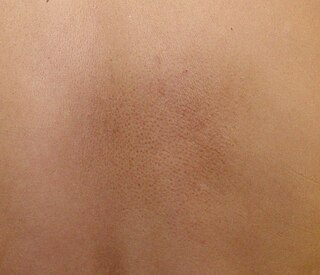
Primary cutaneous amyloidosis is a form of amyloidosis associated with oncostatin M receptor. This type of amyloidosis has been divided into the following types:

Erythrokeratodermia variabilis is a rare autosomal dominant disorder that usually presents at birth or during the first year of life. To date, it is thought to be caused by mutations in genes encoding for connexin channels proteins in the epidermis, leading to the misregulation of homeostasis in keratinocytes.
Keratosis pilaris atrophicans faciei begins in infancy as follicular papules with perifollicular erythema. Initially, the lesions are restricted to the lateral eyebrows, but with time spread to involve the cheeks and forehead, and may also be associated with keratosis pilaris on the extremities and buttocks.
Keratosis follicularis spinulosa decalvans is a rare X-linked disorder described by Siemens in 1926, a disease that begins in infancy with keratosis pilaris localized on the face, then evolves to more diffuse involvement.
Schöpf–Schulz–Passarge syndrome is an autosomal recessive condition with punctate symmetric palmoplantar keratoderma, with the keratoderma and fragility of the nails beginning around age 12. In addition to palmoplantar keratoderma, other symptoms include hypodontia, hypotrichosis, nail dystrophies, and eyelid cysts. Patients may also develop syringofibroadenoma and squamous cell carcinomas.
Lichen scrofulosorum is a rare tuberculid that presents as a lichenoid eruption of minute papules in children and adolescents with tuberculosis. The lesions are usually asymptomatic, closely grouped, skin-colored to reddish-brown papules, often perifollicular and are mainly found on the abdomen, chest, back, and proximal parts of the limbs. The eruption is usually associated with a strongly positive tuberculin reaction. Of the three tuberculids, the incidence of lichen scrofulosorum was found to be the lowest (2%) in a large study conducted in Hong Kong. This highlights its rarity and significance as an important marker of undetected tuberculosis.
Gougerot–Blum syndrome is a variant of pigmented purpuric dermatitis, a skin condition characterized by minute, rust-colored to violaceous, lichenoid papules that tend to fuse into plaques of various hues. Relative to other variants, it is characterized clinically by a male predominance, pruritus, with a predilection for the legs, and histologically, it features a densely cellular lichenoid infiltrate.
Lichen aureus is a skin condition characterized by the sudden appearance of one or several golden or rust-colored, closely packed macules or lichenoid papules.
Howel–Evans syndrome is an extremely rare condition involving thickening of the skin in the palms of the hands and the soles of the feet (hyperkeratosis). This familial disease is associated with a high lifetime risk of esophageal cancer. For this reason, it is sometimes known as tylosis with oesophageal cancer (TOC).
Keratosis linearis with ichthyosis congenita and sclerosing keratoderma syndrome is a rare cutaneous condition characterized by ichthyosis and keratoderma.
Focal palmoplantar and gingival keratosis is a rare autosomal dominant disease whose clinical features, and in particular, pathologic alterations and molecular mechanisms remains to be well defined.
Lichen verrucosus et reticularis is a cutaneous condition that may be related to keratosis lichenoides chronica.
Giant cell lichenoid dermatitis is a cutaneous condition usually drug-associated entity, characterized by a lichenoid dermatitis with a granulomatous infiltrate composed of histiocytes and multinucleated giant cells.
Histopathology of dermatitis can be performed in uncertain cases of inflammatory skin condition that remain uncertain after history and physical examination.
References
- ↑ Rapini, Ronald P.; Bolognia, Jean L.; Jorizzo, Joseph L. (2007). Dermatology: 2-Volume Set. St. Louis: Mosby. ISBN 978-1-4160-2999-1.
- ↑ Piñol Aguadé J, De Asprer J, Ferrando J (1974). "Lichenoid tri-keratosis (Kaposi-Bureau-Barrière-Grupper)". Dermatologica. 148 (3): 179–88. doi:10.1159/000251619. PMID 4836959.
 | This cutaneous condition article is a stub. You can help Wikipedia by expanding it. |