Related Research Articles
In bilingual education,students are taught in two languages. It is distinct from learning a second language as a subject because both languages are used for instruction in different content areas like math,science,and history. The time spent in each language depends on the model. For example,some models focus on providing education in both languages throughout a student's entire education while others gradually transition to education in only one language. The ultimate goal of bilingual education is fluency and literacy in both languages through a variety of strategies such as translanguaging and recasting.
Language education –the process and practice of teaching a second or foreign language –is primarily a branch of applied linguistics,but can be an interdisciplinary field. There are four main learning categories for language education:communicative competencies,proficiencies,cross-cultural experiences,and multiple literacies.
Adele Eva Goldberg is an American linguist known for her development of construction grammar and the constructionist approach in the tradition of cognitive linguistics.
Applied linguistics is an interdisciplinary field which identifies,investigates,and offers solutions to language-related real-life problems. Some of the academic fields related to applied linguistics are education,psychology,communication research,information science,natural language processing,anthropology,and sociology. Applied linguistics is a practical use of language.
Second-language acquisition (SLA),sometimes called second-language learning—otherwise referred to as L2acquisition,is the process by which people learn a second language. Second-language acquisition is also the scientific discipline devoted to studying that process. This involves learning an additional language after the first language is established,typically through formal instruction or immersion. A central theme in SLA research is that of interlanguage: the idea that the language that learners use is not simply the result of differences between the languages that they already know and the language that they are learning,but a complete language system in its own right,with its own systematic rules. This interlanguage gradually develops as learners are exposed to the targeted language. The order in which learners acquire features of their new language stays remarkably constant,even for learners with different native languages and regardless of whether they have had language instruction. However,languages that learners already know can have a significant influence on the process of learning a new one. This influence is known as language transfer.

Charles J. Fillmore was an American linguist and Professor of Linguistics at the University of California,Berkeley. He received his Ph.D. in Linguistics from the University of Michigan in 1961. Fillmore spent ten years at Ohio State University and a year as a Fellow at the Center for Advanced Study in the Behavioral Sciences at Stanford University before joining Berkeley's Department of Linguistics in 1971. Fillmore was influential in the areas of syntax and lexical semantics.
Sequential bilingualism occurs when a person becomes bilingual by first learning one language and then another. The process is contrasted with simultaneous bilingualism,in which both languages are learned at the same time.
Brian James MacWhinney is a Professor of Psychology and Modern Languages at Carnegie Mellon University. He specializes in first and second language acquisition,psycholinguistics,and the neurological bases of language,and he has written and edited several books and over 100 peer-reviewed articles and book chapters on these subjects. MacWhinney is best known for his competition model of language acquisition and for creating the CHILDES and TalkBank corpora. He has also helped to develop a stream of pioneering software programs for creating and running psychological experiments,including PsyScope,an experimental control system for the Macintosh;E-Prime,an experimental control system for the Microsoft Windows platform;and System for Teaching Experimental Psychology (STEP),a database of scripts for facilitating and improving psychological and linguistic research.
Beryl T. "Sue" Atkins was a British lexicographer,specialising in computational lexicography,who pioneered the creation of bilingual dictionaries from corpus data.
Susan Moore Ervin-Tripp (1927–2018) was an American linguist whose psycholinguistic and sociolinguistic research focused on the relation between language use and the development of linguistic forms,especially the developmental changes and structure of interpersonal talk among children.
Merrill Swain is a Canadian applied linguist whose research has focused on second language acquisition (SLA). Some of her most notable contributions to SLA research include the Output Hypothesis and her research related to immersion education. Swain is a Professor Emerita at the Ontario Institute for Studies in Education (OISE) at the University of Toronto. Swain is also known for her work with Michael Canale on communicative competence. Swain was the president of the American Association for Applied Linguistics in 1998. She received her PhD in psychology at the University of California. Swain has co-supervised 64 PhD students.
Elaine Tarone is a retired professor of applied linguistics and is a distinguished teaching professor emerita at the University of Minnesota. She is currently a member of the editorial board of The Modern Language Journal.
Translanguaging is a term that can refer to different aspects of multilingualism. It can describe the way bilinguals and multilinguals use their linguistic resources to make sense of and interact with the world around them. It can also refer to a pedagogical approach that utilizes more than one language within a classroom lesson. The term "translanguaging" was coined in the 1980s by Cen Williams in his unpublished thesis titled “An Evaluation of Teaching and Learning Methods in the Context of Bilingual Secondary Education.”Williams used the term to describe the practice of using two languages in the same lesson,which differed from many previous methods of bilingual education that tried to separate languages by class,time,or day. In addition,Vogel and Garcia argued that translanguaging theory posits that rather than possessing two or more autonomous language systems,as previously thought when scholars described bilingual or multilingual speakers,bilinguals and multilingual speakers select and deploy their languages from a unitary linguistic repertoire. However,the dissemination of the term,and of the related concept,gained traction decades later due in part to published research by Ofelia García,among others. In this context,translanguaging is an extension of the concept of languaging,the discursive practices of language speakers,but with the additional feature of using multiple languages,often simultaneously. It is a dynamic process in which multilingual speakers navigate complex social and cognitive demands through strategic employment of multiple languages.

Judit Kormos is a Hungarian linguist. She is a professor and the Director of Studies for the MA TESOL Distance programme at the Department of Linguistics and English Language at Lancaster University,United Kingdom. She is renowned for her work on motivation in second language learning,and self-regulation in second language writing. Her current interest is in dyslexia in second language learning.

Diane Larsen-Freeman is an American linguist. She is currently a Professor Emerita in Education and in Linguistics at the University of Michigan in Ann Arbor,Michigan. An applied linguist,known for her work in second language acquisition,English as a second or foreign language,language teaching methods,teacher education,and English grammar,she is renowned for her work on the complex/dynamic systems approach to second language development.
Alison Mackey is a linguist who specializes in applied linguistics,second language acquisition and research methodology and is one of the most highly cited scholars in the world in these areas.
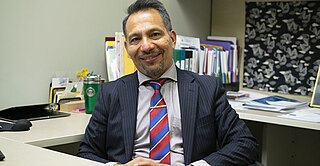
Martin Guardado is a Salvadorian-born Canadian sociolinguist. He is currently a professor of sociocultural linguistics and applied linguistics at the University of Alberta. His research focuses on heritage language socialization and teaching English as a second language. He is noted for his work on heritage language socialization and for recommending that heritage languages need to be studied multidimensionally as well as from macro and micro perspectives. His recent and current research respectively examines the experiences of Japanese-Canadian mothers in mixed language families in Montreal and the characteristics of mixed language parents across a number of linguistic groups in Alberta.
Patsy M. Lightbown is an American applied linguist whose research focuses on the teaching and acquisition of second and/or foreign languages in a classroom context. Her theories of second language acquisition earned her the SPEAQ Award for "contributions which have had an impact on the entire English teaching community in Quebec". She served in the United States Peace Corps in Niger,West Africa from 1965 to 1967. In her more than forty years in the field she has taught at multiple universities across the United States,Australia and Canada. She holds the title of Distinguished Professor Emerita at Concordia University in Montreal,Quebec. She has written seven published books and has been featured in many book chapters and refereed journals. She currently works as an independent consultant,editor,researcher and writing in second language acquisition and learning.
Mary J. Schleppegrell is an applied linguist and Professor of Education at the University of Michigan. Her research and praxis are based on the principles of Systemic Functional Linguistics (SFL),a theory derived from the work of social semiotic linguist Michael Halliday. Schleppegrell is known for the SFL-based literacy practices she has continuously helped to develop for multilingual and English language learners throughout her decades long career,which she began as an educational specialist before transitioning to the field of applied linguistics. As a result,her publications demonstrate a deep understanding of both the theories and practices related to teaching and learning.

Jasone Cenoz is a professor of education at the University of the Basque Country (UPV/EHU) University of the Basque Country in Donostia-San Sebastian,Spain since 2004. From 2000 to 2004 she was Professor of Applied Linguistics at the University of the Basque Country in Vitoria-Gasteiz. Her research focuses on multilingual education,bilingualism and multilingualism. She is known for her work on the influence of bilingualism on third language acquisition,pedagogical translanguaging,linguistic landscape,minority languages and Content and Language Integrated Learning.
References
- ↑ "Lily Wong Fillmore | Research UC Berkeley". vcresearch.berkeley.edu. Retrieved 2018-08-18.
- 1 2 McField, Grace P. (2008), "Wong Fillmore, Lily (1934-)", Encyclopedia of Bilingual Education, SAGE Publications, Inc., pp. 907–908, doi:10.4135/9781412963985.n344, ISBN 9781412937207 , retrieved 2018-08-18
- ↑ "Ph.D. Alumni | Department of Linguistics". linguistics.stanford.edu. Retrieved 2018-08-18.
- ↑ "Lily Wong Fillmore | Research UC Berkeley". vcresearch.berkeley.edu. Retrieved 2018-08-19.
- ↑ "In love with LANGUAGE / No 'ivory tower' educator, feisty UC Berkeley linguistics expert got her start teaching migrant workers' children". SFGate. 2004-07-18. Retrieved 2018-08-18.
- ↑ Wong Fillmore. "What Teachers Need To Know about Language" (PDF).
| International | |
|---|---|
| National | |
