The IFAF World Championship of Football is an international gridiron competition held every four years and contested by teams representing member nations. The competition is run by the International Federation of American Football (IFAF), the international governing body for the sport. Seventy-one nations have a national American football team. The most recent tournament, in 2015, featured seven teams.
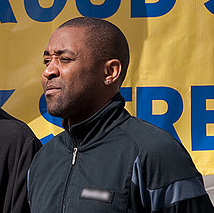
Darren Andrew Campbell, is a British former sprint athlete. He was the sprint coach at Wasps Rugby Club for the 2015–16 season. He competed in the 100 metres and 200 metres, as well as the 4 × 100 metres relay.

Roger Kingdom is an American former sprint hurdler who was twice Olympic champion in the 110 meters. Kingdom set a world record of 12.92 in 1989. He is now an athletics coach and strength and conditioning coach who currently works as a speed and conditioning coach for the Tampa Bay Buccaneers of the NFL.

In team sport, a player of the match award is often given to the most outstanding player in a particular match. This can be a player from either team, although the player is generally chosen from the winning team.

Allsvenskan is a Swedish professional league for men's association football clubs. It was founded in 1924 and is the top tier of the Swedish football league system, operating on a system of promotion and relegation with Superettan. Seasons run from late March or early April to the beginning of November, with the 16 clubs all meeting each other twice, resulting in a 30-match season, for a total of 240 matches league-wide.

Sport in the United Kingdom plays an important role in British culture and the United Kingdom has played a significant role in the organisation and spread of sporting culture globally. In the infancy of many organised sports, the Home Nations were heavily involved in setting out the formal rules of many sports and formed among the earliest separate governing bodies, national teams and domestic league competitions. After 1922, some sports formed separate bodies for Northern Ireland, though many continued to be organised on an all-Ireland basis. For this reason, in many though not all sports, most domestic and international sport is carried on a Home Nations basis, and England, Wales, Scotland and Ireland are recognised as national entities.

Sportin Germany is an important part of German culture and their society. In 2006 about 28 million people were members of the more than 87.000 sport clubs in Germany. Almost all sports clubs are represented by the German Olympic Sports Federation.
The Page playoff system is a playoff format used primarily in softball and curling at the championship level, and the Indian Premier League and Pakistan Super League cricket tournaments. Teams are seeded using a round-robin tournament and the top four play a mix of a single-elimination and double-elimination tournament to determine the winner. It is identical to a four-team McIntyre system playoff, first used by the WANFL, SANFL and VFL in Australia in 1931, originally called the Page–McIntyre system, after the VFL delegate, the Richmond Football Club's Secretary, Percy "Pip" Page, who had advocated its use. A form has been adopted in the Canadian Premier League national soccer competition.
Valley Rovers GAA Club is a Gaelic Athletic Association club in the parish of Innishannon in County Cork, Ireland. The club was formed in 1919 when two teams in the parish, Innishannon and Knockavilla, came together. The club fields teams in hurling, camogie, Gaelic football and Ladies' football. It participates in the Carrigdhoun division of Cork GAA.
Sport in Spain in the second half of the 20th century has always been dominated by football. Other popular sport activities include basketball, tennis, cycling, padel, handball, rugby, rally, motorcycling, judo, Formula One, water sports, rhythmic gymnastics, bullfighting, golf, and skiing.
Sport in Serbia includes football, basketball, handball, tennis, volleyball, and water polo. Professional sports in Serbia are organized by sporting federations and leagues. Serbian professional sports includes multi-sport clubs, biggest and most successful of which are Crvena Zvezda, Partizan, Radnički and Beograd in Belgrade, Vojvodina in Novi Sad, Radnički in Kragujevac, Spartak in Subotica. Serbia had successes in basketball, winning the Olympic silver medal and Nikola Jokic winning 2 NBA MVPs, as well as the 2023 NBA Championship and Finals MVP, Novak Djokovic winning a record setting 24th Grand Slam, and in handball, volleyball and water polo as well.
Sport in Denmark is diverse. The national sport is running, but club sport is football with the most notable results being qualifying for the European Championships six times in a row (1984–2004) and winning the Championship in 1992. Other significant achievements include winning the Confederations Cup in 1995 and reaching the quarter final of the 1998 World Cup. Other popular sports include handball, esports, cycling, sailing sports, badminton, ice hockey, swimming, and recently also golf. A few youths also play basketball.
Sports in Portugal are important in Portuguese culture. High-profile, successful competitive athleticism and sportsmanship in Portugal can be traced back to the time of Ancient Rome. Gaius Appuleius Diocles was a noteworthy charioteer born in Lamego who became one of the most celebrated athletes in ancient history. He is often cited as the highest-paid athlete of all time. Football is the most popular sport in Portugal. Other than football, many other professional or semi-professional well organized sport competitions take place every season in Portugal, including basketball, swimming, athletics, tennis, gymnastics, futsal, rink hockey, team handball, volleyball, surfing, canoeing and rugby union championships among the hundreds of sports played in this country.
Greece has risen to prominence in a number of sporting areas in recent decades. Football in particular has seen a rapid transformation, with the Greece national football team winning the UEFA Euro 2004. Many Greek athletes have also achieved significant success and have won world and olympic titles in numerous sports during the years, such as basketball, wrestling, water polo, athletics, weightlifting, with many of them becoming international stars inside their sports. The successful organisation of the Athens 2004 Olympic and Paralympic Games led also to the further development of many sports and has led to the creation of many world class sport venues all over Greece and especially in Athens. Greek athletes have won a total 161 medals for Greece in 17 different Olympic sports at the Summer Olympic Games, including the Intercalated Games, an achievement which makes Greece one of the top nations globally, in the world's rankings of medals per capital
Sport plays an important role in Estonian culture. Estonia first competed as a nation at the 1920 Summer Olympics, although the National Olympic Committee was established in 1923. Estonian athletes took part at every Olympic Games until the country was annexed by the Soviet Union in 1940. The 1980 Summer Olympics sailing regatta was held in the capital city Tallinn. Estonia has won most of its Olympic medals in wrestling, athletics, weightlifting, and cross-country skiing.
Sport in Algeria dates back to antiquity. In the Aurès Mountains, people played games such as El Kherdba or El khergueba. Playing cards, checkers and chess games are part of Algerian culture. Horse racing (fantasia) and rifle shooting are among the recreational traditions of Algeria.
Daniel Patrick Keenan was an Irish Gaelic games administrator, Gaelic football coach, selector and former player. He was the president of the Gaelic Athletic Association from 1973 until 1976.


