Synchronized Multimedia Integration Language ) is a World Wide Web Consortium recommended Extensible Markup Language (XML) markup language to describe multimedia presentations. It defines markup for timing, layout, animations, visual transitions, and media embedding, among other things. SMIL allows presenting media items such as text, images, video, audio, links to other SMIL presentations, and files from multiple web servers. SMIL markup is written in XML, and has similarities to HTML.
In human–computer interaction, computer accessibility refers to the accessibility of a computer system to all people, regardless of disability type or severity of impairment. The term accessibility is most often used in reference to specialized hardware or software, or a combination of both, designed to enable use of a computer by a person with a disability or impairment. Specific technologies may be referred to as assistive technology.
Microsoft Compiled HTML Help is a Microsoft proprietary online help format, consisting of a collection of HTML pages, an index and other navigation tools. The files are compressed and deployed in a binary format with the extension .CHM, for Compiled HTML. The format is often used for software documentation.
Microsoft Reader is a Microsoft application for reading e-books, first released in August 2000, or a Microsoft application for reading PDF and XPS files, first released for Windows 8.1.
This is an overview of software support for the OpenDocument format, an open document file format for saving and exchanging editable office documents.
Mobipocket SA was a French company incorporated in March 2000 that created the .mobi e-book file format and produced the Mobipocket Reader software for mobile phones, personal digital assistants (PDA) and desktop operating systems.
Screenwriting software are word processors specialized to the task of writing screenplays.
The following is a comparison of e-book formats used to create and publish e-books.
Design Science, Inc. is a US-based software company whose products allow editing and display of mathematical notation, mostly on the basis of MathML.
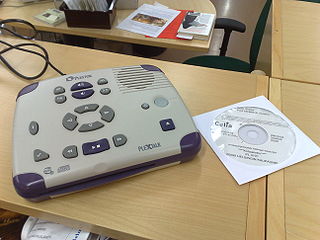
Accessible publishing is an approach to publishing and book design whereby books and other texts are made available in alternative formats designed to aid or replace the reading process. Alternative formats that have been developed to aid different people to read include varieties of larger fonts, specialised fonts for certain kinds of reading disabilities, Braille, e-books, and automated Audiobooks and DAISY digital talking books.

EPUB is an e-book file format that uses the ".epub" file extension. The term is short for electronic publication and is sometimes styled ePub. EPUB is supported by many e-readers, and compatible software is available for most smartphones, tablets, and computers. EPUB is a technical standard published by the International Digital Publishing Forum (IDPF). It became an official standard of the IDPF in September 2007, superseding the older Open eBook standard.

libvirt is an open-source API, daemon and management tool for managing platform virtualization. It can be used to manage KVM, Xen, VMware ESXi, QEMU and other virtualization technologies. These APIs are widely used in the orchestration layer of hypervisors in the development of a cloud-based solution.
HTML5 can generally be used as an alternative to Adobe Flash. Both include features for playing audio and video within web pages, It can also be used to play some basic HTML5 browser games and integrated vector graphics are possible with both.

Mono is a free and open-source project to create an Ecma standard-compliant .NET Framework-compatible software framework, including a C# compiler and a Common Language Runtime. Originally by Ximian, it was later acquired by Novell, and is now being led by Xamarin, a subsidiary of Microsoft and the .NET Foundation. The stated purpose of Mono is not only to be able to run Microsoft .NET applications cross-platform, but also to bring better development tools to Linux developers. Mono can be run on many software systems including Android, most Linux distributions, BSD, macOS, Windows, Solaris, and even some game consoles such as PlayStation 3, Wii, and Xbox 360.
Lektz is an eBook business platform developed by AEL Data, operating from UK and India. The solutions available in the Lektz platform include DRM, ebook reader applications, virtual book store, ebook conversion, elending, consumer analytics, and digital marketing solutions for small, medium-sized publishers and independent authors. Dr. M.S. Mohammed Sadiq, Sr. Vice President of AEL Data, is the chief architect of the Lektz platform and it draws support from AEL Data's ePublishing, digitization, accessibility solutions and application development services.

FBReader is an e-book reader for Linux, Microsoft Windows, Android, and other platforms.