Related Research Articles

The Dayak or Dyak or Dayuh are one of the native groups of Borneo. It is a loose term for over 200 riverine and hill-dwelling ethnic groups, located principally in the central and southern interior of Borneo, each with its own dialect, customs, laws, territory, and culture, although common distinguishing traits are readily identifiable. The Dayak were animist in belief; however, since the 19th century there has been mass conversion to Christianity as well as Islam due to the spreading of Abrahamic religions.

The Iban language is spoken by the Iban, one of the Dayak ethnic groups, who live in Brunei, the Indonesian province of West Kalimantan and in the Malaysian state of Sarawak. It belongs to the Malayic subgroup, a Malayo-Polynesian branch of the Austronesian language family.

The Ibans or Sea Dayaks are an Austronesian ethnic group indigenous to northwestern Borneo. The Ibans are also known as Sea Dayaks and the title Dayak was given by the British and the Dutch to various ethnic groups in Borneo island.

Bidayuh is the collective name for several indigenous groups found in southern Sarawak, Malaysia and northern West Kalimantan, Indonesia, on the island of Borneo, which are broadly similar in language and culture. The name Bidayuh means 'inhabitants of land'. Originally from the western part of Borneo, the collective name Land Dayak was first used during the period of Rajah James Brooke, the White Rajah of Sarawak. At times, they were also lesser referred to as Klemantan people. They constitute one of the main indigenous groups in Sarawak and West Kalimantan and live in towns and villages around Kuching and Serian in the Malaysian state of Sarawak, while in the Indonesian province of West Kalimantan they are mainly concentrated in the northern Sanggau Regency. In Sarawak, most of Bidayuh population can be found within 40 km of the geographical area known as Greater Kuching, within the Kuching and Serian Division. They are the second-largest Dayak ethnic group in Sarawak after the Iban and one of the major Dayak tribes in West Kalimantan.

Bukitan are the indigenous people native to the Nanga Palin in Embaloh Hilir of Kapuas Hulu Regency, Indonesia. Nowadays, the Bukitan diaspora can be found in the neighbouring Nanga Palin as well; including the district of Bintulu in Sarawak.

WO1 Temenggong Datuk Kanang anak Langkau, SP, PGB, PGBK, PBS (Rt) was a Malaysian hero and soldier from the Iban Dayak community in Sarawak. He was in the Royal Ranger Regiment and Regimental Sergeant Major of 8 Renjer of the Malaysian Army with his tag number 901378. He was awarded the Panglima Gagah Berani and Seri Pahlawan Gagah Perkasa medals from the Yang di-Pertuan Agong, Sultan Ahmad Shah on 3 June 1981. He is the sole recipient of both the Seri Pahlawan Gagah Perkasa and Pingat Gagah Berani, and was the last living recipient of the Seri Pahlawan Gagah Perkasa.
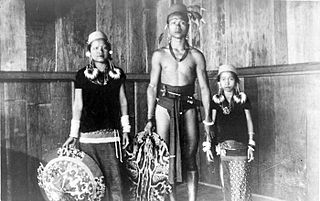
The Kenyah people are an indigenous, Austronesian-speaking people of Borneo, living in interior North and East Kalimantan, Indonesia and Sarawak, Malaysia.
The Sarawak National Party known by its acronym as "SNAP", is now a defunct political party in Malaysia. It was a member party of the Alliance Party from 1963 to 1966 and a member of Barisan Nasional (BN) coalition from 1976 until its expulsion in 2004. It contested the General Election in 2004 as well as the Sarawak state elections of 2006 and 2011 as an opposition party.

Tan Sri Datuk Amar Stephen Kalong Ningkan was a Malaysian politician who served as the first Chief Minister of Sarawak from 1963 to 1966.
Tun Datuk Patinggi Temenggong Jugah anak Barieng, also known as Tun Jugah, was a Malaysian politician of Iban descent from the state of Sarawak. He was the Paramount Chief of the Iban people for more than 55 years. They affectionately called him "Apai" meaning "father" in the Iban language.
The Dayak Unity Party was a political party in Indonesia. Formed to represent 'primordial' interests of the Dayak people, the party was one few political parties in Indonesia at the time which was formed along ethnic lines. Oevaang Oeray, the first governor of West Kalimantan and one of the founders of the PPD, was a prominent leader of the party.
The 1966 Sarawak constitutional crisis took place in the state of Sarawak, Malaysia from 1965 to 1966. This crisis was started by a group of politicians who were dissatisfied towards Stephen Kalong Ningkan's leadership as chief minister. Ningkan was later removed from the chief minister post by the Governor of Sarawak in June 1966. However, Ningkan was reinstated by the High Court in early September 1966. He was ousted from the chief minister office for the final time at the end of September 1966 and was replaced by Tawi Sli as the new chief minister. It was widely believed that the ouster of Ningkan was a result of interference by the Malaysian federal government due to him being a strong advocate of greater state autonomy.
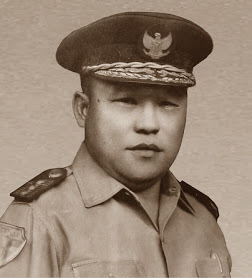
Johanes Chrisostomus Oevaang Oeray was an Indonesian politician. He was the Governor of West Kalimantan from 1960 to 1966 and was the first Christian, ethnic Dayak and only Roman Catholic to hold the position.

Kuching Heroes' Cemetery is a mausoleum located in Kuching, Sarawak, Malaysia. This cemetery is located at Jalan Taman Budaya.
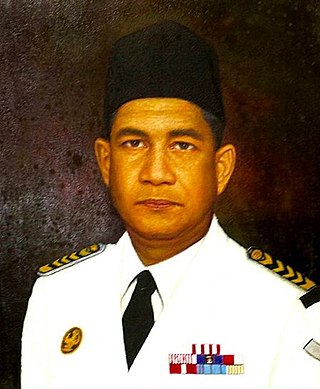
Anakletus Tjilik Riwut was an Indonesian military officer and journalist who served as the governor of Central Kalimantan from 1959 to 1967. He participated in the Indonesian National Revolution, becoming one of the leaders of the Kalimantan Physical Revolution in Dutch Borneo. In 1988, the government of Indonesia declared him a national hero.
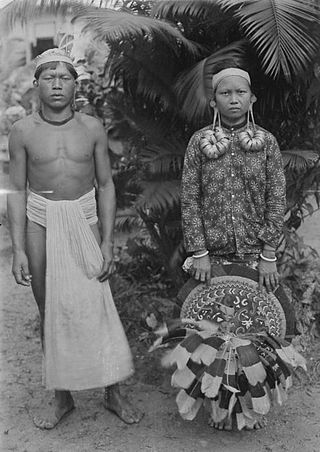
The Apo Kayan people are one of the Dayak people groups that are spread throughout Sarawak of Malaysia, North Kalimantan and North Kalimantan of Indonesia. The earliest Apo Kayan people are from the riverside of the Kayan River, Bulungan Regency, East Kalimantan, Indonesia. According to the Apo Kayan Dayak legend, the Kayan people are the forefathers of which all smaller sub-ethnic Dayak people that are found along the Kayan River came from. Today, the population of the Apo Kayan people are estimated about 64,900.
The second Sarawak district council elections was held in 1963. The results of the election was announced from 18 to 25 June 1963. A total of 185,000 voters cast votes in this election. A total of 998 candidates were vying for 429 district council seats in Sarawak.

Hendrik Isam Mahar was an Indonesian Army officer from the Special Forces Command who spearheaded the suppression of the communist insurgency in Sarawak.
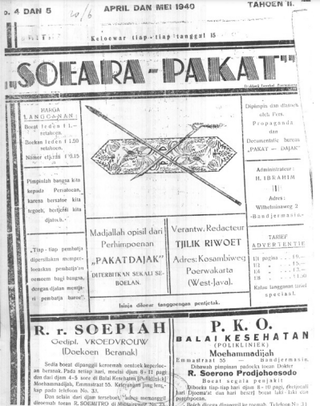
Dayak in politics refers to the participation of Dayaks to represent their political ideas and interests outside of their community. The movement has continued to have a profound impact on the development of Indonesia and Malaysia, especially in Kalimantan and Sarawak.
References
- ↑ Ded (2021). "HUT KE-76 RI – Mengenang 34 Tahun Tjilik Riwut, Pahlawan Nasional Kalteng". Tabengan Online (in Indonesian). Retrieved 27 May 2022.
- ↑ "JC Oevaang Oeray, Mengorbankan sang Pencetus Pancasila". Kalbarina.web.id (in Indonesian). Kalbarina. 2011. Retrieved 27 May 2022.
- ↑ "Drs. Cornelis MH: Pemersatu Dayak untuk NKRI". Kompasiana (in Indonesian). 2022. Retrieved 27 May 2022.
- ↑ Siska Permata Sari (2022). "5 Artis Indonesia Keturunan Dayak, yang Terakhir Malang Melintang sejak Era 1980-an". lifestyle.sindonews.com (in Indonesian). Sindonews. Retrieved 30 May 2022.
- ↑ Tasneem Nazarm (2020). "Kanang Anak Langkau: The Fearless Iban Warrior Who Is Malaysia's Most-Decorated War Hero". Open Research Library. The Rakyat Post. Retrieved 27 May 2022.
- ↑ Matthew Umpang (2019). "Stephen Kalong Ningkan, as remembered by his siblings". Borneo Post Online. Borneo Post . Retrieved 27 May 2022.
- ↑ Postill (1999). "Borneo again: media, social life and nation-building among the Iban of Malaysian Borneo" (PDF). Core. Borneo Post . Retrieved 27 May 2022.
- ↑ Tun Jugah Foundation
- ↑ "Pandelela – Shining example of true grit". Borneo Post . 21 July 2012. Retrieved 20 August 2012.
- ↑ Iylia Adreena (2019). "Henry Golding Says He's Proud Of His Iban Tattoo And Its History". Gempak.com. Gempak. Retrieved 27 May 2022.
- ↑ Tania Jayatilaka (2021). "Why Francisca Luhong James Celebrated Her Indigenous Heritage On The World Stage". Tatler Asia. Retrieved 27 May 2022.