
The Messerschmitt Bf 109 is a German World War II fighter aircraft that was, along with the Focke-Wulf Fw 190, the backbone of the Luftwaffe's fighter force. The Bf 109 first saw operational service in 1937 during the Spanish Civil War and was still in service at the end of World War II in 1945. It was one of the most advanced fighters when it first appeared, with an all-metal monocoque construction, a closed canopy, and retractable landing gear. It was powered by a liquid-cooled, inverted-V12 aero engine. It was called the Me 109 by Allied aircrew and some German aces, even though this was not the official German designation.

Nördlingen is a town in the Donau-Ries district, in Swabia, Bavaria, Germany, with a population of approximately 20,674. It is located approximately 115 km (71 mi) east of Stuttgart, and 145 km (90 mi) northwest of Munich. It was built in an impact crater 15 million years old and 25 km in diameter—the Nördlinger Ries—of a meteorite which hit with an estimated speed of 70,000 km/h, and left the area riddled with an estimated 72,000 tons of micro-diamonds.

The Rhön Mountains are a group of low mountains in central Germany, located around the border area where the states of Hesse, Bavaria and Thuringia come together. These mountains, which are at the extreme southeast end of the East Hesse Highlands, are partly a result of ancient volcanic activity. They are separated from the Vogelsberg Mountains by the river Fulda and its valley. The highest mountain in the Rhön is the Wasserkuppe, which is in Hesse. The Rhön Mountains are a popular tourist destination and walking area.
Bundesautobahn 3 is an autobahn in Germany running from the Germany-Netherlands border near Wesel in the northwest to the Germany-Austria border near Passau.
Die Länderbahn GmbH (DLB), formerly Vogtlandbahn GmbH, is a German rail transport company based in Viechtach, operating transport services originally only in the Vogtland, but now also on a regional basis. Die Länderbahn is a subsidiary of Regentalbahn AG, which is owned by Ferrovie dello Stato subsidiary Netinera. The term vogtlandbahn remains in use as a trademark of Die Länderbahn in Vogtland.
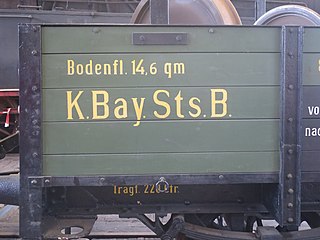
The Royal Bavarian State Railways was the state railway company for the Kingdom of Bavaria. It was founded in 1844. The organisation grew into the second largest of the German state railways with a railway network of 8,526 kilometres by the end of the First World War.

The Class S 3/6 steam locomotives of the Royal Bavarian State Railways were express train locomotives with a 4-6-2 Pacific or 2'C1' wheel arrangement.
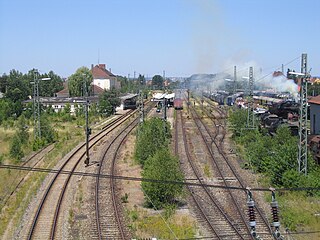
The Bavarian Railway Museum is a railway museum based in the old locomotive sheds at Nördlingen station in Bavaria, Germany. It is home to more than 100 original railway vehicles and has been located in the depot at Nördlingen since 1985.

The Bavarian Forest Railway links the heart of the Bavarian Forest around Regen and Zwiesel to Plattling and the Danube valley on one side, and the Czech Republic through Bayerisch Eisenstein on the other. In the Danube valley it forms a junction with the Nuremberg–Regensburg–Passau long-distance railway and, to the south, regional lines to Landshut and Munich.

The Regentalbahn is railway company based in Bavaria, and is owned by Ferrovie dello Stato and the Luxembourg infrastructure fund Cube, through the German holding company of Netinera. It runs railway infrastructure, as well as regional and long-distance passenger services in Bavaria and Saxony with links into the Czech Republic, and Germany-wide goods trains.
The Deggendorf–Kalteneck railway linked the railway line running through the Bavarian Forest from Plattling via Zwiesel to Bayerisch Eisenstein with the Ilz Valley railway (Ilztalbahn) from Passau via Waldkirchen to Freyung. In keeping with the naming of the Bavarian Forest railway or Waldbahn from Plattling to Bayerisch Eisenstein, it was called the Vorwaldbahn.
The Deggendorf–Plattling Railway company was an early German railway company founded in 1865 with an original capital of 300,000 gulden and established to build a railway line between Deggendorf and Plattling in Bavaria, southern Germany. The capital was divided into 3,000 shares of 100 gulden each.

The Schweinfurt–Meiningen railway, route number 5240, is a single-tracked main line in the states of Bavaria and Saxony in southern Germany. It is also called the Main-Rhön-Bahn and is listed in the Deutsche Bahn timetable as route (Kursbuchstrecke) 815. The railway has been part of the Erfurt–Schweinfurt route since 1993. Passenger services on the line are provided by DB Regio and the Erfurter Bahn (EB).
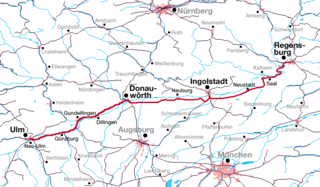
The Regensburg–Ingolstadt railway is a single-track, electrified mainline railway in Bavaria, Germany. It runs in the Danube valley from Regensburg to Ingolstadt. The Regensburg–Ingolstadt railway and the Ingolstadt–Neuoffingen railway together form the Bavarian Danube Valley Railway (Donautalbahn).
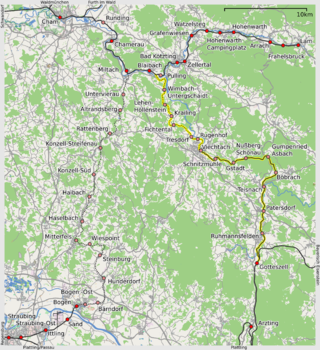
The Gotteszell–Blaibach railway is a railway line in the state of Bavaria in southern Germany that runs from Gotteszell in Lower Bavaria to Blaibach in the Upper Palatinate.

Aalen Hauptbahnhof is a junction on the Stuttgart-Bad Cannstatt–Nördlingen railway from Stuttgart to Nördlingen and the Aalen–Ulm railway from Ulm. The station is located 200 metres northeast of the historic old town (Altstadt) of Aalen in the German state of Baden-Württemberg. It is classified by Deutsche Bahn as a category 3 station. Aalen station was renamed a Hauptbahnhof at the timetable change on 11 December 2016.
The 2013 Bayern Rundfahrt was the 34th edition of the Bayern Rundfahrt, an annual cycling road race. Departing from on 22 May, it concluded on 26 May. The stage race was part of the 2013 UCI Europe Tour, and was rated as a 2.HC event.

The BR-Radltour is an annual bicycle tour for recreational bicycle riders that was established in 1990. It is organized by the Bavarian Broadcasting Corporation. The inventor of the BR-Radltour, Thomas Gaitanides retired in 2013 after his 23rd tour.
The Augsburg–Nördlingen railway is an electrified main line in Bavaria, Germany, originally built and operated as part of the Ludwig South-North Railway (Ludwig-Süd-Nord-Bahn) from Lindau to Hof. It runs from Augsburg via Donauwörth to Nördlingen.