The following is a partial list of direct action groups. Some groups known for their use of direct action include:
Green anarchism, also known as ecological anarchism or eco-anarchism, is an anarchist school of thought that focuses on ecology and environmental issues. It is an anti-capitalist and anti-authoritarian form of radical environmentalism, which emphasises social organization, freedom and self-fulfillment.
Propaganda of the deed is specific political direct action meant to be exemplary to others and serve as a catalyst for revolution.
According to different scholars, the history of anarchism either goes back to ancient and prehistoric ideologies and social structures, or begins in the 19th century as a formal movement. As scholars and anarchist philosophers have held a range of views on what anarchism means, it is difficult to outline its history unambiguously. Some feel anarchism is a distinct, well-defined movement stemming from 19th-century class conflict, while others identify anarchist traits long before the earliest civilisations existed.

Anarchism in Africa refers both to purported anarchic political organisation of some traditional African societies and to modern anarchist movements in Africa.
Leaderless resistance, or phantom cell structure, is a social resistance strategy in which small, independent groups, or individuals, challenge an established institution such as a law, economic system, social order, or government. Leaderless resistance can encompass anything from non-violent protest and civil disobedience to vandalism, terrorism, and other violent activity.
Anarchism in the United States began in the mid-19th century and started to grow in influence as it entered the American labor movements, growing an anarcho-communist current as well as gaining notoriety for violent propaganda of the deed and campaigning for diverse social reforms in the early 20th century. By around the start of the 20th century, the heyday of individualist anarchism had passed and anarcho-communism and other social anarchist currents emerged as the dominant anarchist tendency.

Black anarchism, also known as New Afrikan anarchism or Panther anarchism, is an anti-authoritarian and anti-racist current of the Black power movement and anarchism in the United States. It is characterized by its intersectional analysis of different forms of oppression, its skepticism of both authoritarian socialism and Eurocentric anarchism, and its advocacy of community organizing, armed self-defense and revolutionary black nationalism.
Anarchism in Russia developed out of the populist and nihilist movements' dissatisfaction with the government reforms of the time.

Anarchism in Ireland has its roots in the stateless organisation of the tuatha in Gaelic Ireland. It first began to emerge from the libertarian socialist tendencies within the Irish republican movement, with anarchist individuals and organisations sprouting out of the resurgent socialist movement during the 1880s, particularly gaining prominence during the time of the Dublin Socialist League.
Prefigurative politics are the modes of organization and social relationships that strive to reflect the future society being sought by the group. According to Carl Boggs, who coined the term, the desire is to embody "within the ongoing political practice of a movement [...] those forms of social relations, decision-making, culture, and human experience that are the ultimate goal". Besides this definition, Leach also gave light to the definition of the concept stating that the term "refers to a political orientation based on the premise that the ends a social movement achieves are fundamentally shaped by the means it employs, and that movement should therefore do their best to choose means that embody or prefigure the kind of society they want to bring about". Prefigurativism is the attempt to enact prefigurative politics.
The following outline is provided as an overview of and topical guide to anarchism:
The following is a list of terms specific to anarchists. Anarchism is a political and social movement which advocates voluntary association in opposition to authoritarianism and hierarchy.
Contemporary anarchism within the history of anarchism is the period of the anarchist movement continuing from the end of World War II and into the present. Since the last third of the 20th century, anarchists have been involved in anti-globalisation, peace, squatter and student protest movements. Anarchists have participated in armed revolutions such as in those that created the Makhnovshchina and Revolutionary Catalonia, and anarchist political organizations such as the International Workers' Association and the Industrial Workers of the World have existed since the 20th century. Within contemporary anarchism, the anti-capitalism of classical anarchism has remained prominent.

Total liberation, also referred to as total liberation ecology or veganarchism, is a political philosophy and movement that combines anarchism with a commitment to animal and earth liberation. Whilst more traditional approaches to anarchism have often focused primarily on opposing the state and capitalism, total liberation is additionally concerned with opposing all additional forms of human oppression as well as the oppression of other animals and ecosystems. Proponents of total liberation typically espouse a holistic and intersectional approach aimed at using direct action to dismantle all forms of domination and hierarchy, common examples of which include the state, capitalism, patriarchy, racism, heterosexism, cissexism, disablism, ageism, speciesism, and ecological domination.
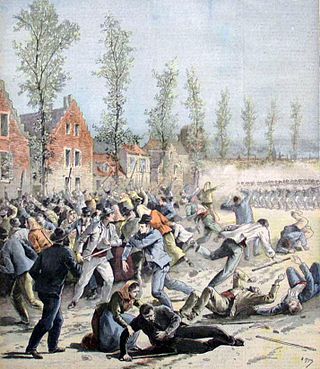
Direct action is a term for economic and political behavior in which participants use agency—for example economic or physical power—to achieve their goals. The aim of direct action is to either obstruct a certain practice or to solve perceived problems.
Insurrectionary anarchism is a revolutionary theory and tendency within the anarchist movement that emphasizes insurrection as a revolutionary practice. It is critical of formal organizations such as labor unions and federations that are based on a political program and periodic congresses. Instead, insurrectionary anarchists advocate informal organization and small affinity group based organization. Insurrectionary anarchists put value in attack, permanent class conflict and a refusal to negotiate or compromise with class enemies.

Anarchism in the Czech Republic is a political movement in the Czech Republic, with its roots in the Bohemian Reformation, which peaked in the early 20th century. It later dissolved into the nascent Czech communist movement, before seeing a resurgence after the fall of the Fourth Czechoslovak Republic in the Velvet Revolution.
Anarchism in Peru emerged from the Peruvian trade union movement during the late 19th century and the first two decades of the 20th century.
Anarchism in Malaysia arose from the revolutionary activities of Chinese immigrants in British Malaya, who were the first to construct an organized anarchist movement in the country, reaching its peak during the 1920s. After a campaign of repression by the British authorities, anarchism was supplanted by Bolshevism as the leading revolutionary current, until the resurgence of the anarchist movement during the 1980s, as part of the Malaysian punk scene.
Anarchism in Croatia first emerged in the late 19th century within the socialist workers' movement. Anarchist tendencies subsequently spread from neighboring countries, taking root in a number of cities throughout the country. The movement experienced repression from a succession of authoritarian regimes before finally reemerging around the time of the independence of Croatia.


