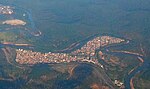
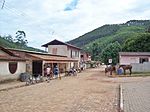
This is a list of the 68 bairros (neighborhoods) and seven sectors of Coronel Fabriciano, Minas Gerais, Brazil. [1] [2]
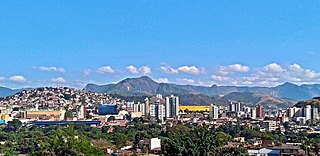
Coronel Fabriciano is a municipality in the state of Minas Gerais in the Southeast region of Brazil. It is located in the region of Vale do Rio Doce and is situated 200 km from the state capital. The municipal population was estimated in 2020 by IBGE in 110,290 inhabitants. The area is 221.252 km2 (85.426 sq mi).
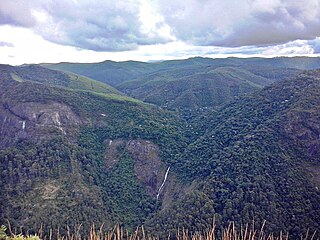
The Serra dos Cocais is a mountain chain located in the Brazilian municipality of Coronel Fabriciano, in the interior of the state of Minas Gerais. It is part of the geologic province of the Espinhaço mountains and is composed of continuous blocks of granite over 600 million years old. Its altitude, which reaches a high point of 1200 meters above sea level, stands out from the surrounding terrain with average altitudes ranging between 500 and 800 meters. It contains an important remnant of the Atlantic Forest, in the middle of considerable reforestation with eucalyptus, and has been considered an area of environmental protection since 2002.
Rubem Siqueira Maia was a Brazilian physician and politician. After living in São João del-Rei during his childhood and graduating from the School of Medicine of Federal University of Minas Gerais (UFMG), he moved to Vale do Rio Doce to work on the construction of the Vitória-Minas Railway (EFVM) in the 1930s.

The Saint Sebastian Cathedral is a Catholic religious temple located in the Brazilian city of Coronel Fabriciano, in the interior of the state of Minas Gerais. It was inaugurated in 1993 and since then shares the title of seat of the Diocese of Itabira-Fabriciano with the Our Lady of the Rosary Cathedral, which also represents the Episcopal See, in Itabira.

Saint Sebastian Parish is a division of the Catholic Church based in the Brazilian city of Coronel Fabriciano, in the interior of the state of Minas Gerais. The parish is part of the Diocese of Itabira-Fabriciano, and is located in Pastoral Region III. Its mother church is the Saint Sebastian Parish Church and its territory houses the co-cathedral of Saint Sebastian, which is one of the diocesan headquarters.

Escola Normal Nossa Senhora do Carmo e Ginásio Angélica, also known as Colégio Angélica, is an educational institution in the Brazilian municipality of Coronel Fabriciano, in the interior of the state of Minas Gerais. It was created in 1950 under the administration the Congregation of the Carmelite Sisters of Divine Providence, which maintained the school until 2011. Since 2016, the Catholic Institute of Minas Gerais (ICMG) has been responsible for the institution, providing nursary, primary, elementary, and vocacional school.

Doutor José Maria Morais Hospital is an institution located in the Brazilian city of Coronel Fabriciano, in the interior of the state of Minas Gerais. It was created by Belgo-Mineira in 1936, due to an epidemic of tropical diseases that the town was facing at the time.

The Catholic University Center of Eastern Minas Gerais (Unileste) is a Brazilian private higher education institution based in Coronel Fabriciano, in the interior of the state of Minas Gerais. It was created as part of the social works of the Padres do Trabalho Congregation in 1969, configuring itself as the first technical and higher education level school in the current Steel Valley Metropolitan Region (RMVA).
The Calado Station, also known as Coronel Fabriciano Station, was a railway station that operated as a passenger and loading and unloading terminal in the Brazilian municipality of Coronel Fabriciano, in the countryside of the state of Minas Gerais. It was inaugurated on June 9, 1924, being at the time one of the three largest stations of the Vitória-Minas Railway (EFVM). Around it was established the urban core that gave rise to the headquarters of the then-subordinated district to Antônio Dias, emancipated in 1948.
The history of Coronel Fabriciano, a Brazilian municipality in the interior of the state of Minas Gerais, began at the end of the 16th century. Expeditions followed the so-called Doce River Hinterlands in search of precious metals, however, the settlement of the region was forbidden at the beginning of the XVII century, to avoid smuggling of the gold extracted in the Diamantina region.

The Caladão Stream is a watercourse that rises and flows in the Brazilian municipality of Coronel Fabriciano, in the state of Minas Gerais. The source is located in Serra dos Cocais and runs for 10 kilometers to its mouth in the Piracicaba River. Its sub-basin covers 53 km2 and encompasses the Senador Melo Viana district, the most populous area of the city.
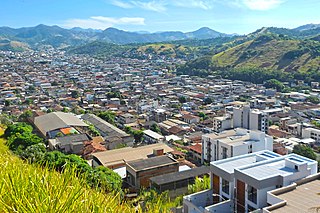
Giovannini is a neighborhood in the Brazilian municipality of Coronel Fabriciano, in the state of Minas Gerais. It is located in the Senador Melo Viana district, in Sector 4. According to the Brazilian Institute of Geography and Statistics (IBGE), its population in 2010 was 3,020, distributed over an area of 0.5 km2.

Júlia Kubitschek, popularly known as JK, is a neighborhood in the Brazilian municipality of Coronel Fabriciano, in the interior of the state of Minas Gerais. It is located in the Senador Melo Viana district, in Sector 4. According to the Brazilian Institute of Geography and Statistics (IBGE), its population in 2010 was 3,452 inhabitants, distributed over an area of 1.4 km2.
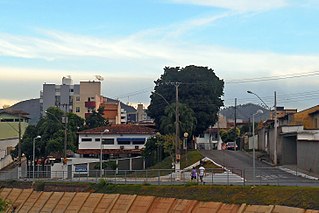
Professores is a neighborhood in the Brazilian municipality of Coronel Fabriciano, in the interior of the state of Minas Gerais. It is located in the Senador Melo Viana district, in Sector 1. According to the Brazilian Institute of Geography and Statistics (IBGE), its population in 2010 was 887 inhabitants, distributed over an area of 0.1 km2.
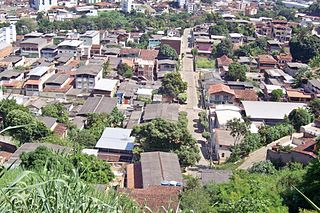
Santa Terezinha or Santa Terezinha I is a neighborhood in the Brazilian municipality of Coronel Fabriciano, in the interior of the state of Minas Gerais. It is located in the Senador Melo Viana district, in Sector 1. According to the Brazilian Institute of Geography and Statistics (IBGE), its population in 2010 was 1 712 inhabitants, distributed over an area of 0.3 km2.

Centro is a neighborhood in the Brazilian municipality of Coronel Fabriciano, in the interior of the state of Minas Gerais. It is located in the headquarters district, in Sector 1. According to the Brazilian Institute of Geography and Statistics (IBGE), its population in 2010 was 2,799 inhabitants, distributed over an area of 0.6 km2.

Santa Helena is a neighborhood in the Brazilian municipality of Coronel Fabriciano, in the interior of the state of Minas Gerais. It is located in the headquarters district, in Sector 1. According to the Brazilian Institute of Geography and Statistics (IBGE), its population in 2010 was 1 359 inhabitants, distributed over an area of 0.2 km2.

Floresta is a neighborhood in the Brazilian municipality of Coronel Fabriciano, in the interior of the state of Minas Gerais. It is located in the Senador Melo Viana district, in Sector 6. According to the Brazilian Institute of Geography and Statistics (IBGE), its population in 2010 was 2,820 inhabitants, distributed over an area of 0.4 km2.

The Caladinho Stream is a watercourse that rises and flows in the Brazilian municipality of Coronel Fabriciano, in the state of Minas Gerais. The source is located near the Caladinho neighborhood and it runs for about 12 kilometers to its mouth in the Piracicaba River through the Industrial Novo Reno, Universitário, Aparecida do Norte, Morada do Vale, Aldeia do Lago and Santa Terezinha II neighborhoods. Its sub-basin covers 9 km2.

The Pedro Nolasco Street is located in the Brazilian municipality of Coronel Fabriciano, in the state of Minas Gerais. It begins at the intersection of Rio Piracicaba, Albert Scharlet, Doutor Querubino and Rubem Siqueira Maia streets and ends at São Sebastião Street. It originated in the 1920s when the old Calado Station was built on the site. Some of the buildings located on the street still retain their original architecture.