
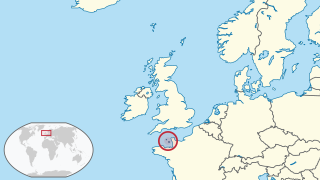
The Channel Islands are an archipelago in the English Channel, off the French coast of Normandy. They are divided into two Crown Dependencies: the Bailiwick of Jersey, which is the largest of the islands; and the Bailiwick of Guernsey, consisting of Guernsey, Alderney, Sark, Herm and some smaller islands. Historically, they are the remnants of the Duchy of Normandy. Although they are not part of the United Kingdom, the UK is responsible for the defence and international relations of the islands as it is for the other Crown Dependency, the Isle of Man, and the British Overseas Territories. The Crown Dependencies are neither members of the Commonwealth of Nations, nor part of the European Union. They have a total population of about 171,916, and the bailiwicks' capitals, Saint Helier and Saint Peter Port, have populations of 33,500 and 18,207 respectively.
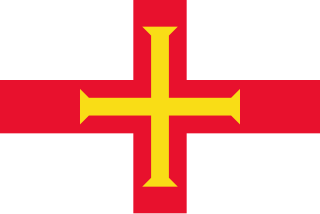
Guernsey is the second-largest island in the Channel Islands, located 27 miles (43 km) west of the Cotentin Peninsula, Normandy. It is the largest island in the Bailiwick of Guernsey, which includes five other inhabited islands – Alderney, Herm, Jethou, Lihou and Sark – and many small islets and rocks. The bailiwick has a population of 63,950, the vast majority of whom live on Guernsey, and the island has a land area of 24 square miles (62 km2).
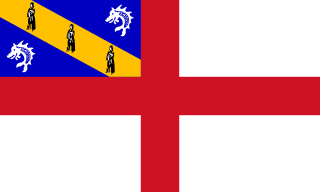
Herm is one of the Channel Islands and part of the Parish of St Peter Port in the Bailiwick of Guernsey. It is located in the English Channel, north-west of France and south of England. It is 2,183 m (7,162 ft) long and under 873 metres (2,864 ft) wide; oriented north–south, with several stretches of sand along its northern coast. The much larger island of Guernsey lies to the west, Jersey lies to the south-east, and the smaller island of Jethou is just off the south-west coast.
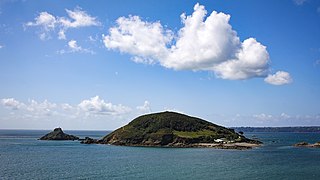
Jethou is a small island that is part of the Bailiwick of Guernsey in the Channel Islands. It is privately leased from the Crown, and not open to the public. Resembling the top of a wooded knoll, it is immediately south of Herm and covers approximately 44 acres (18 ha).
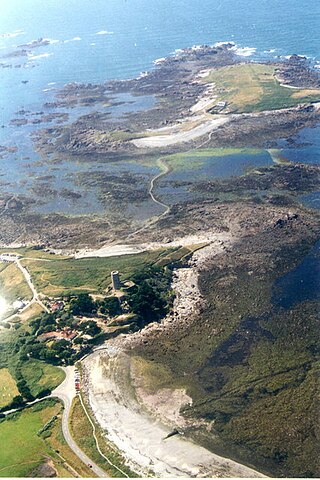
Lihou is a small tidal island located just off the west coast of the island of Guernsey, in the English Channel, between Great Britain and France. Administratively, Lihou forms part of the Parish of St. Peter's in the Bailiwick of Guernsey, and is now owned by the parliament of Guernsey, although there have been a number of owners in the past. Since 2006, the island has been jointly managed by the Guernsey Environment Department and the Lihou Charitable Trust. In the past the island was used by locals for the collection of seaweed for use as a fertiliser, but today Lihou is mainly used for tourism, including school trips. Lihou is also an important centre for conservation, forming part of a Ramsar wetland site for the preservation of rare birds and plants as well as historic ruins of a priory and a farmhouse.
The Crown Dependencies are three offshore island territories in the British Islands that are self-governing possessions of the British Crown: the Bailiwick of Guernsey and the Bailiwick of Jersey, both located in the English Channel and together known as the Channel Islands, and the Isle of Man in the Irish Sea between Great Britain and Ireland.
The Bailiwick of Guernsey is a self-governing British Crown Dependency off the coast of Normandy, France, comprising several of the Channel Islands. It has a total land area of 78 square kilometres (30 sq mi) and an estimated total population of 67,334.
A bailiwick is usually the area of jurisdiction of a bailiff, and once also applied to territories in which a privately appointed bailiff exercised the sheriff's functions under a royal or imperial writ.

St. Peter Port is a town and one of the ten parishes on the island of Guernsey in the Channel Islands. It is the capital of the Bailiwick of Guernsey as well as the main port. The population in 2019 was 18,958.

The linguistic situation of the Bailiwick of Guernsey is quite similar to that of Jersey, the other Bailiwick in the Channel Islands. English is the official language, French is used for administration, there are several varieties of Norman language used by a minority of the population, and Portuguese is spoken by some foreigners in the workforce.
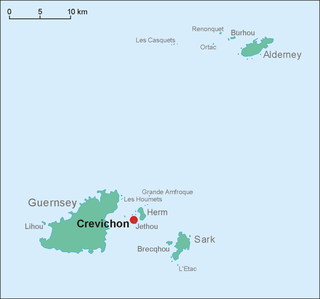
Crevichon is an islet off the west coast of Herm, immediately to the north of Jethou, in the Channel Islands
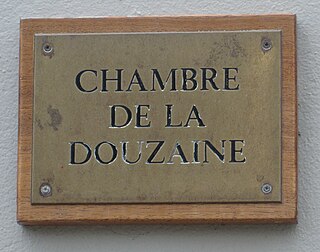
The Bailiwick of Guernsey includes the island of Guernsey and other islands such as Alderney, Sark, Herm, Jethou, Brecqhou, and Lihou. Each parish was established, probably in the 11th century, as a religious area, each having its parish church. Administratively each parish is now administered by an elected council known as a Douzaine.
The following outline is provided as an overview of and topical guide to Guernsey:
This page list topics related to the Bailiwick of Guernsey, including Guernsey, Alderney, Sark and smaller islands.
Mignot Memorial Hospital is the principal hospital in Alderney, Channel Islands. It is located in the northern part of St. Anne, and operates as part of the States of Guernsey Health and Social Services Department. The hospital was established in 2008 and has 22 beds, serving Alderney's population of 2,300. 14 beds are used for continuing care; 8 of the beds are used for medical, post-operative, maternity or paediatric care.
The Alderney Steam Packet Company provided shipping services between Alderney and Sark, Guernsey and Cherbourg from 1897 to 1931.

The first postal service took place using mail sent with captains of packet ships, using agents in the England and in the islands for the end delivery. The cost was normally 3d. The first pillar boxes in Britain were introduced in the Channel Islands as an experiment in 1852, to collect mail for the Royal Mail packet boats. The oldest pillar box in use in the British Isles is in Guernsey.
Ernest David Marquand (1848–1918) was an English botanist, perhaps best known as the author of Flora of Guernsey. His son was the noted botanist Cecil Victor Boley Marquand.
The history of the Jews in Guernsey dates back to well before the events of 1940–5. A London Jew named Abraham was described in 1277 as being from "La Gelnseye" (Guernsey). A converted Portuguese Jew, Edward Brampton, was appointed Governor of Guernsey in 1482.

Archaeology is promoted in Jersey by the Société Jersiaise and by Jersey Heritage. Promotion in the Bailiwick of Guernsey being undertaken by La Société Guernesiaise, Guernsey Museums, the Alderney Society with World War II work also undertaken by Festung Guernsey.
