List of tlatoque of Tetzcoco

Last updated
Glyph of Tetzcoco Tetzcoco glyph.svg
Glyph of Tetzcoco

This is a list of Mesoamerican tlatoque of the altepetl of Tetzcoco from the first tlatoani in 1298 to the end of the line of indigenous rulers. From the early 15th century to 1521, Tetzcoco was one of the three leading members of the Triple Alliance, commonly known as the Aztec Empire, but was often subservient to the rulers of Tenochtitlan. The Aztec Empire was conquered by Spain in 1521, but the Spanish colonial authorities continued to appoint tlatoque of Tetzcoco until the office was abolished in 1564.

Contents

Pre-colonial rulers (1298–1521)

Early Tetzcoco (1298–1431)

The tlatoque of Tetzcoco were descendants and successors of earlier tlatoque of the Chichimeca, succeeding Xolotl (1172–1232), Nopaltzin (1232–1263) and Tlotzin (1263–1298). [1]

PortraitNameReignSuccession and notesLife details
Quinatzin.jpg Quinatzin
Quinatzin
1298–1357 [1]
(59 years)
First tlatoani of Tetzcoco. ? – 1357
Died of natural causes
Techotlalatzin.jpg Techotlalatzin
Techotlala
1357–1409 [1]
(52 years)
Son of Quinatzin (1298–1357). ? – 1409
Died of natural causes
Ixtlilxochitl.jpg Ixtlilxochitl I
Ixtlilxochitl
1409–1418 [1]
(9 years)
Son of Techotlalatzin (1357–1409). ? – 1520
Executed by the Tepanec conqueror Tezozomoc. [2]
Yancuiltzin
Yancuiltzin
1418–1431 [3]
(13 years)
Son of Ixtilxochtli I (1409–1418). Appointed by Tezozomoc. Co-ruler with Tochpilli under Tepanec suzerainty. [2] Unknown fate
Tochpilli
Tochpilli
1418–1431 [3]
(13 years)
Son of Ixtilxochtli I (1409–1418). Appointed by Tezozomoc. Co-ruler with Yancuiltzin under Tepanec suzerainty. [2] Unknown fate

In the Triple Alliance (1431–1521)

PortraitNameReignSuccession and notesLife details
Nezahualcoyotl.jpg Nezahualcoyotl
Nezahualcoyōtl
1431–1472 [4]
(41 years)
Son of Ixtilxochtli I (1409–1418). Nearly executed by Tezozomoc in 1418 but escaped with the aid of Itzcoatl of Tenochtitlan. [2] Became king in 1431 during Tenochtitlan's uprising against the Tepanecs; founding member of the Triple Alliance (Aztec Empire) who led great campaigns of conquest. [5]  ? – 1472
Died of natural causes
Nezahualpilli.jpg Nezahualpilli
Nezahualpilli
1472–1515 [4]
(43 years)
Son of Nezahualcoyotl (1431–1472). ? – 1515
Died of natural causes
Cacamatzin, ~1494 - 7-1520, retrato anonimo (siglo XVI).png Cacamatzin
Cacamatzin
1515–1519 [4]
(4 years)
Son of Nezahualpilli (1472–1515). Revolted against the forces of Hernán Cortés after they imprisoned Moctezuma II in 1519. [6]  ? – 1520
Arrested by Cortés and deposed. [6] Died shortly thereafter.
Cuicuizcatl
Cuicuizcatl
1519–1520
(less than a year)
Son of Nezahualpilli (1472–1515). Appointed by Hernán Cortés in Tenochtitlan after Cacamatzin's revolt; never took power in Tetzcoco itself and not regarded as legitimate by the city's nobility. [7]  ? – 1520
Escaped Tenochtitlan during La Noche Triste. Executed by Coanacoch, who believed he was sent home by the Spaniards. [7]
Coanacoch
Coanacochtzin
1520–1521 [4]
(1 year)
Son of Nezahualpilli (1472–1515). Elected in Tetzcoco as Cacamatzin's successor. [7]  ? – 1524
Fled to Tenochtitlan in 1521 after the approach of the Spaniards. [8] Captured there later in the same year. Executed by Cortés in 1524. [9]

Colonial period (1521–1564)

The line of tlatoque continued in Tetzococo after the Spanish conquest. Adept at navigating the new Spanish colonial governing system and adapting to changing circumstances, many of the nobles of Tetzcoco, including the tlatoque, came through the cataclysmic downfall of the Aztec Empire in a stronger position than they had been previously. [10] Allowing the nobility of Tetzcoco to continue to appoint local rulers of the same pre-colonial dynasty was also beneficial for the Spaniards, who utilized their legitimacy to ensure the delivery of tribute and political subordination. [11]

PortraitNameReignSuccession and notesLife details
Tecocoltzin
Fernando Tecocoltzin
1521 [4]
(less than a year)
Son of Nezahualpilli (1472–1515). Appointed by Hernán Cortés after the flight of Coanacoch due to his sympathies for the Spaniards. Tecocoltzin repopulated and strengthened Tetzcoco and also took a leading role in the offensive against Tenochtitlan. [8]  ? – 1521
Died of natural causes just before the fall of Tenochtitlan [12]
Ixtlilxochitl II (cropped).jpg Ixtlilxochitl II
Fernando Cortés Ixtlilxochitl
1521–1531 [4]
(10 years)
Son of Nezahualpilli (1472–1515). Previously a rival claimant to the position of tlatoani. Appointed by Hernán Cortés. [12]  ? – 1531
Died of natural causes
Yoyontzin
Jorge Yoyontzin
1532–1533 [4]
(1 year)
Son of Nezahualpilli (1472–1515). [11]  ? – 1533
Died of natural causes
Tetlahuehuetzquititzin
Pedro Tetlahuehuetzquititzin
1534–1539 [4]
(5 years)
Son of Nezahualpilli (1472–1515). Previously passed over in 1515 in favor of Cacamatzin. [13]  ? – May 1539 [14]
Died of natural causes
Tlahuitoltzin.png Tlahuitoltzin
Antonio Pimentel Tlahuitoltzin
1540–1545 [4]
(5 years)
Son of Nezahualpilli (1472–1515). Politically skilled, Tiahuitoltzin's rule was a period of relative stability in Tetzcoco despite the upheaval that ravaged Mesoamerica at the time. [15]  ? – 1545
Died of natural causes
Ihuian
Hernando Pimentel Ihuian
1545–1564 [4]
(19 years)
Son of Coanacoch (1520–1521). Politically skilled like his predecessor, also oversaw a peaceful and stable period in Tetzcoco. [15]  ? – 1564
Died of natural causes

The state of affairs in Tetzcoco after the death of Ihuian in 1564 is unclear given that few surviving sources discuss local politics during this time. [16] It seems that the position of tlatoani was left vacant due to interfamilial conflict in regard to who was to be the next ruler, which in turn led to the office being entirely replaced by the Spanish-appointed governors of the city. [17]

See also

Related Research Articles

<span class="mw-page-title-main">Moctezuma I</span> Fifth Tlatoani of Tenochtitlan

Moctezuma I, also known as Moteuczomatzin Ilhuicamina, Huehuemoteuczoma or Montezuma I, was the second Aztec emperor and fifth king of Tenochtitlan. During his reign, the Aztec Empire was consolidated, major expansion was undertaken, and Tenochtitlan started becoming the dominant partner of the Aztec Triple Alliance. Often mistaken for his popular descendant, Moctezuma II, Moctezuma I greatly contributed to the famed Aztec Empire that thrived until Spanish arrival, and he ruled over a period of peace from 1440 to 1453. Moctezuma brought social, economical, and political reform to strengthen Aztec rule, and Tenochtitlan benefited from relations with other cities.

<span class="mw-page-title-main">Aztecs</span> Ethnic group of central Mexico and its civilization

The Aztecs were a Mesoamerican culture that flourished in central Mexico in the post-classic period from 1300 to 1521. The Aztec people included different ethnic groups of central Mexico, particularly those groups who spoke the Nahuatl language and who dominated large parts of Mesoamerica from the 14th to the 16th centuries. Aztec culture was organized into city-states (altepetl), some of which joined to form alliances, political confederations, or empires. The Aztec Empire was a confederation of three city-states established in 1427: Tenochtitlan, city-state of the Mexica or Tenochca, Texcoco, and Tlacopan, previously part of the Tepanec empire, whose dominant power was Azcapotzalco. Although the term Aztecs is often narrowly restricted to the Mexica of Tenochtitlan, it is also broadly used to refer to Nahua polities or peoples of central Mexico in the prehispanic era, as well as the Spanish colonial era (1521–1821). The definitions of Aztec and Aztecs have long been the topic of scholarly discussion ever since German scientist Alexander von Humboldt established its common usage in the early 19th century.
<span class="mw-page-title-main">Tetzcoco (altepetl)</span>

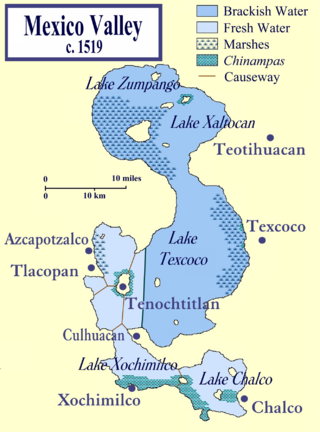
Tetzcoco was a major Acolhua altepetl (city-state) in the central Mexican plateau region of Mesoamerica during the Late Postclassic period of pre-Columbian Mesoamerican chronology. It was situated on the eastern bank of Lake Texcoco in the Valley of Mexico, to the northeast of the Aztec capital, Tenochtitlan. The site of pre-Columbian Tetzcoco is now subsumed by the modern Mexican municipio of Texcoco and its major settlement, the city formally known as Texcoco de Mora. It also lies within the greater metropolitan area of Mexico City.
<span class="mw-page-title-main">Nezahualcoyotl (tlatoani)</span> Tlatoani of Texcoco

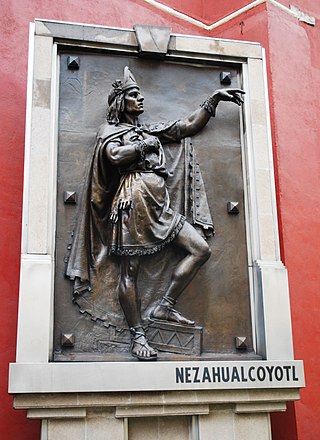
Nezahualcoyotl was a scholar, philosopher (tlamatini), warrior, architect, poet and ruler (tlatoani) of the city-state of Texcoco in pre-Columbian era Mexico. Unlike other high-profile Mexican figures from the century preceding Spanish conquest of the Aztec Empire, Nezahualcoyotl was not fully Mexica; his father's people were the Acolhua, another Nahuan people settled in the eastern part of the Valley of Mexico, on the coast of Lake Texcoco. His mother, however, was the sister of Chimalpopoca, the Mexica king of Tenochtitlan.

<span class="mw-page-title-main">Itzcoatl</span> Fourth Tlatoani of Tenochtitlan

Itzcoatl (1380–1440) was the fourth king of Tenochtitlan, and the founder of the Aztec Empire, ruling from 1427 to 1440. Under Itzcoatl the Mexica of Tenochtitlan threw off the domination of the Tepanecs and established the Triple Alliance together with the other city-states Tetzcoco and Tlacopan.

<span class="mw-page-title-main">Tlatoani</span> Ruler of a Mesoamerican āltepētl (city-state)

Tlahtoāni is a historical title used by the dynastic rulers of āltepēmeh, autonomous political entities formed by many pre-Colombian Nahuatl-speaking peoples in the Valley of Mexico during the Postclassic Period. The title of huēyi tlahtoāni was used by the rulers of the Aztec Empire, an alliance between the āltepēmeh of Tenochtitlan, Tetzcoco, and Tlacopan.

Fernando de Alva Cortés Ixtlilxóchitl was a nobleman of partial Aztec noble descent in the Spanish Viceroyalty of New Spain, modern Mexico; he is known primarily for his works chronicling indigenous Aztec history.

<span class="mw-page-title-main">Tlacopan</span> Former city-state in the Valley of Mexico

Tlacopan, also called Tacuba, was a Tepanec / Mexica altepetl on the western shore of Lake Texcoco. The site is today the neighborhood of Tacuba, in Mexico City.

<span class="mw-page-title-main">Aztec Empire</span> Imperial alliance of city states located in central Mexico during the 15th and 16th centuries

The Aztec Empire or the Triple Alliance was an alliance of three Nahua city-states: Mexico-Tenochtitlan, Tetzcoco, and Tlacopan. These three city-states ruled that area in and around the Valley of Mexico from 1428 until the combined forces of the Spanish conquistadores and their native allies who ruled under Hernán Cortés defeated them in 1521.
<span class="mw-page-title-main">History of the Aztecs</span>

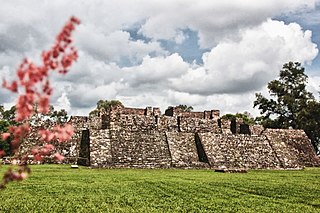
The Aztecs were a Pre-Columbian Mesoamerican people of central Mexico in the 14th, 15th, and 16th centuries. They called themselves Mēxihcah.

<span class="mw-page-title-main">Acolhua</span> Mesoamerican people

The Acolhua are a Mesoamerican people who arrived in the Valley of Mexico in or around the year 1200 CE. The Acolhua were a sister culture of the Aztecs as well as the Tepanec, Chalca, Xochimilca and others.

<span class="mw-page-title-main">Luis de Santa María Nanacacipactzin</span> Tlatoani and Governor of Tenochtitlan

Don Luis de Santa María Nanacacipactzin, also known as Cipac, was the last tlatoani ("king") of the Nahua altepetl of Tenochtitlan, as well as its governor (gobernador) under the colonial Spanish system of government. The previous ruler Cristóbal de Guzmán Cecetzin having died in 1562, Nanacacipactzin was installed on September 30, 1563, and ruled until his death on December 27, 1565.
<span class="mw-page-title-main">Antonio Pimentel Tlahuitoltzin</span> Mexican politician

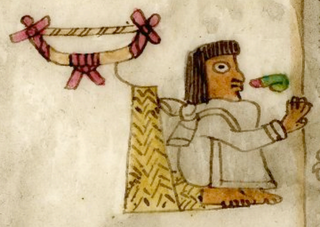
Antonio Pimentel Tlahuitoltzin was tlatoani (ruler) of Texcoco from 1540 to 1545.

Coanacochtzin was the last tlatoani (ruler) of Texcoco before the city came under Spanish control.

<span class="mw-page-title-main">Codex Azcatitlan</span> 16th or 17th century Aztec pictorial manuscript

The Codex Azcatitlan is an Aztec codex detailing the history of the Mexica and their migration journey from Aztlán to the Spanish conquest of the Aztec Empire. The exact date when the codex was produced is unknown, but scholars speculate it was crafted some time between the mid-16th and 17th centuries. The name of this important Mexica pictorial manuscript was suggested by its first editor, Robert H. Barlow, who erroneously interpreted the anthill on page 2 as the glyph for “Aztlán.” In the Bibliothèque nationale de France, where it is housed, it is known as Histoire mexicaine, [Manuscrit] Mexicain 59–64.

<span class="mw-page-title-main">Tlatelolco (altepetl)</span> Pre-Columbian city-state in Mexico

Tlatelolco was a pre-Columbian altepetl, or city-state, in the Valley of Mexico. Its inhabitants, known as the Tlatelolca, were part of the Mexica, a Nahuatl-speaking people who arrived in what is now central Mexico in the 13th century. The Mexica settled on an island in Lake Texcoco and founded the altepetl of Mexico-Tenochtitlan on the southern portion of the island. In 1337, a group of dissident Mexica broke away from the Tenochca leadership in Tenochtitlan and founded Mexico-Tlatelolco on the northern portion of the island. Tenochtitlan was closely tied with its sister city, which was largely dependent on the market of Tlatelolco, the most important site of commerce in the area.

Quecholcohuatl was a Chalcan musician. He was known for making peace between his native altepetl of Chalco and Tenochtitlan by serenading its Tlatoani, Axayacatl, in 1479.
<span class="mw-page-title-main">Codex Ixtlilxochitl</span> Pictorial Aztec record, early 1580s

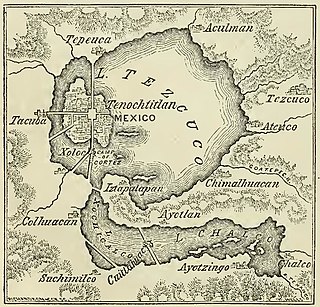
The Codex Ixtlilxochitl is a pictorial Aztec Codex created between 1580 and 1584, after the arrival of the Conquistadors and during the early Spanish colonial period. It is a record of the past ceremonies and holidays observed at the Great Teocalli of the Aztec city of Texcoco, near modern-day Mexico City, and contains visual representations of rulers and deities with association to Texcoco. The existence of this codex is a demonstration of the cultural assimilations and interactions between native Aztecs, Spanish colonists, and mestizos that occurred during the 17th century in Mexico as the colonies developed and their residents, of all cultures, endeavored to find a balance between native tradition and colonial innovation. Contrasting with the attitude of colonists from the prior century of striving for a complete annihilation of all native culture, this codex served as a quasi-translator between native and European cultural languages, and denotes an occurrence of European fascination with the unknown resulting in a valuable preservation of the native cultures they had previously sought to destroy.

References

  1. 1 2 3 4 Brokaw & Lee 2016, p. 293.
  2. 1 2 3 4 Lee 2014, p. 66.
  3. 1 2 Lee 2014, pp. 66, 68.
  4. 1 2 3 4 5 6 7 8 9 10 Benton 2017, p. 166.
  5. Lee 2014, p. 68.
  6. 1 2 Benton 2017, p. 29–30.
  7. 1 2 3 Benton 2017, p. 30.
  8. 1 2 Benton 2017, p. 31.
  9. Benton 2017, p. 32–34.
  10. Benton 2017, p. 47.
  11. 1 2 Benton 2017, p. 37.
  12. 1 2 Benton 2017, p. 32.
  13. Benton 2017, p. 27.
  14. Benton 2017, p. 50.
  15. 1 2 Benton 2017, p. 48–49.
  16. Benton 2017, p. 134.
  17. Benton 2017, p. 152.

Bibliography