Liszt Collection

Last updated

The Liszt Collection contains over one million generally nineteenth-century engravings and images. The Liszt Collection is an international project to preserve a portrayal of history through contemporary engravings, articles and books.

Contents

The Liszt Collection mainly covers Europe and the United States as well as other locations in the rest of the world, such as Canada, Australia, certain African countries, and South America and Asia.

The main areas of interest covered by the collection are history, society, art and culture. These areas are covered by showing geographical locations (towns, villages, counties and countries) as well as by showing various aspects of life in the nineteenth century. Ranging from topics such as politics, fashion in nineteenth-century France and social activities in the nineteenth-century German village to topics such as science, hiking in Switzerland, transport and coaches and trains crossing the country side.

In the mid-nineteenth-century wood engraving was used extensively for the speed and ease with which wood engravings could be produced. Engravings could be made within days of the event shown on the engraving. At this time very few (mainly American) painters could make a living selling their canvases and many turned to engraving to earn a living. Artists of the Liszt Collection’s engravings go from J. B. Allan,W. H. Bartlett and Thomas Bewick to R. Zogbaum.

The Liszt Press

The Liszt Collection houses an abundance of information in images and text about the nineteenth century. The information will be made available in books through the Liszt Press. The imprint will have a large list of books, focused and specialized. Examples from the publishing list are; The Germans in Africa in 1884; Henry Landsdell, A Journey through Central Asia, around 1880; British advertisements from 1884; Major Cavagnari and the rebellion in Cabul, Afghanistan 1879; The restoration of Ely Cathedral in 1856; The Valparaíso and Santiago Railway in 1856; General Sir Colin Campbell, 1856; East Lancashire Railway, 1848; The French Republic’s Presidential Election in 1848; The Crimea in 1855, Bagtcheserai, The valley of Baidar and Woronzow Road; Visit of English Ships in 1855 to Japan, Comprising The Sybille, Hornet and Bittern.

History

The Liszt collection’s roots lay in the Austro-Hungarian Empire, where Gizella Schwarz (1877–1962), started to collect some ‘Liszt’ prints. These were portraits of Franz Liszt and woodcuts of the places where he lived and worked. However, her interest quickly broadened and Gizella bought prints of a great variety of subjects. Amongst many others these include butterflies and flowers, engravings of Budapest and Hungary, but also London, Paris and New York.

On 15 October 1877, Károly Schwarz and Maria Habetler got a daughter, which they named Gizella. The baby was born in Körmend, Hungary, where Gizella spent her childhood. Károly Schwarz owned the well known Schwarz Coffee House and here it was that the young Gizella met many interesting people. Körmend being a frequented stop for travellers on their way from Hungary to Austria.

Gizella loved music and literature and spent her whole life reading. As family history has it, around 1880 in Budapest she even, as a little girl, met Franz Liszt, the famous nineteenth-century composer.

In 1939 she asked her birth certificate¹ from the Catholic Church in Körmend and by obtaining this certificate she saved herself from the concentration camps. The birth certificate is shown on the right and proves the validity of her origins being Roman Catholic. It is signed by the Vicar of Körmend which verifies the genuinity of the information. This is proven by his signature and stamp under the sentence: "That the certificate is in compliance with the original birth register of the Roman Catholic Church, and that I further strengthen this proof with my signature and official stamp." As it can be seen a red satisfactory tick has later been added, presumably by a German officer, to certify that her origins were indeed 'lawful'.

The birth certificate that saved Gizella Schwarz from the concentration camps Birth certificateweb.jpg
The birth certificate that saved Gizella Schwarz from the concentration camps

In 1957, Gizella was portrayed by Janos Szikra, at the age of 80, 4 years before her death.

Over the past hundred years the Liszt collection was gradually expanded and now houses over one million nineteenth-century engravings, prints and images and over two million articles.

Gizella used this suitcase to keep her first prints in Schwarz-suitcase.gif
Gizella used this suitcase to keep her first prints in

The Liszt Collection and image libraries

For The Liszt Collection, a diversity of image libraries like FotoLibra, Alamy, Album Archivo Fotográfico, [1] Cultural Heritage Online/museum-images.com, Heritage Image Partnership Picture Library, TopFoto [2] etc. offer a way of getting its collection online. The Liszt Collection is becoming a source of world heritage by the publication of the assets (image and text) as identifiable electronic publications, registered with a DOI (Digital Object Identifier) for permanent referencing and linking. One of the Liszt Collection's main aims is to be an eye-opener, showing a variety of cultures and regions, which will be now achieved through cooperating with the picture libraries.

Related Research Articles

<span class="mw-page-title-main">Franz Liszt</span> Hungarian composer and pianist (1811–1886)

Franz Liszt was a Hungarian composer, virtuoso pianist, conductor and teacher of the Romantic period. With a diverse body of work spanning more than six decades, he is considered to be one of the most prolific and influential composers of his era, and his piano works continue to be widely performed and recorded.
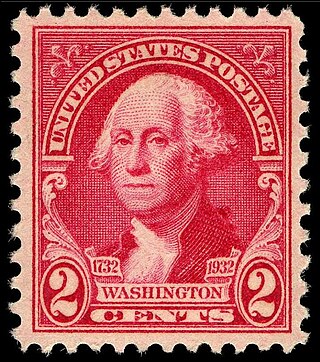
<span class="mw-page-title-main">Washington Bicentennial stamps of 1932</span> Postage stamps issued by the United States government in 1932

The Washington Bicentennial stamps of 1932 are postage stamps issued by the United States government in 1932 to commemorate the 200th anniversary of U.S. President George Washington's birth. Twelve stamps were issued as a collection, with each one depicting the President in a different period in his life.
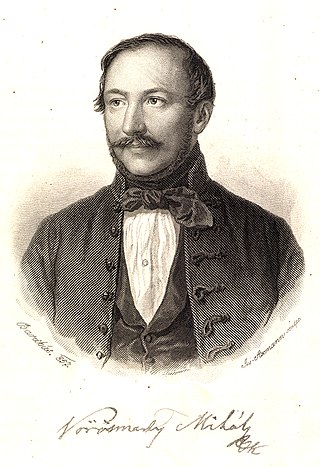
<span class="mw-page-title-main">Mihály Vörösmarty</span> Hungarian poet and dramatist

Mihály Vörösmarty was an important Hungarian poet and dramatist.

<span class="mw-page-title-main">St. Stephen's Basilica</span> Church in Budapest-Lipótváros, Hungary

St. Stephen's Basilica is a Roman Catholic basilica in Budapest, Hungary. It is named in honour of Stephen, the first King of Hungary, whose right hand is housed in the reliquary.

<span class="mw-page-title-main">National Széchényi Library</span> Library in Budapest, Hungary

The National Széchényi Library (OSZK) is a library in Budapest, Hungary, located in Buda Castle. It is one of two Hungarian national libraries, the other being University of Debrecen Library.

<span class="mw-page-title-main">Ferenc Joachim</span>

Ferenc Joachim was a Hungarian painter of portraits and landscapes in oil, watercolors and pastels on canvas, board and paper. He studied and painted in Budapest and Western Europe. As an untitled member of the minor nobility, Joachim was entitled to bear the honorary prefix Csejtei, so prior to the Communist abolition of honorifics in 1947 his name might be found in the form "Csejtei Joachim Ferenc" in Hungarian, or in German "Franz Joachim von Csejthey".

The "Rákóczi March", sometimes known as the "Hungarian March" was one of the unofficial state anthems of Hungary before Ferenc Kölcsey wrote the Himnusz. It was most likely composed by Nikolaus Scholl in 1820. The melody later used in many famous compositions, most notably: La damnation de Faust and Hungarian Rhapsody No. 15.
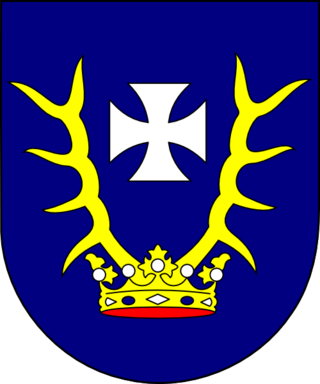
<span class="mw-page-title-main">Zichy family</span> Hungarian noble family

The House of Zichy is the name of a Magyar family of the Hungarian nobility, conspicuous in Hungarian history from the latter part of the 13th century onwards.
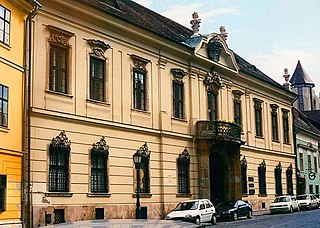
<span class="mw-page-title-main">Music of Budapest</span>

Budapest has long been an important part of the music of Hungary. Its music history has included the composers Franz Liszt, Ernő Dohnányi, Zoltán Kodály and Béla Bartók and the opera composer Ferenc Erkel.

<span class="mw-page-title-main">Matthias Church</span> Catholic church in Budapest, Hungary

The Church of the Assumption of the Buda Castle, more commonly known as the Matthias Church, more rarely the Coronation Church of Buda, is a Catholic church located in the Holy Trinity Square, Budapest, Hungary, in front of the Fisherman's Bastion at the heart of Buda's Castle District. According to church tradition, it was originally built in Romanesque style in 1015, although few references exist. The current building was constructed in the florid late Gothic style in the second half of the 14th century and was extensively restored in the late 19th century. It was the second largest church of medieval Buda and the seventh largest church of the medieval Hungarian Kingdom.

<span class="mw-page-title-main">Alajos Stróbl</span> Hungarian sculptor and artist

Alajos Stróbl ) was a Austro-Hungarian sculptor and artist of Slovak origin. His work is characterised by sensitive realistic modelling and he became one of the most renowned sculptors of memorials in Hungary at the turn of the 20th century.

<span class="mw-page-title-main">Károly Aggházy</span> Hungarian piano virtuoso and composer

Károly Aggházy was a Hungarian piano virtuoso and composer.

Őriszentpéter is a town in Vas County, Hungary.
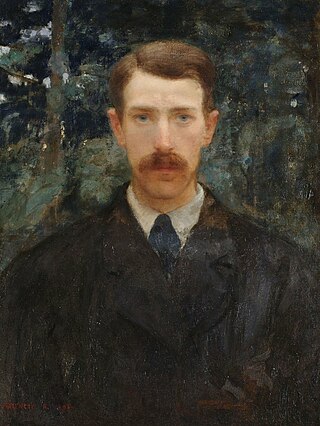
<span class="mw-page-title-main">Károly Ferenczy</span> Hungarian painter

Károly Ferenczy was a Hungarian painter and leading member of the Nagybánya artists' colony.

<span class="mw-page-title-main">Judith beheading Holofernes</span> Biblical episode and artistic theme

The account of the beheading of Holofernes by Judith is given in the deuterocanonical Book of Judith, and is the subject of many paintings and sculptures from the Renaissance and Baroque periods. In the story, Judith, a beautiful widow, is able to enter the tent of Holofernes because of his desire for her. Holofernes was an Assyrian general who was about to destroy Judith's home, the city of Bethulia. Overcome with drink, he passes out and is decapitated by Judith; his head is taken away in a basket.
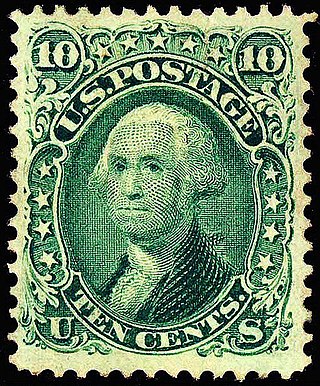
<span class="mw-page-title-main">Presidents of the United States on U.S. postage stamps</span> History of U.S. presidents on postage stamps

Presidents of the United States have frequently appeared on U.S. postage stamps since the mid-19th century. The United States Post Office Department released its first two postage stamps in 1847, featuring George Washington on one, and Benjamin Franklin on the other. The advent of presidents on postage stamps has been definitive to U.S. postage stamp design since the first issues were released and set the precedent that U.S. stamp designs would follow for many generations.

<span class="mw-page-title-main">Henri Gobbi</span> Hungarian composer

Henri Gobbi, was a 19th-century Hungarian classical composer and piano professor. He was also a student and close friend of Franz Liszt. Many of Henri Gobbi's most important works still remain unpublished to date.

<span class="mw-page-title-main">Nándor Fettich</span> Hungarian archaeologist and goldsmith (1900–1971)

Nándor Fettich was a Hungarian archaeologist, goldsmith, and member of the Hungarian Academy of Sciences.
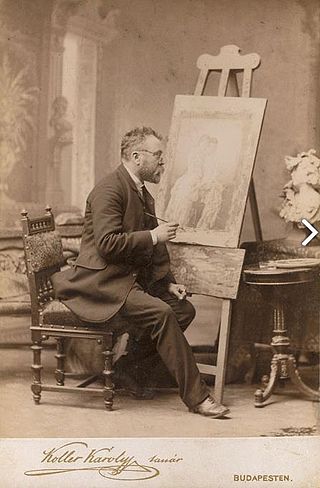
<span class="mw-page-title-main">Károly Koller</span>

Károly Koller, originally Karl was an Austro-Hungarian photographer and painter.

References

  1. "Home". album-online.com.
  2. "Home". topfoto.co.uk.

Notes

1. ^ Rom. Kat. Plébániahivatal Körmend, archive number: 1377/1939, November 11, 1939
2. ^ Zádor, A. & Genthon, I. (1984) Művészeti Lexikon. Akadémiai Kiadó ISBN   963-05-2360-4