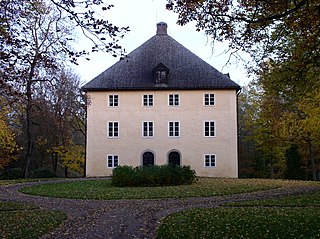
Lohja Museum (Finnish: Lohjan museo, Swedish: Lojo museum) is a local history museum in Lohja, Finland. The museum is housed in an old vicarage near the medieval St. Lawrence's Church. It was founded in 1911 and boasts a collection of around 25,000 items and tens of thousands of photos.[1][2]
Additionally, Lohja Museum operates a local history archive and library, and visitors can enter the museum with the Finnish Museum Card.[3]
History
In 1894, Robert Boldt founded Finland's first local heritage organisation in Lohja, called Lohjan Kotiseutututkimuksen Ystävät ry. Within the organisation, the idea of a museum began to take shape. Lohja Museum was officially founded in 1911, and in 1978, The City of Lohja, together with the rural Municipality of Lohja, assumed responsibility for the museum's management. They rented the old vicarage from Lohja Parish, which had been unused, to serve as the main building for the museum.[4]
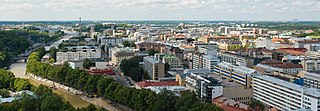
Turku is a city in Finland and the regional capital of Southwest Finland. It is located on the southwestern coast of the country at the mouth of the River Aura. The population of Turku is approximately 202,000, while the metropolitan area has a population of approximately 311,000. It is the 6th most populous municipality in Finland, and the third most populous urban area in the country after Helsinki and Tampere.
Lohja is a town in Finland, located in the southern interior of the country. Lohja is situated in the western part of the Uusimaa region. The population of Lohja is approximately 46,000. It is the 25th most populous municipality in Finland. Lohja is part of the Helsinki sub-region, but not directly part of the Helsinki metropolitan area.
Siuntio is a municipality in the Uusimaa region of Southern Finland. Its neighboring municipalities are Ingå to the west, Kirkkonummi, to the east, Lohja to the north-west, and Vihti to the north. It is 46 kilometres (29 mi) west of Helsinki.
Uusikaupunki is a town and municipality of Finland. It is located in the Southwest Finland region, 71 kilometres (44 mi) northwest of Turku and 97 kilometres (60 mi) south of Pori. The municipality has a population of 14,938 and covers an area of 551.65 square kilometres (212.99 sq mi) of which 49.04 km2 (18.93 sq mi) is inland water. The population density is 29.68 inhabitants per square kilometre (76.9/sq mi).
Littoinen (Finnish; Littois
Modern Finnish paganism, also known as Finnish neopaganism or the Finnish native faith, is the contemporary revival of Finnish paganism, the pre-Christian polytheistic ethnic religion of the Finns. A precursor movement was the Ukonusko of the early 20th century. The main problem in the revival of Finnish paganism is the nature of pre-Christian Finnish culture, which relied on oral tradition which may be subject to change over time. The primary sources concerning Finnish native culture are written by latter-era Christians.
Puutori is a market square in the city centre of Turku, Finland. It measures at approximately 100 by 40 metres. It is bordered by Aninkaistenkatu/Aningaisgatan, Maariankatu/Mariegatan, Brahenkatu/Brahegatan and Sibeliuksenkatu/Sibeliusgatan. Today, it has no regular market square activity but Puutorin puolesta ry organises different events there each year. Located at one end of the square are Ystävyydenpuisto and Wäinö Aaltonen's statue Kun ystävyyssuhteet solmitaan, which was designed in 1955 in honour of the friendship between Turku and Göteborg. There are also small cafés and shops surrounding Puutori, as well as a pet store.
The Old Great Square is a medieval market square located in the city centre of Turku, Finland. It is located in the II District in very close proximity to Turku Cathedral. The area was the administrative and commercial centre of Turku since the founding of the city in the 13th century up until the Great Fire of Turku.
Kankainen Manor is a late medieval manor in Masku, Finland, located along a small river about one kilometre south of Masku town centre. Kankainen Manor is considered to be the oldest surviving residential building in Finland, as its oldest parts may be from the end of the 15th century. In 2009, the Finnish Heritage Agency defined it as one of Finland's nationally significant built cultural environments.
Tilkka Hospital is a former military hospital in Helsinki, Finland. It is located at Mannerheimintie 164 in the Pikku Huopalahti district.
Meyer Turku Oy is a Finnish shipbuilding company located in Turku, Finland Proper. The company is fully owned by German shipbuilder Meyer Werft GmbH. The main products are cruise ships and cruiseferries.
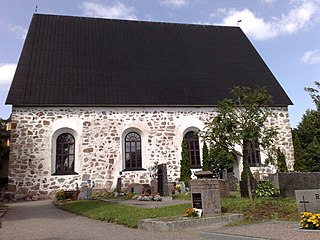
The Church of St. Lawrence is a church in Lohja, Finland. It is the third largest medieval parish church in Finland. The murals from early 16th century make it one of the most valuable medieval buildings in Finland. The rustic and naive murals depicted biblical stories for the illiterate population.
Pedro Aibéo is a Portuguese-born internationally awarded architect, civil engineer, a researcher in Architectural Democracy, local politician in Finland. He is the founder & CEO of the Gamified Cohousing Oy, founder and Artistic Director of the "Cidadania" theatre+games group, a professional Musician at Homebound, the founder and Chairman of the World Music School Helsinki, a drawing teacher at Croquis Nights and a bestseller Graphic Novelist.
Villa Karo is a Finnish-African culture center and artist residence in the coastal village of Grand-Popo, Benin. Its purpose is to build a bridge between Finnish and African artists and cultural figures. The primary task is to offer a possibility to reside in Africa for Finnish artists, researchers, teachers and other professionals in cultural and social fields. In addition, African professionals in culture are encouraged to visit Finland.
Nummi is a former municipality in the Uusimaa region of Finland. In 1981, Nummi merged with Pusula to form the municipality of Nummi-Pusula. In 2013, Nummi-Pusula in turn merged with the city of Lohja, and nowadays the Nummi village centre is the 103rd district of Lohja. Before the 1981 merger, the neighbouring municipalities of Nummi were Kiikala, Lohja, Pusula, Sammatti, Somero, Suomusjärvi and Vihti.
Orthex Oyj is a Finnish company that manufactures and markets plastic household products such as storage boxes, kitchenware and utensils. Orthex has manufactured some of the very common items in Finnish homes. In the example over 8 of 10 households owned the Orthex freezer box Jäänalle and the 10-liter bucket according to a survey conducted by Ilta-Sanomat in 2019. Orthex's classic sled was described as the most common kids sled over the years by Helsingin Sanomat in 2005.
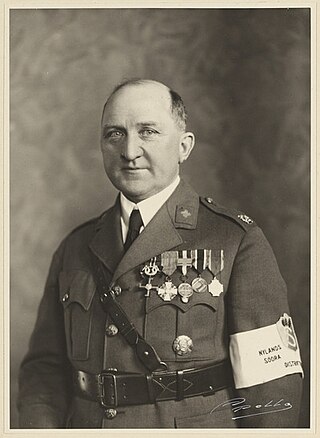
Petter Teodor Forsström was a Finnish industrialist, Vuorineuvos and the father of the Lohja lime industry. Forsström worked as Lohjan Kalkkitehdas Oy's managing director for an exceptionally long period of time, 65 years. In 1946 he was sentenced to six years prison for treason after participating in the pro-German resistance movement in the late stages of the Continuation War and during the Lapland War.
Paikkari Croft is a 19th-century croft in Sammatti, Finland. The croft is known as the childhood home of Elias Lönnrot, the creator of the Finnish national epic Kalevala.
Nummi Church is a Lutheran stone church in the former municipality of Nummi, situated in the Finnish city of Lohja in the Uusimaa region. Constructed of gray stone in 1822, the church was designed by Abraham Niklas Edelcrantz at the Royal Intendent's Office in Stockholm in 1807.
This page is based on this Wikipedia article Text is available under the CC BY-SA 4.0 license; additional terms may apply. Images, videos and audio are available under their respective licenses.