
Louis XIII was King of France from 1610 until his death in 1643 and King of Navarre from 1610 to 1620, when the crown of Navarre was merged with the French crown.

Armand Jean du Plessis, 1st Duke of Richelieu, known as Cardinal Richelieu, was a French Catholic prelate and statesman who had an outsize influence in civil and religious affairs. He became known as l'Éminence Rouge, a term derived from the title "Eminence" applied to cardinals and their customary red robes.

Jules Mazarin, from 1641 known as Cardinal Mazarin, was an Italian Catholic prelate, diplomat and politician who served as the chief minister to the Kings of France Louis XIII and Louis XIV from 1642 to his death.

Jean François Paul de Gondi, Cardinal de Retz was a French churchman, writer of memoirs, and agitator in the Fronde.

Catherine de Vivonne, marquise de Rambouillet, known as Madame de Rambouillet, was a society hostess and a major figure in the literary history of 17th-century France.

Étienne Charles de Loménie de Brienne was a French clergyman, bishop, cardinal, politician and finance minister of King Louis XVI.

Jean François Sarrazin, or Sarasin, was a French writer.
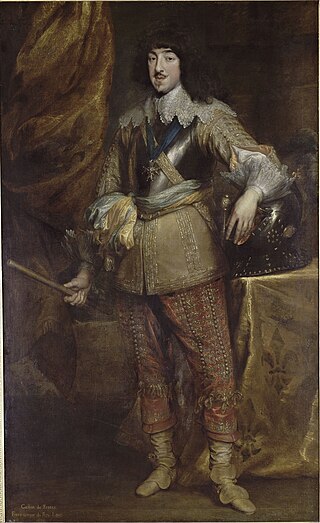
MonsieurGaston, Duke of Orléans, was the third son of King Henry IV of France and his second wife, Marie de' Medici. As a son of the king, he was born a Fils de France. He later acquired the title Duke of Orléans, by which he was generally known during his adulthood. As the eldest surviving brother of King Louis XIII, he was known at court by the traditional honorific Monsieur.

Henri Coiffier de Ruzé, Marquis of Cinq-Mars was a favourite of King Louis XIII of France, who led the last and most nearly successful of many conspiracies against the Cardinal Richelieu, the king's powerful first minister.
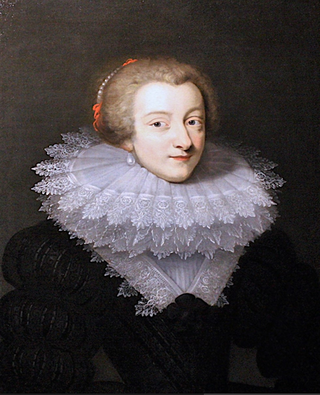
Marie Aimée de Rohan was a French courtier and political activist, famed for being the center of many of the intrigues of the first half of the 17th century in France. In various sources, she is often known simply as Madame de Chevreuse.

Louis de Bourbon, Comte de Soissons was the son of Charles de Bourbon, Count of Soissons and his wife, Anne de Montafié, Countess of Clermont-en-Beauvaisis. A second cousin of Louis XIII of France he was a prince du Sang, those considered part of the royal family. Part of the faction who opposed Cardinal Richelieu and his policy of war with Spain, he was killed leading a revolt at the Battle of La Marfée in 1641.
Claude de Bourdeille, comte de Montrésor (c. 1606–1663) was a French aristocrat and Count of Montrésor, who played a role in the intrigues of the first half of the 17th century, and was also a memoir-writer.

The County of Brienne was a medieval county in France centered on Brienne-le-Château.
The secretary of state of the Maison du Roi was the secretary of state in France during the Ancien Régime and Bourbon Restoration in charge of the Département de la Maison du Roi. The exact composition of the ministry and the secretary's duties changed several times over the Early Modern period, but in general, the Département de la Maison du Roi oversaw four main areas: the "Maison du Roi", the "Bâtiments du Roi", the General Affairs of the Clergy, Affairs of the RPR, and the administration of the capital city of Paris and the provinces. The post later reappeared as the minister for the Maison du Roi.

Cinq-Mars, subtitled Une conjuration sous Louis XIII, is an opera in four acts by Charles Gounod to a libretto by Paul Poirson and Louis Gallet loosely adapted from Alfred de Vigny's historical novel.
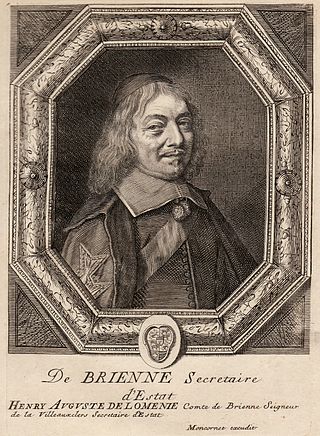
Henri-Auguste de Loménie, Count of Brienne, Seigneur de La Ville-aux-Clercs was a French politician. He was secretary of state for the navy from 1615 to February 1643, and then secretary of state for foreign affairs from 1643 to 1663 under Mazarin during the minority of Louis XIV. From the Loménie family, he was the son of Antoine de Loménie, secretary of state to Henry IV and a Huguenot convert.

Louis-Marie-Athanase de Loménie, Comte de Brienne was a French officer and politician, who was guillotined during the French Revolution.
Events from the year 1634 in France.

Marguerite Bahuche, also sometimes called Marguerite Bunel was a French woman painter, specialising in portraits, especially of women.

The Cabale des Importants is the name given to a plot organized in the last days of August 1643 by François de Vendôme, duke of Beaufort, and Marie de Rohan, duchess of Chevreuse, with the help of many "Great" of the time. The aim of this plot was to remove Cardinal Mazarin from power, as he was considered to be too hostile to the interests of that nobility, and to also sign a separate peace with Spain. This plot was a failure: the Duke of Beaufort was arrested and imprisoned, and other conspirators were exiled.
