Related Research Articles

Puppetry is a form of theatre or performance that involves the manipulation of puppets – inanimate objects, often resembling some type of human or animal figure, that are animated or manipulated by a human called a puppeteer. Such a performance is also known as a puppet production. The script for a puppet production is called a puppet play. Puppeteers use movements from hands and arms to control devices such as rods or strings to move the body, head, limbs, and in some cases the mouth and eyes of the puppet. The puppeteer sometimes speaks in the voice of the character of the puppet, while at other times they perform to a recorded soundtrack.
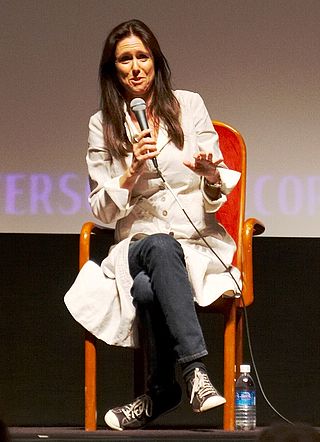
Julie Taymor is an American director and writer of theater, opera, and film. Her stage adaptation of The Lion King debuted in 1997 and received eleven Tony Award nominations, with Taymor receiving Tony Awards for her direction and costume design. Her film Frida, about Mexican artist Frida Kahlo, was nominated for five Academy Awards, including a Best Original Song nomination for Taymor's composition "Burn It Blue". She also directed the jukebox movie musical Across the Universe, based on the music of The Beatles.

A marionette is a puppet controlled from above using wires or strings depending on regional variations. A marionette's puppeteer is called a marionettist. Marionettes are operated with the puppeteer hidden or revealed to an audience by using a vertical or horizontal control bar in different forms of theatres or entertainment venues. They have also been used in films and on television. The attachment of the strings varies according to its character or purpose.
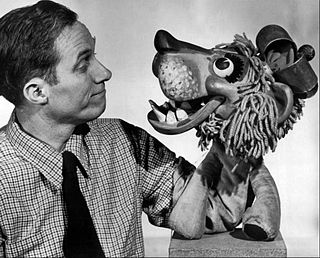
William Britton "Bil" Baird was an American puppeteer of the mid- and late 20th century. In a career that spanned over 60 years, he and his puppets performed for millions of adults and children. One of his better known creations was Charlemane the lion. He and his wife Cora Eisenberg Baird (1912–1967) produced and performed the famous puppetry sequence for "The Lonely Goatherd" in the film version of The Sound of Music. His son Peter Baird was also a puppeteer, and he continued his family's legacy until his own death in July 2004.

The Center for Puppetry Arts, located in Atlanta, is the United States' largest organization dedicated to the art form of puppetry. The center focuses on three areas: performance, education and museum. It is one of the few puppet museums in the world. The center is located in Midtown, the city's arts district. It was founded in 1978 by Vincent Anthony.
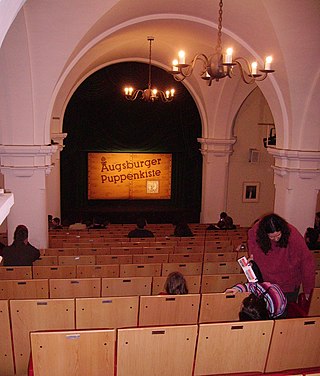
The Augsburger Puppenkiste is a marionette theater in Augsburg, Germany.

Dadi Pudumjee is a leading puppeteer in India and he is the founder of The Ishara Puppet Theatre Trust. He was awarded the Sangeet Natak Akademi Award in 1992.
Salzburg Marionette Theatre was established in 1913 and is one of the oldest continuing marionette theatres in the world. It is based in the city of Salzburg, Austria. Original productions featured live actors and musicians. Today soundtracks are recorded. The Salzburg Marionette Theatre performs a large repertoire of operas, ballets and productions for both children and adults, using marionettes.

Peter Scriven MBE (1930–1998) was the founding artistic director of the Marionette Theatre of Australia.

Karin Schäfer is a performance artist and the head of the Karin Schäfer Figuren Theater - Visual Theatre Productions company. After studying puppetry arts with Harry V. Tozer at Barcelona's Instituto del Teatro and working in Spain for several years, she returned to Austria in 1993.

A puppet is an object, often resembling a human, animal or mythical figure, that is animated or manipulated by a person called a puppeteer. The puppeteer uses movements of their hands, arms, or control devices such as rods or strings to move the body, head, limbs, and in some cases the mouth and eyes of the puppet. The puppeteer often speaks in the voice of the character of the puppet, and then synchronizes the movements of the puppet's mouth with this spoken part. The actions, gestures and spoken parts acted out by the puppeteer with the puppet are typically used in storytelling. Puppetry is a very ancient form of theatre which dates back to the 5th century BC in Ancient Greece. There are many different varieties of puppets, and they are made from a wide range of materials, depending on their form and intended use. They range from very simple in construction and operation to very complex.

The Puppet Theatre Barge is a unique, fifty-seat marionette theatre on a converted barge in London. The theatre presents puppet shows for children and adults and is moored in Little Venice throughout the year and in Richmond-upon-Thames during the summer.
Sue Hastings was an American puppeteer known for popularizing the ancient art of puppetry in the 1930s and 1940s. She was a protégé of famous advertising artist and master puppeteer Tony Sarg. She was known as a society hostess and for performing with her large collection of professionally made marionettes, which she created with the assistance of her large team of artisan puppeteers. Her many renowned performing companies were headquartered in New York City, New York, USA. During the height of her career, as owner and CEO of Sue Hastings Marionettes, Inc., she reputedly, in her inimitable "hands-on" style, was actively and very successfully directing over 50 performing companies, some of which performed worldwide for heads of Royalty, such as Queen Elizabeth I, and many other dignitaries and distinguished national and international diplomats and world leaders.
Ellsworth Avenue is located in the Shadyside neighborhood of Pittsburgh, Pennsylvania. It is mostly a commercial street that has locally owned businesses, galleries, restaurants, and bars. It runs southwest-northeast, parallel to Walnut Street, another commercial street, and is bounded by Shady Avenue to the east and South Neville Street to the west. Ellsworth Avenue is one of Shadyside's three business districts, along with South Highland Avenue and Walnut Street.
Anurupa Roy is a puppeteer, puppet designer and director of the puppet theater. Puppeteer Anurupa Roy's views puppetry as not "manipulating dolls with strings" but an amalgam of plastic and performing arts where sculptures, masks, figures, materials, found objects and narratives come together with music, movement, physicality and theater to create the theater where humans and puppets are co actors. She started at her group Katkatha in 1998 which was registered as the Katkatha Puppet Arts Trust 2006. She has directed over 15 shows for children and adults ranging from the Ramayana and Mahabharata to Shakespearean comedy to the Humayun-nama. The puppets used by the group range from 3 inches to forty feet. The shows have toured across Europe, Japan and South Asia. A major aspect of her work is using puppets for psycho social interventions in conflict areas like Kashmir, Sri Lanka and Manipur to Juvenile Remand homes. She has worked with youth and women across the country using puppets to raise awareness about HIV/AIDS and gender issues. She is a recipient of the Ustad Bismillah Khan Yuva Puraskar ine Puppetry(2006). She has been a visiting faculty at the University of California Los Angeles an Artists in Residence at Pro Helvetia Swiss Arts Council.
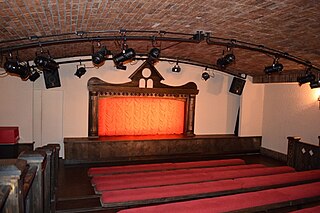
Le Theatre de Marionette is a marionette theater and production company that began in Arlington, Texas and, later, moved to Dallas, Texas. The theater, which caters to families and school groups, operates both in a physical location and as a touring group.

Russian puppet theater appears to have originated either in migrations from the Byzantine Empire in the sixth century or possibly by Mongols travelling from China. Itinerant Slavic minstrels were presenting puppet shows in western Russia by the thirteenth century, arriving in Moscow in the mid-sixteenth century. Although Russian traditions were increasingly influenced by puppeteers from western Europe in the eighteenth century, Petrushka continued to be one of the principal figures. In addition to glove puppets and marionettes, rod puppets and flat puppets were introduced for a time but disappeared in the late nineteenth century.
Margo Rose was an American puppeteer. She designed many puppets for films and the show Howdy Doody with her husband. The couple won a Peabody Award for ''The Blue Ferry" in 1958.
Paul Vincent Davis is an American puppeteer. For over 30 years, he served as Artist in Residence at Puppet Showplace Theater in Brookline, Massachusetts. In the 1980s, UNIMA-USA awarded Davis five Citations of Excellence for his work.
Kamela Portuges, also known as Kamela Portuges-Robbins, was an American puppeteer, puppet designer, sculptor, animator, illustrator, writer, and director. Her work can be seen in many films including Being John Malkovich, James and the Giant Peach, Monkeybone, and Bicentennial Man. She started her career in puppetry in 1989 and was the co-founder of production company Images In Motion.
References
- 1 2 3 "Guide to the Lovelace Marionette Theatre Company Records, 1952–1984 CTC.1986.01". digital.library.pitt.edu. Box 6 (of 21 boxes) – folders 2 through 22 (newspaper articles). Retrieved 2019-10-14.
- 1 2 3 Conner, Lynne (2007). Pittsburgh in Stages: Two Hundred Years of Theater. University of Pittsburgh Press. pp. 174–175. ISBN 978-0-8229-4330-3.
- 1 2 "Guide to the Lovelace Marionette Theatre Company Records, 1952–1984 CTC.1986.01". digital.library.pitt.edu. Box 4 – folders 1 through 32 (numerous Lovelace Theatre programs). Retrieved 2019-10-14.
- ↑ "File #: 2012-0640 Proclamation". City of Pittsburgh. 2012-06-24. Retrieved 2019-10-14.