Related Research Articles

Mecklenburg-Vorpommern, also known by its anglicized name Mecklenburg–Western Pomerania, is a state in the north-east of Germany. Of the country's sixteen states, Mecklenburg-Vorpommern ranks 14th in population; it covers an area of 23,300 km2 (9,000 sq mi), making it the sixth largest German state in area; and it is 16th in population density. Schwerin is the state capital and Rostock is the largest city. Other major cities include Neubrandenburg, Stralsund, Greifswald, Wismar, and Güstrow. It was named after the two regions of Mecklenburg and Fore Pomerania.

Johann Ludwig "Lutz" Graf Schwerin von Krosigk was a German senior government official who served as the minister of finance of Germany from 1932 to 1945 and de facto chancellor of Germany during May 1945.

Gojko Mitić is a Serbian-German actor and director. He gained great popularity in the German Democratic Republic (GDR) as the leading actor in historical and fictional Indian personalities in numerous DEFA Indian films. His popularity may be recognizable from the fact that both in the GDR and later in the Federal Republic of Germany attempts were made to attach labels to him: "DEFA bosses" on the one hand, "Winnetou of the East" on the other. However, Gojko Mitić never portrayed the latter role in a film. This Winnetou formulation refers more to the popularity of Gojko Mitić compared to the actor of the role from the West, the Frenchman Pierre Brice.
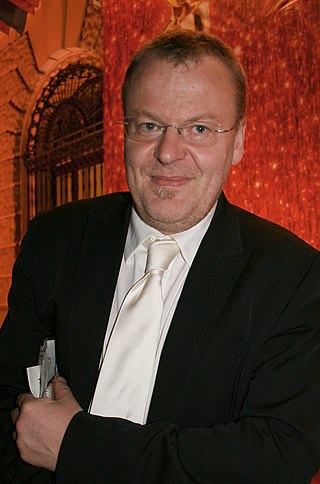
Stefan Ruzowitzky is an Austrian film director and screenwriter.

Volker David Kirchner was a German composer and violist. After studies of violin and composition at the Peter Cornelius Conservatory, the Hochschule für Musik Köln and the Hochschule für Musik Detmold, he worked for decades as a violist in the Radio-Sinfonie-Orchester Frankfurt. He was simultaneously the violist in the Kehr Trio founded by his violin teacher Günter Kehr, and a composer of incidental music at the Hessisches Staatstheater Wiesbaden.
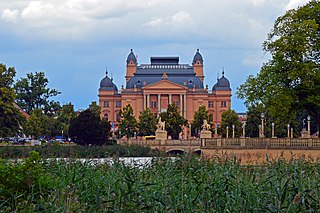
The Mecklenburg State Theatre is the principal theatre of Schwerin in Germany. Its main theatre seats 650 people and is used for the performance of plays, opera, musical theatre and ballet. Designed by Georg Daniel, the present building was built between 1883 and 1886 after the previous court theatre had been destroyed by fire in 1882. It was inaugurated on 3 October 1886 with a performance of Gluck's Iphigénie en Aulide with Marie Wittich in the title role. The complex also includes the State Museum in Schwerin and a 240-seat concert hall, now used for performances of chamber works.
Werner Spies is a German art historian, journalist and exhibition organizer. From 1997 to 2000, he was a director of the Centre Georges Pompidou in Paris. Klaus Albrecht Schröder, director of the Albertina in Vienna, has called Spies "one of the most influential art historians of the 20th century."

Anatol Herzfeld was a German sculptor and mixed-media artist, and also a policeman. A student of Joseph Beuys, he primarily used wood, iron and stone as materials. As an artist, he simply signed Anatol. He received attention for a happening, crossing the Rhine in a boat he created with Beuys, after Beuys had been expelled from the Kunstakademie Düsseldorf.

Hans-Heinrich Voigt was a German astronomer and director of the Göttingen Observatory.
Thomas W. Gaehtgens is a German art historian with special interest in French and German art and art history from the 18th to the 20th century. He was the founding director of the Deutsches Forum für Kunstgeschichte in Paris and was director of the Getty Research Institute in Los Angeles, California.
Jakob Geis, stage name Papa Geis was a German performer, folksinger, and musical director. He was considered a master of Bavarian cuplés. The dramatist and director Jacob Geis was his grandchild.
Kurt Dornis is a German painter, graphic artist and draughtsman associated with the Leipzig School. His family fled to Leipzig in 1944 and he became a professional painter in 1952. His paintings often depict life in Leipzig and the cityscape itself from unusual perspectives. His style has been called "neoverist".
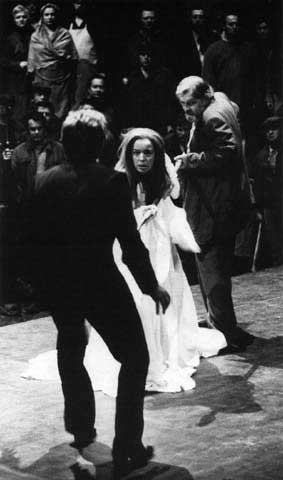
Manfred Jung was a German operatic tenor, who performed Wagner's heldentenor roles internationally, including the Metropolitan Opera and the Bayreuth Festival where he was Siegfried in the Jahrhundertring, but he also sang all other tenor roles in Der Ring des Nibelungen.

Michael Hofstetter is a German conductor and academic. He was chief conductor of the festival Ludwigsburger Schlossfestspiele from 2005 to 2012, and has been Generalmusikdirektor of Gießen since. He has worked internationally at notable opera houses and festivals. He is regarded as an expert of historically informed performance, who has rediscovered and recorded rarely performed operas.

Günther Schneider-Siemssen was a German-born Austrian scenic designer, working as the chief designer for all Austrian State Theatres and the Salzburg Festival, where he created 28 productions for Herbert von Karajan and 60 for Otto Schenk. He was a pioneer in using lighting and projections on stage. He designed sets for major international opera houses.
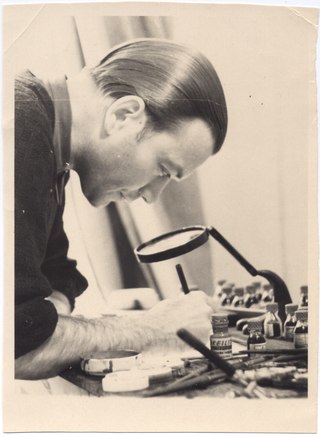
Hainer Hill was a German scenic designer, costume designer, painter, graphic artist and theatre photographer who was based in Berlin and worked internationally. After studying painting in Frankfurt, he worked at the Oper Frankfurt, assisting Caspar Neher. Together they moved to Brecht's Berliner Ensemble where Hill created an iconic stage for Mutter Courage and took hundreds of scene photographs now archived at the Akademie der Künste. When the Berlin Wall was erected, Hill, who lived in the West and had worked in the East, began to work freelance, including at the Royal Opera House. In 1966 he became director of scenery (Ausstattunggsleiter) at Opernhaus Dortmund, and there he created the stage for the world premiere of Eli by Walter Steffens, which was followed by 45 other productions. Hill is best remembered for his focus on light projection.
Horst Leuchtmann was a German musicologist.

The Salonorchester Cappuccino is an ensemble founded in Leipzig in 1989 and dedicated to the cultivation of salon music as a form of upmarket light music.
Hannes Kilian was a German photographer.
Rolf Fritz was a German art historian. His research focused on German art from the Middle Ages to the 19th century, especially on the art and cultural history of Westphalia, as well as on various genres of arts and crafts.
References
- 1 2 3 Szenische Räume - Arbeiten aus fünf Jahrzehnten [Scenic spaces - works from five decades] (in German), Germany: Hauspost, 2017, retrieved 13 March 2023
- 1 2 Szenische Räume – Arbeiten aus fünf Jahrzehnten [Scenic spaces – works from five decades] (in German), Mecklenburgisches Staatstheater, 2023, retrieved 13 March 2023
- 1 2 3 4 5 Seitz, Alex (2023), Bühnenbildner Lutz Kreisel: Ausstellung zum 80. Geburtstag [Stage designer Lutz Kreisel: exhibition for the 80th birthday] (in German), Germany: NDR, retrieved 13 March 2023
- ↑ Musik und Gesellschaft[Music and Society] (in German). Henschelverlag. 1979. p. 56.
- ↑ Schlossfestspiele Schwerin jetzt erstmals im Schlossgarten [Castle Festival Schwerin now for the first time in the castle garden] (in German), Life PR, 2011, retrieved 13 March 2023
- ↑ Bühnenbildner Lutz Kreisel: Ausstellung zum 80. Geburtstag ["Freischütz" opens the Castle Festival in Schwerin] (in German), Germany: Hamburger Abendblatt, 2011, retrieved 13 March 2023
- ↑ Wir für 850 Jahre Schwerin [We for 850 years of Schwerin](PDF) (in German), Germany: Amtliche Bekanntmachungen, 2009, retrieved 13 March 2023
- ↑ Kapuhs, Franziska (2010), Ausstellungseröffnung /Filmvorführung zum Festumzug von 1985 am 11. März 2010 [Exhibition opening/film screening of the 1985 parade on March 11, 2010] (in German), Germany: 850 Jahre Scwerin, retrieved 13 March 2023
- ↑ "Freischütz" successful in Schwerin März 2010 ["Freischütz" in Schwerin erfolgreich] (in German), Germany: Welt.de, 2011, retrieved 13 March 2023
- ↑ Lutz Kreisel Bühnenbild [Lutz Kreisel Bühnenbild] (in German), Operabase, retrieved 13 March 2023
- ↑ Volker, Ulrich (2004), "Dorian Gray" ["Dorian Gray"] (in German), Tanznetz., retrieved 13 March 2023
- ↑ PRÖBER, Anette (2008), Schlossfestspiele präsentieren Bühnenbild für „Carmen“ [present castle festivals Set design for "Carmen"](PDF) (in German), Ostsee-Zeitung Rostock, retrieved 13 March 2023
- ↑ Hanssen, Frederik (2004), Kultur: Schwedische Sardinen [Culture: Swedish sardines], Tages Spiegel, retrieved 13 March 2023
- ↑ Eine Stadt hält Hof [A city holds court] (in German), Germany: ARD.de, 2010, retrieved 13 March 2023
- ↑ FIVE DECADES WITH LUTZ KREISEL [A city holds court] (in German), Germany: Schwerin Live, 2010, retrieved 13 March 2023
- ↑ Bühnenbildner Lutz Kreisel: Ausstellung zum 80. Geburtstag [Stage designer Lutz Kreisel: Exhibition for his 80th birthday] (in German), KNews.Media Deutschland, 2023, retrieved 13 March 2023