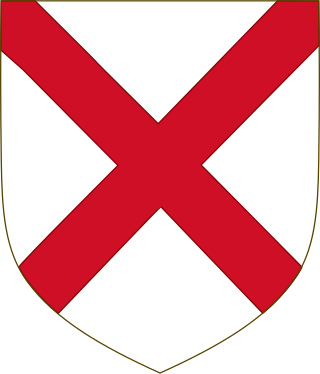
The FitzGerald dynasty is a Hiberno-Norman noble and aristocratic dynasty, originally of Cambro-Norman and Anglo-Norman origin. They have been peers of Ireland since at least the 13th century, and are described in the Annals of the Four Masters as having become "more Irish than the Irish themselves" or Gaels, due to assimilation with the native Gaelic aristocratic and popular culture. The dynasty has also been referred to as the Geraldines and Ireland's largest landowners. They achieved power through colonisation and the conquest of large swathes of Irish territory by the sons and grandsons of Gerald de Windsor. Gerald de Windsor was the first Castellan of Pembroke Castle in Wales, and became the male progenitor of the FitzMaurice and FitzGerald Dynasty. His father, Baron Walter FitzOther, was the first Constable and Governor of Windsor Castle for William the Conqueror, and was the Lord of 38 manors in England, making the FitzGeralds one of the "service families" on whom the King relied for his survival. Some of its members became the Black Knights, Green Knights and White Knights.
There have been two creations of the title Baron Offaly, both in the Peerage of Ireland.
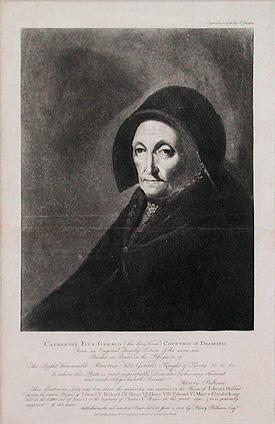
Katherine FitzGerald, Countess of Desmond was a noblewoman of the Anglo-Norman FitzGerald dynasty in Ireland. English writers of the Tudor period, including Sir Walter Raleigh, helped popularise "the old Countess of Desmond" as a nickname for her, due to her longevity. One estimate placed her age at death in excess of 120 years. Another ranged as high as 140. Most likely she lived to about 100. A recent biography of the countess suggested that Katherine was at least 90 when she died.

Gerald FitzGerald, 11th Earl of Kildare, also known as the "Wizard Earl", was an Irish peer. He was the son of Gerald FitzGerald, 9th Earl of Kildare and his second wife Elizabeth Grey of the Royal House of Grey.
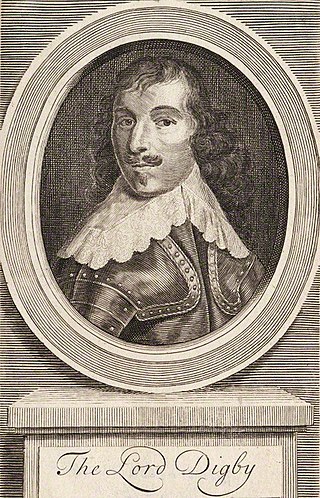
Robert Digby, 1st Baron Digby, was an Anglo-Irish peer.
Henry Windsor Villiers-Stuart, was a British soldier, clergyman, politician, Egyptologist, and author.
Mabel Browne, Countess of Kildare was an English courtier. She was wife of Gerald FitzGerald, 11th Earl of Kildare, Baron of Offaly. She was born into the English Roman Catholic Browne family whose members held prominent positions at the courts of the Tudor sovereigns for three generations. Mabel served as a gentlewoman of Queen Mary I's privy chamber, and enjoyed the Queen's favour.
Maud de Prendergast, Lady of Offaly, was a Norman-Irish noblewoman, the first wife of Maurice FitzGerald, 3rd Lord of Offaly, Justiciar of Ireland, and the mother of his two daughters, Juliana FitzGerald and Amabel. She married three times; Maurice FitzGerald, 3rd Lord of Offaly was her third husband.
General Sir William Stewart, was a Scottish-born soldier, Commander-in-chief of Queen Anne's Forces in Ireland, Member of Parliament for County Waterford and a Privy Councillor. He was a benefactor of Hanover Square, London, donating the land and laying the first stone of St George's, Hanover Square.
Gerald FitzGerald, 14th Earl of Kildare was an Irish peer. Much of his adult life was dominated by litigation with relatives over the Kildare inheritance.
Maurice FitzMaurice FitzGerald was an Irish magnate, soldier, and Justiciar of Ireland from 1272 to 1273. His family would come to epitomise the ideal of cultural synthesis in Ireland, becoming "more Irish than the Irish themselves", fusing Gaelic and Norman customs in Irish identity. "But others say he never enjoyed that lordship himself, but that it passed to the son and grandson of his eldest brother Gerald."
Katherine FitzGerald, suo jure Viscountess Grandison (1660–1725), was a wealthy Irish heiress, being the only child of Sir John FitzGerald of Dromana, County Waterford. She inherited the Dromana estate in 1664 upon the death of her father. She was married three times; firstly to John Le Poer, 2nd Earl of Tyrone; secondly to Brigadier-General, Hon. Edward FitzGerald-Villiers; and thirdly and lastly to General William Steuart.
Lettice FitzGerald, 1st Baroness Offaly was an Irish noblewoman and a member of the FitzGerald dynasty. Although she became heiress-general to the Earls of Kildare on the death of her father, the title instead went to the next FitzGerald male heir when her grandfather, the 11th Earl of Kildare, died in 1585. In 1620, she was created suo jure Baroness Offaly by King James I of England.
Cormac na hAoine MacCarthy Reagh, 13th Prince of Carbery (1490–1567) was an Irish chieftain who owned almost half a million acres in south west Ireland.
Richard Power, 1st Earl of Tyrone (1630–1690) was an Irish Jacobite nobleman.
Helen Burke, Countess Clanricarde, also styled Helen FitzGerald, was brought to France by her mother fleeing the Cromwellian conquest of Ireland, against which her father, the 2nd Earl Muskerry, resisted to the bitter end. In France, she was educated at the abbey of Port-Royal-des-Champs together with her cousin Elizabeth Hamilton. She married three times. All her children were by her second husband, William Burke, 7th Earl of Clanricarde. She was the mother of Ulick Burke, 1st Viscount Galway, Margaret, Viscountess Iveagh, and Honora Sarsfield.
Sir Robert Digby PC(I) was an English courtier who owned an estate at Coleshill, Warwickshire. His marriage to Lettice FitzGerald, heir-general to the 11th Earl of Kildare, led him to spend his life litigating over her claims to the Kildare lands. He divided his time between local business in Warwickshire and in Ireland.
Sir John FitzGerald of Dromana was the last of the FitzGeralds of Dromana. He sat as MP for Dungarvan in the Irish Parliament of 1661–1666.

John de Courcy, 21st Baron Kingsale sat in the House of Lords of the Irish Parliament of 1661–1666.
Richard Power, 1st Baron Power of Curraghmore
