Related Research Articles
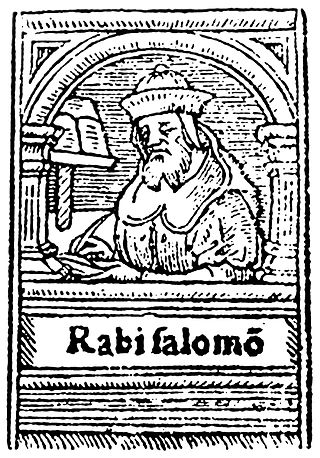
Shlomo Yitzchaki, today generally known by the acronym Rashi, was a medieval French rabbi and author of a comprehensive commentary on the Talmud and commentary on the Hebrew Bible. Acclaimed for his ability to present the basic meaning of the text in a concise and lucid fashion, Rashi appeals to both learned scholars and beginner students, and his works remain a centerpiece of contemporary Jewish study. His commentary on the Talmud, which covers nearly all of the Babylonian Talmud, has been included in every edition of the Talmud since its first printing by Daniel Bomberg in the 1520s. His commentary on Tanakh—especially on the Chumash —serves as the basis for more than 300 "supercommentaries" which analyze Rashi's choice of language and citations, penned by some of the greatest names in rabbinic literature.
Asher ben Jehiel was an eminent rabbi and Talmudist best known for his abstract of Talmudic law. He is often referred to as Rabbenu Asher, “our Rabbi Asher” or by the Hebrew acronym for this title, the Rosh. His yahrzeit is on 9 Cheshvan.
Eliezer ben Nathan of Mainz (1090–1170), or Ra'avan, was a halakist and liturgical poet. As an early Rishon, he was a contemporary of the Rashbam and Rabbeinu Tam, and one of the earliest of the Tosafists. He was the son-in-law of Rabbi Eliakim b. Joseph of Mainz, a fellow student of Rashi. Through his four daughters Eliezer became the ancestor of several learned families which exerted a great influence upon religious life in the subsequent centuries. One of his great-grandsons was Asher b. Jehiel (ROSH), father of R. Jacob, author of the Ṭurim.

Jacob ben Asher, also known as Ba'al ha-Turim as well as Rabbi Yaakov ben Raash, was an influential Medieval rabbinic authority. He is often referred to as the Ba'al ha-Turim, after his main work in halakha, the Arba'ah Turim.

The Tosafot,Tosafos or Tosfot are medieval commentaries on the Talmud. They take the form of critical and explanatory glosses, printed, in almost all Talmud editions, on the outer margin and opposite Rashi's notes.
Samuel ben Meir, after his death known as "Rashbam", a Hebrew acronym for RAbbi SHmuel Ben Meir, was a leading French Tosafist and grandson of Shlomo Yitzhaki, "Rashi".
Moshe haDarshan was chief of the yeshiva of Narbonne, and perhaps the founder of Jewish exegetical studies in France. Along with Rashi, his writings are often cited as the first extant writings in Zarphatic, the Judæo-French language.
Tobiah ben Eliezer was a Talmudist and poet of the 11th century, author of Lekach Tov or Pesikta Zutarta, a midrashic commentary on the Pentateuch and the Five Megillot.
Nathan ben Jehiel of Rome was a Jewish Italian lexicographer. He authored the Arukh, a notable dictionary of Talmudic and Midrashic words, and consequently he himself is often referred to as "the Arukh".
Samson ben Abraham of Sens ,was one of the leading French Tosafists in the second half of the 12th and the beginning of the 13th centuries. He was the most outstanding student and the spiritual heir of Rabbi Isaac ben Samuel ha-Zaken. He is referred also known as "the Rash" or "the Prince of Sens", and within Tosafot as "Rashba".
Isaac ben Samuel the Elder, also known as the Ri ha-Zaken, was a French tosafist and Biblical commentator. He flourished at Ramerupt and Dampierre, France in the twelfth century. He is the father of Elhanan ben Isaac of Dampierre.
Judah ben Isaac Messer Leon (1166–1224) was a French tosafist born in Paris.

Shir ha-Shirim Rabbah is an aggadic midrash on Song of Songs, quoted by Rashi under the title "Midrash Shir ha-Shirim". It is also called Aggadat Hazita, from its initial word "Hazita", or Midrash Hazita.
Leviticus Rabbah, Vayikrah Rabbah, or Wayiqra Rabbah is a homiletic midrash to the Biblical book of Leviticus. It is referred to by Nathan ben Jehiel in his Arukh as well as by Rashi (1040–1105). According to Leopold Zunz, Hai Gaon (939-1038) and Nissim knew and made use of it. Zunz dates it to the middle of the 7th century, but The Encyclopaedia Judaica and Jacob Neusner date it to the 5th century. It originated in the Land of Israel, and is composed largely of older works. Its redactor made use of Genesis Rabbah, Pesikta de-Rav Kahana, and the Jerusalem Talmud, in addition to other ancient sources. The redactor appears to have referred also to the Babylonian Talmud, using several expressions in the sense in which only that work employs them.
Baraita on the Erection of the Tabernacle is a baraita cited several times by Hai Gaon, by Nathan ben Jehiel in the Arukh, as well as in Rashi, Yalḳut, and Maimonides. Rashi calls it a "Mishnah".
Rashi's daughters were the three daughters and only children of the medieval Talmudic scholar, Rashi and his wife Rivka. Their three daughters were Yocheved, Miriam and Rachel. They each married their father's finest students and were the mothers of the leaders of the next generation of French Talmudic scholars. Almost every Ashkenazi rabbinic dynasty traces its ancestry back to either Yocheved or Miriam, and the majority of the tosafists, were recent descendants of Rashi's daughters. All born in Troyes, France, their descendants inhabited Germany, France, and Italy in the early 11th to 15th centuries, with the majority later moving to Eastern Europe, where they established several notable rabbinic dynasties.
Meir ben Samuel, also known by the Hebrew acronym RaM for Rabbi Meir, was a French rabbi and tosafist, who was born in about 1060 in Ramerupt, and died after 1135. His father was an eminent scholar. Meir received his education in the Talmudical schools of Lorraine, his principal teachers being Isaac ben Asher ha-Levi and Eleazar ben Isaac of Mainz, with whom he later carried on a correspondence.
Judah ben Nathan, also referred to by the Hebrew acronym RIBaN, was a gifted French rabbi and commentator on the Talmud in the eleventh to twelfth century, best known for being the son-in-law and pupil of the great commentator Rashi, and to a great extent his continuator.

Isaac ben Melchizedek, , was a rabbinic scholar from Siponto, Italy, and one of the first medieval scholars to have composed a commentary on the Mishnah, of which only his commentary on Seder Zera'im survives. Elements of the Mishnaic order of Taharot are also cited in his name by the Tosafists, but the complete work is no longer extant.
References
 This article incorporates text from a publication now in the public domain : Crawford Howell Toy and M. Seligsohn (1901–1906). "Machir ben Judah". In Singer, Isidore; et al. (eds.). The Jewish Encyclopedia . New York: Funk & Wagnalls.
