
A microscope is a laboratory instrument used to examine objects that are too small to be seen by the naked eye. Microscopy is the science of investigating small objects and structures using a microscope. Microscopic means being invisible to the eye unless aided by a microscope.

The optical microscope, also referred to as a light microscope, is a type of microscope that commonly uses visible light and a system of lenses to generate magnified images of small objects. Optical microscopes are the oldest design of microscope and were possibly invented in their present compound form in the 17th century. Basic optical microscopes can be very simple, although many complex designs aim to improve resolution and sample contrast.
The microscopic scale is the scale of objects and events smaller than those that can easily be seen by the naked eye, requiring a lens or microscope to see them clearly. In physics, the microscopic scale is sometimes regarded as the scale between the macroscopic scale and the quantum scale. Microscopic units and measurements are used to classify and describe very small objects. One common microscopic length scale unit is the micrometre, which is one millionth of a metre.

In optics, any optical instrument or system – a microscope, telescope, or camera – has a principal limit to its resolution due to the physics of diffraction. An optical instrument is said to be diffraction-limited if it has reached this limit of resolution performance. Other factors may affect an optical system's performance, such as lens imperfections or aberrations, but these are caused by errors in the manufacture or calculation of a lens, whereas the diffraction limit is the maximum resolution possible for a theoretically perfect, or ideal, optical system.
The macroscopic scale is the length scale on which objects or phenomena are large enough to be visible with the naked eye, without magnifying optical instruments. It is the opposite of microscopic.

Macroscope is a science fiction novel by British-American writer Piers Anthony. It was nominated for the Hugo Award for Best Novel in 1970.
Extinction, in biology and palaeontology, is the end of a species or other taxon.
Petrography is a branch of petrology that focuses on detailed descriptions of rocks. Someone who studies petrography is called a petrographer. The mineral content and the textural relationships within the rock are described in detail. The classification of rocks is based on the information acquired during the petrographic analysis. Petrographic descriptions start with the field notes at the outcrop and include macroscopic description of hand-sized specimens. The most important petrographer's tool is the petrographic microscope. The detailed analysis of minerals by optical mineralogy in thin section and the micro-texture and structure are critical to understanding the origin of the rock.

Macro photography is extreme close-up photography, usually of very small subjects and living organisms like insects, in which the size of the subject in the photograph is greater than life-size . By the original definition, a macro photograph is one in which the size of the subject on the negative or image sensor is life-size or greater. In some senses, however, it refers to a finished photograph of a subject that is greater than life-size.
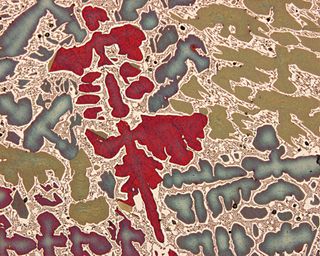
Characterization, when used in materials science, refers to the broad and general process by which a material's structure and properties are probed and measured. It is a fundamental process in the field of materials science, without which no scientific understanding of engineering materials could be ascertained. The scope of the term often differs; some definitions limit the term's use to techniques which study the microscopic structure and properties of materials, while others use the term to refer to any materials analysis process including macroscopic techniques such as mechanical testing, thermal analysis and density calculation. The scale of the structures observed in materials characterization ranges from angstroms, such as in the imaging of individual atoms and chemical bonds, up to centimeters, such as in the imaging of coarse grain structures in metals.

A cloak of invisibility is an item that prevents the wearer from being seen. In folklore, mythology and fairy tales, a cloak of invisibility appears either as a magical item used by duplicitous characters or an item worn by a hero to fulfill a quest. It is a common theme in Welsh and Germanic folklore, and may originate with the cap of invisibility seen in ancient Greek myths. The motif falls under "D1361.12 magic cloak of invisibility" in the Stith Thompson motif index scheme.
Macroscope is an integrated set of methods aimed at enterprise IT activities. Macroscope was developed and is maintained by Fujitsu in Canada. It is primarily used as their core body of knowledge to support the consulting services that they provide to their clients and is also licensed as a commercial product to a number of their clients

Leica Microsystems GmbH is a German microscope manufacturing company. It is a manufacturer of optical microscopes, equipment for the preparation of microscopic specimens and related products. There are ten plants in eight countries with distribution partners in over 100 countries. Leica Microsystems emerged in 1997 out of a 1990 merger between Wild-Leitz, headquartered in Heerbrugg Switzerland, and Cambridge Instruments of Cambridge England. The merger of those two umbrella companies created an alliance of the following 8 individual manufacturers of scientific instruments. American Optical Scientific Products, Carl Reichert Optische Werke AG, R.Jung, Bausch and Lomb Optical Scientific Products Division, Cambridge Instruments, E.Leitz Wetzlar, Kern & Co., and Wild Heerbrugg AG, bringing much-needed modernization and a broader degree of expertise to the newly created entity called Leica Holding B.V. group. In 1997 the name was changed to Leica Microsystems and is a wholly-owned entity of Danaher Corporation since July 2005. Danaher is a US venture capital company.

Macroscope is the fifth album by The Nels Cline Singers led by American guitarist Nels Cline which was released in April 29th 2014 on the Mack Avenue label.
Ernst Leitz GmbH was a German corporation based in Wetzlar, a German centre for optics as well as an important location for the precision engineering industry.
Correlative light-electron microscopy (CLEM) is the combination of an optical microscope – usually a fluorescence microscope – with an electron microscope. In an integrated CLEM system, the sample is imaged using an electron beam and an optical light path simultaneously. Traditionally, samples would be imaged using two separate microscopy modalities, potentially at different facilities and using different sample preparation methods. Integrated CLEM is thus considered to be beneficial because the methodology is quicker and easier, and it reduces the chance of changes in the sample during the process of data collection. Overlay of the two images is thus performed automatically as a result of the integration of two microscopes.
A microscope is an instrument used to see objects that are too small to be seen by the naked eye.
In science, the concept of a macroscope is the antithesis of the microscope, namely a method, technique or system appropriate to the study of very large objects or very complex processes, for example the Earth and its contents, or conceptually, the Universe. Obviously, a single system or instrument does not presently exist that could fulfil this function, however its concept may be approached by some current or future combination of existing observational systems. The term "macroscope" has also been applied to a method or compendium which can view some more specific aspect of global scientific phenomena in its entirety, such as all plant life, specific ecological processes, or all life on earth. The term has also been used in the humanities, as a generic label for tools which permit an overview of various other forms of "big data". As discussed here, the concept of a "macroscope" differs in essence from that of the macroscopic scale, which simply takes over from where the microscopic scale leaves off, covering all objects large enough to be visible to the unaided eye, as well as from macro photography, which is the imaging of specimens at magnifications greater than their original size, and for which a specialised microscope-related instrument known as a "Macroscope" has previously been marketed. For some workers, one or more "macroscopes" can already be constructed, to access the sum of relevant existing observations, while for others, deficiencies in current sampling regimes and/or data availability point to additional sampling effort and deployment of new methodologies being required before a true "macroscope" view of Earth can be obtained.
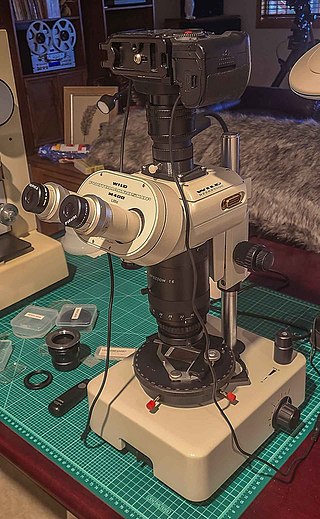
A macroscope or photomacroscope in its camera-equipped version is a type of optical microscope developed and named by Swiss microscope manufacturers Wild Heerbrugg and later, after that company's merger with Leica in 1987, by Leica Microsystems of Germany, optimised for high quality macro photography and/or viewing using a single objective lens and light path, rather than stereoscopic viewing of specimens, at magnifications up to around x40. The Wild, subsequently Leica "macroscope" line was in production from approximately 1976–2003; it was succeeded by the Leica Z6 and Z16 offerings, which continued an equivalent functionality, but without the "macroscope" designation. The macroscope remains a useful, if somewhat specialised, instrument for examination of relevant specimens in various laboratories today.

