
The Chittagong Hill Tracts, often shortened to simply the Hill Tracts and abbreviated to CHT, are group of districts within the Chittagong Division in southeastern Bangladesh, bordering India and Myanmar (Burma). Covering 13,295 square kilometres (5,133 sq mi), they formed a single district until 1984, when they were divided into three districts: Khagrachari District, Rangamati Hill District, and Bandarban District.
The Chakma people are a tribal group from the eastern-most regions of the Indian subcontinent. They are the largest ethnic group in the Chittagong Hill Tracts region of southeastern Bangladesh, and the second-largest in Mizoram, India. Other places in Northeast India also have significant Chakma populations. Around 60,000 Chakma people live in Arunachal Pradesh, India; a first generation migrated there in 1964 after the construction of the Kaptai Dam forced them off their lands. Another 79,000 Chakmas live in Tripura, India, and 20,000-30,000 in Assam, India.

The Marma, formerly known as Moghs or Maghs, are the second-largest ethnic community in Bangladesh's Chittagong Hill Tracts, primarily residing in the Bandarban, Khagrachari and Rangamati Hill Districts. Some Marmas live in Bangladesh's coastal districts of Cox's Bazar and Patuakhali, while others live in Tripura, India and Myanmar. There are over 210,000 Marmas living in Bangladesh. Since the 16th century, the Marma have considered the Bengal's Chittagong Hill Tracts their home, where they have established the Bohmong and Mong Circles (chiefdoms).

Bandarban is a district in South-Eastern Bangladesh, and a part of the Chittagong Division. It is one of the three hill districts of Bangladesh and a part of the Chittagong Hill Tracts, the others being Rangamati District and Khagrachhari District. Bandarban district (4,479 km2) is not only the most remote district of the country, but also the least populous. There is an army contingent at Bandarban Cantonment.

Khagrachari is a district in the Chittagong Division of Southeastern Bangladesh. It is a part of the Chittagong Hill Tracts region.

The Rakhine people, also known as the Arakanese people, are a Southeast Asian ethnic group in Myanmar (Burma) forming the majority along the coastal region of present-day Rakhine State, although Rakhine communities also exist throughout the country, particularly in Ayeyarwady and Yangon Regions. They constitute approximately 5.53% or more of Myanmar's total population, but no accurate census figures exist. Smaller Rakhine communities exist in southeastern parts of Bangladesh, especially in Chittagong Division and Barisal Division, as well as in India. A group of Rakhine descendants, living in the Chittagong Hill Tracts of Bangladesh at least since the 16th century, are known as the Marma people or Mog people.
The Baharistan-i-Ghaibi, written by Mirza Nathan, is a 17th-century chronicle on the history of Bengal, Cooch Behar, Assam and Bihar under the reign of Mughal emperor Jahangir (1605-1627). Unlike other history books of the Mughal Empire, written by court historians by order of the emperor and covering the history of the whole empire, the Baharistan-i-Ghaibi deals only with the affairs of Bengal and the adjoining area.
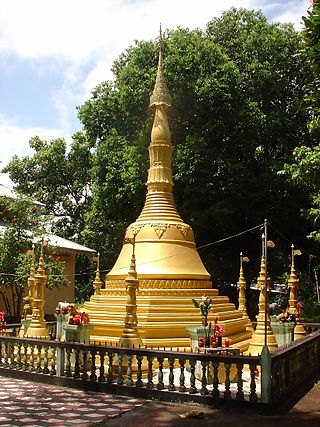
The Barua, are an ethnic group native to Chittagong Division in Bangladesh, Rakhine State in Myanmar, where they are known as the Maramagyi or Maramagri, and parts of Assam, West Bengal and Tripura in northeast India. According to Arakanese chronology, the Barua Buddhists have lived there for five thousand years. Another derivation of 'Barua' is 'Baru' and 'Arya' meaning great arya. They are commonly identified by their last name, "Barua". Barua is derived from "Baru" meaning "great" and "ua", meaning "noble rulers". In Myanmar, the Barua is classified as one of the seven groups that make up the Rakhine nation. Originally, the Barua title is of Assamese origin.
The Tribal people of Bangladesh refer to ethnic minorities in Chittagong Hill Tracts (southeastern), Sylhet Division (northeastern), Rajshahi Division (west), and Mymensingh Division (north-central) areas of the country. They are indigenous and the tribal races, total population of ethnic minorities in Bangladesh was estimated to be over 2 million in 2010. They are diverse ethnic communities including Tibeto-Burman, Austric and Dravidian people. Indigenous people of Bangladesh are the mainstream people originating from Dravidian, Indo-Aryan, Middle Eastern and Asiatic ancestry.

The national language and official language of Bangladesh is Bangla according to the third article of the Constitution of Bangladesh. The second most spoken language in Bangladesh is claimed to be Burmese which is spoken by the Marma tribe in Chittagong Hill districts as the districts border Myanmar; it is also spoken by the Rohingya people. Almost 99% of Bangladeshis speak Bengali as their first language. Bengali Language Implementation Act, 1987 made it mandatory to use Bengali in all government affairs except in the cases of foreign relations. According to a 2022 census, Bengali is predominantly spoken by 99% of the country's population and it also serves as the national language of the nation. The indigenous people of northern and southeastern Bangladesh speak a variety of native languages. Bangladesh has 44 indigenous languages according to Professor Shameem Reza.
The Mog are the Northwest Burmese people who live in the Indian state of Tripura.

The Bengal Subah, also referred to as Mughal Bengal, was the largest subdivision of the Mughal Empire encompassing much of the Bengal region, which includes modern Bangladesh and the Indian state of West Bengal, Indian state of Bihar, Jharkhand, Odisha between the 16th and 18th centuries. The state was established following the dissolution of the Bengal Sultanate, a major trading nation in the world, when the region was absorbed into one of the gunpowder empires. Bengal was the wealthiest region in the Indian subcontinent, due to their thriving merchants, Seth's, Bankers and traders and its proto-industrial economy showed signs of driving an Industrial revolution.

The region of Chittagong is traditionally centred around its seaport which has existed since ancient times. The region was home to the ancient independent Buddhist kingdoms of Samatata and Harikela. It later fell under of the rule of the Gupta Empire, the Pala Empire and the Arakanese kingdom of Waithali until the 7th century. Arab Muslims traded with the port from as early as the 9th century. Historian Lama Taranath is of the view that the Buddhist king Gopichandra had his capital at Chittagong in the 10th century. According to Tibetan tradition, this century marked the birth of Tantric Buddhism in the region. The region has been explored by numerous historic travellers, most notably Ibn Battuta of Morocco who visited in the 14th century. During this time, the region was conquered and incorporated into the independent Sonargaon Sultanate by Fakhruddin Mubarak Shah in 1340 AD. Sultan Ghiyasuddin Azam Shah constructed a highway from Chittagong to Chandpur and ordered the construction of many lavish mosques and tombs. After the defeat of the Sultan of Bengal Ghiyasuddin Mahmud Shah in the hands of Sher Shah Suri in 1538, the Arakanese Kingdom of Mrauk U managed to regain Chittagong. From this time onward, until its conquest by the Mughal Empire, the region was under the control of the Portuguese and the Magh pirates for 128 years.
Chittagong, the second largest city and main port of Bangladesh, was home to a thriving trading post of the Portuguese Empire in the East in the 16th and 17th centuries. The Portuguese first arrived in Chittagong around 1528 and left in 1666 after the Mughal conquest. It was the first European colonial enclave in the historic region of Bengal.

Arakan is a historic coastal region in Southeast Asia. Its borders faced the Bay of Bengal to its west, the Indian subcontinent to its north and Burma proper to its east. The Arakan Mountains isolated the region and made it accessible only by the Indian subcontinent and the sea. The region now forms the Rakhine State in Myanmar.

The Mong Circle is one of three hereditary chiefdoms in the Chittagong Hill Tracts of modern-day Bangladesh. The jurisdiction of the Mong Circle encompasses parts of Khagrachhari District. The chiefdom's members are of Marma descent and are known as phalansa. Most inhabitants of the Mong Circle settled in the northwest during a migration wave from the Kingdom of Mrauk U between the 16th and 18th centuries, while inhabitants of the other Marma chiefdom, the Bohmong Circle settled in the south and are known as ragraisa.

Rajdhar Manikya I, also spelt Rajadhara Manikya, was the Maharaja of Tripura from 1586 to 1600. Formerly a warrior-prince who fought with distinction during his father's reign, upon his own ascension to the throne, Rajdhar showed little interest in such matters, instead becoming occupied with religious pursuits. The decline of Tripura is thought to have begun during his reign.
Amar Manikya was the Maharaja of Tripura from 1577 to 1586.
The Greater Noakhali region predominantly includes the districts of Noakhali, Feni and Lakshmipur in Bangladesh, though it has historically also included Bhola, Mirsarai, Sandwip and some southern parts of Tripura in India and southern Comilla. The history of the Noakhali region begins with the existence of civilisation in the villages of Shilua and Bhulua. Bhulua became a focal point during the Buddhist and Hindu kingdoms of Pundra, Harikela and Samatata leading it to become the initial name of the region as a whole. The medieval Kingdom of Bhulua enjoyed autonomy under the Twipra Kingdom and Bengal Sultanate before being conquered by the Mughal Empire. At the beginning of the 17th century, Portuguese pirates led by Sebastian Gonzales took control of the ara but were later defeated by Governor Shaista Khan. Affected by floodwaters, the capital of the region was swiftly moved to a new place known as Noakhali, from which the region presently takes its name. By 1756, the British East India Company had dominated and started to establish several factories in the region. The headquarters was once again moved in 1951, to Maijdee, as a result of Noakhali town vanishing due to fluvial erosion.

The Conquest of Bhulua refers to the 17th-century Mughal conquest of the Bhulua Kingdom, which covered much of the Noakhali region of Bangladesh. The campaign was led by Shaykh Abdul Wahid, under the orders of Islam Khan I, against Raja Ananta Manikya in 1613. The conquest of Bhulua allowed the Mughals to successfully penetrate through southeastern Bengal and conquer Chittagong and parts of Arakan.
