
Mahavira, also known as Vardhamana, was the 24th tirthankara of Jainism. He was the spiritual successor of the 23rd tirthankara Parshvanatha. Mahavira was born in the early part of the 6th century BCE into a royal Kshatriya Jain family in ancient India. His mother's name was Trishala and his father's name was Siddhartha. They were lay devotees of Parshvanatha. Mahavira abandoned all worldly possessions at the age of about 30 and left home in pursuit of spiritual awakening, becoming an ascetic. Mahavira practiced intense meditation and severe austerities for twelve and a half years, after which he attained Kevala Jnana (omniscience). He preached for 30 years and attained Moksha (liberation) in the 6th century BCE, although the year varies by sect.

The Śvētāmbara is one of the two main branches of Jainism, the other being the Digambara. Śvētāmbara means "white-clad", and refers to its ascetics' practice of wearing white clothes, which sets it apart from the Digambara "sky-clad" Jains, whose ascetic practitioners go nude. Śvētāmbaras do not believe that ascetics must practice nudity.
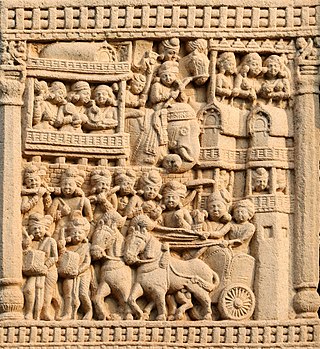
Ajatasattu or Ajatashatru in Buddhist tradition, or Kunika and Kuniya in the Jain histories, was one of the most important kings of the Haryanka dynasty of Magadha in East India. He was the son of King Bimbisara and was a contemporary of both Mahavira and Gautama Buddha. He forcefully took over the kingdom of Magadha from his father and imprisoned him. He fought a war against the Vajjika League, led by the Licchavis, and conquered the republic of Vaishali. The city of Pataliputra was formed by fortification of a village by Ajatashatru.
Mahāvīra was a 9th-century Jain mathematician possibly born in Mysore, in India. He authored Gaṇita-sāra-saṅgraha or the Compendium on the gist of Mathematics in 850 AD. He was patronised by the Rashtrakuta king Amoghavarsha. He separated astrology from mathematics. It is the earliest Indian text entirely devoted to mathematics. He expounded on the same subjects on which Aryabhata and Brahmagupta contended, but he expressed them more clearly. His work is a highly syncopated approach to algebra and the emphasis in much of his text is on developing the techniques necessary to solve algebraic problems. He is highly respected among Indian mathematicians, because of his establishment of terminology for concepts such as equilateral, and isosceles triangle; rhombus; circle and semicircle. Mahāvīra's eminence spread throughout South India and his books proved inspirational to other mathematicians in Southern India. It was translated into the Telugu language by Pavuluri Mallana as Saara Sangraha Ganitamu.

The Kalpa Sūtra is a Jain text containing the biographies of the Jain Tirthankaras, notably Parshvanatha and Mahavira. Traditionally ascribed to Bhadrabahu, which would place it in the 4th century BCE, it was probably put in writing 980 or 993 years after the Nirvana (Moksha) of Mahavira.

Parshvanatha, also Pārśvanātha, Parshva, Pārśva and Parasnath, was the 23rd of 24 Tirthankaras of Jainism. He is the only Tirthankara who gained the title of Kalīkālkalpataru.
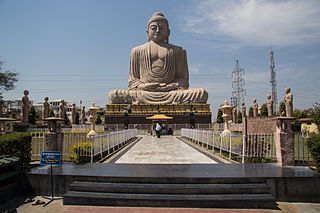
Buddhism and Jainism are two Indian religions that developed in Magadha (Bihar) and continue to thrive in the modern age. Gautama Buddha and Mahavira are generally accepted as contemporaries. Jainism and Buddhism share many features, terminology and ethical principles, but emphasize them differently. Both are śramaṇa ascetic traditions that believe it is possible to attain liberation from the cycle of rebirths and deaths (samsara) through spiritual and ethical disciplines. They differ in some core doctrines such as those on asceticism, Middle Way versus Anekantavada, and self versus not-self.

A Mahavira Hall, usually simply known as a Main Hall, is the main hall or building in a traditional Chinese Buddhist temple, enshrining representations of Gautama Buddha and various other buddhas and bodhisattvas. It is encountered throughout East Asia.
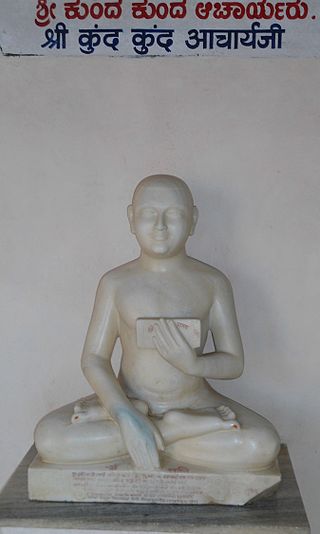
Jain monasticism refers to the order of monks and nuns in the Jain community and can be divided into two major denominations: the Digambara and the Śvētāmbara. The monastic practices of the two major sects vary greatly, but the major principles of both are identical. Five mahāvratas, from Mahavira's teachings, are followed by all Jain ascetics. Historians believe that a united Jain sangha (community) existed before 367 BCE, about 160 years after the moksha (liberation) of Mahavira. The community then gradually divided into the major denominations.

Makkhali Gosala or Manthaliputra Goshalak was an ascetic ajivika teacher of ancient India. He was a contemporary of Gautama Buddha, the founder of Buddhism, and of Mahavira, the last and 24th Tirthankara of Jainism.

Sudharmaswami was the fifth ganadhara of Mahavira. All the current Jain acharyas and monks follow his rule.
Jainism is a religion founded in ancient India. Jains trace their history through twenty-four tirthankara and revere Shree Rishabhnatha Bhagwan as the first tirthankara. The last two tirthankara, the 23rd tirthankara Parshvanatha and the 24th tirthankara Mahavira are considered historical figures. According to Jain texts, the 22nd Tirthankara Neminatha lived about 5,000 years ago and was the cousin of Sri Krishna Bhagwaan.
Gautam Swami was the Ganadhara of Mahavira, the 24th and last Jain Tirthankara of present half cycle of time. He is also referred to as Indrabhuti Gautam, Guru Gautam, Gautam Swami Ganadhara and Gautam Swami.
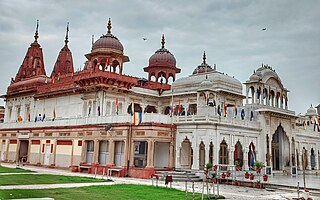
Shri Mahavir Ji is an important and prominent Jain pilgrimage site situated in Shri Mahaveerji town in Hindaun Block, Karauli district in Rajasthan. Given the importance of the religious place, the Indian Railways has specifically developed a railway station under West Central Railway zone by the name of Shri Mahaveerji railway station which is 10 minutes drive from the temple and temple authorities have arranged for regular buses from the station to the temple. The temple is visited by millions of Jain and Hindu devotees every year.
Vajjabhumi was a part of Rarh in ancient times. It is located in what is now Birbhum district in the Indian state of West Bengal. The more rugged western part of the district was known as Vajjabhumi, the country of the thunderbolt.

Kundalpur is a village in Nalanda district in the Indian state of Bihar. It is located about 2.5 kilometres from ancient Nalanda Mahavihara, 11 kilometres southwest of Bihar Sharif, and 80 kilometres southeast of Patna.

Ahinsa Sthal is a Jain temple located in Mehrauli, Delhi. The main deity of the temple is Mahavira, the 24th and last Tirthankara of Avasarpiṇī. A magnificent statue of Tirthankara Mahāvīra is installed here.
Jain festivals occur on designated days of the year. Jain festivals are either related to life events of Tirthankara or they are performed with intention of purification of soul.

Huayan Temple or Huayan Monastery is a Buddhist temple located in Datong, Shanxi, China.
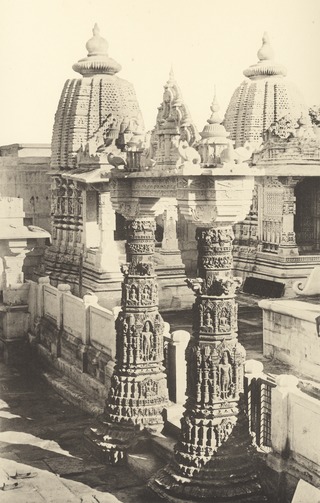
The Mahavira Jain temple is built in Osian of Jodhpur District, Rajasthan. The temple is an important pilgrimage of the Oswal Jain community. This temple is the oldest surviving Jain temple in Western India and was built during the reign of Mahārāja Śrī Vatsarāja of Imperial Pratihāras. The temple is visited by both Jain and Hindu.

