
Blade Runner is a 1982 science fiction film directed by Ridley Scott, and written by Hampton Fancher and David Peoples. Starring Harrison Ford, Rutger Hauer, Sean Young, and Edward James Olmos, it is loosely based on Philip K. Dick's 1968 novel Do Androids Dream of Electric Sheep?. The film is set in a dystopian future Los Angeles of 2019, in which synthetic humans known as replicants are bio-engineered by the powerful Tyrell Corporation to work at space colonies. When a fugitive group of advanced replicants led by Roy Batty (Hauer) escapes back to Earth, burnt-out cop Rick Deckard (Ford) reluctantly agrees to hunt them down.
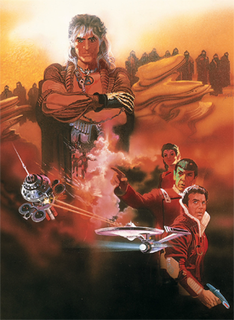
Star Trek II: The Wrath of Khan is a 1982 American science fiction film directed by Nicholas Meyer and based on the television series Star Trek. It is the second film in the Star Trek film series, and is a sequel to Star Trek: The Motion Picture (1979). The plot features Admiral James T. Kirk and the crew of the starship USS Enterprise facing off against the genetically engineered tyrant Khan Noonien Singh, a character who first appeared in the 1967 Star Trek episode "Space Seed". When Khan escapes from a 15-year exile to exact revenge on Kirk, the crew of the Enterprise must stop him from acquiring a powerful terraforming device named Genesis. The film is the beginning of a three-film story arc that continues with the film Star Trek III: The Search for Spock (1984) and concludes with the film Star Trek IV: The Voyage Home (1986).

The Thing is a 1982 American science fiction horror film directed by John Carpenter and written by Bill Lancaster. Based on the 1938 John W. Campbell Jr. novella Who Goes There?, it tells the story of a group of American researchers in Antarctica who encounter the eponymous "Thing", a parasitic extraterrestrial life-form that assimilates, then imitates other organisms. The group is overcome by paranoia and conflict as they learn that they can no longer trust each other and that any one of them could be the Thing. The film stars Kurt Russell as the team's helicopter pilot, R.J. MacReady, and features A. Wilford Brimley, T. K. Carter, David Clennon, Keith David, Richard Dysart, Charles Hallahan, Peter Maloney, Richard Masur, Donald Moffat, Joel Polis, and Thomas G. Waites in supporting roles.

Edward Regan Murphy is an American actor, comedian, writer, producer, and singer. He rose to fame on the sketch comedy show Saturday Night Live, for which he was a regular cast member from 1980 to 1984. Murphy has also worked as a stand-up comedian and was ranked No. 10 on Comedy Central's list of the 100 Greatest Stand-ups of All Time.
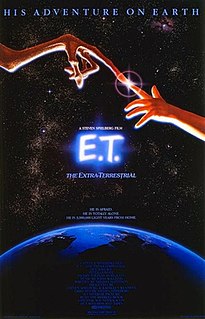
E.T. the Extra-Terrestrial is a 1982 American science fiction film produced and directed by Steven Spielberg, and written by Melissa Mathison. It tells the story of Elliott, a boy who befriends an extraterrestrial, dubbed E.T., who is stranded on Earth. The film stars Dee Wallace, Henry Thomas, Peter Coyote, Robert MacNaughton, and Drew Barrymore.

Lana Turner was an American actress. Over the course of her nearly 50-year career, she achieved fame as both a pin-up model and a film actress, as well as for her highly publicized personal life. In the mid-1940s, she was one of the highest-paid actresses in the United States, and one of Metro-Goldwyn-Mayer's (MGM) biggest stars, with her films earning the studio more than $50 million during her 18-year contract with them. Turner is frequently cited as a popular culture icon of Hollywood glamour and a screen legend of classical Hollywood cinema.

Tron is a 1982 American science fiction action-adventure film written and directed by Steven Lisberger from a story by Lisberger and Bonnie MacBird. The film stars Jeff Bridges, Bruce Boxleitner, David Warner, Cindy Morgan, and Barnard Hughes. Bridges plays Kevin Flynn, a computer programmer who is transported inside the software world of a mainframe computer where he interacts with programs in his attempt to escape.

Gandhi is a 1982 period biographical film based on the life of Mahatma Gandhi, the leader of nonviolent non-cooperative Indian independence movement against the British Raj during the 20th century. A co-production between India and United Kingdom, it is directed and produced by Richard Attenborough from a screenplay written by John Briley. It stars Ben Kingsley in the title role. The film covers Gandhi's life from a defining moment in 1893, as he is thrown off a South African train for being in a whites-only compartment, and concludes with his assassination and funeral in 1948. Although a practising Hindu, Gandhi's embracing of other faiths, particularly Christianity and Islam, is also depicted.

First Blood is a 1982 American action film directed by Ted Kotcheff, and co-written by Sylvester Stallone, who also stars as Vietnam War veteran John Rambo. It co-stars Richard Crenna and Brian Dennehy, and is the first installment in the Rambo franchise, followed by Rambo: First Blood Part II.
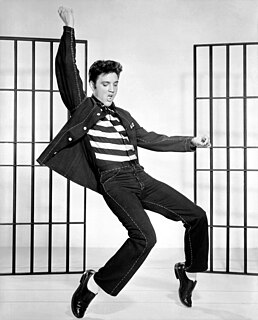
Elvis Presley was an American entertainer who achieved great initial success as a singer and stage performer. He publicly expressed an early career goal of following in the footsteps of his role models James Dean and Marlon Brando to become a top dramatic actor. His manager Colonel Tom Parker's persistent lobbying of William Morris Agency president Abe Lastfogel for a Presley screen test paid off on March 26, 1956, when the singer auditioned at Paramount for a supporting role in The Rainmaker. Although not chosen for the part, he signed a contract with Paramount producer Hal Wallis on April 25 that also allowed him to make films with other studios.
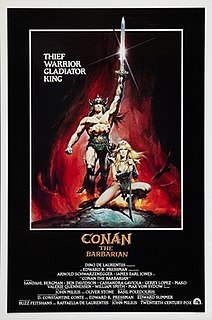
Conan the Barbarian is a 1982 American epic sword-and-sorcery film directed by John Milius and written by Milius and Oliver Stone. It is based on the character Conan, created by Robert E. Howard. The film stars Arnold Schwarzenegger and James Earl Jones, and tells the story of a young muscular barbarian warrior named Conan (Schwarzenegger), who seeks vengeance for the death of his parents at the hands of Thulsa Doom (Jones), the leader of a snake cult.
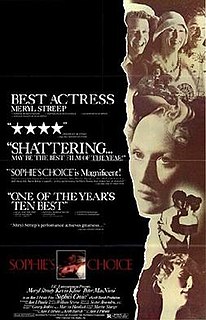
Sophie's Choice is a 1982 American drama film directed and written by Alan J. Pakula, adapted from William Styron's 1979 novel of the same name. The film stars Meryl Streep as Zofia "Sophie" Zawistowski, a Polish immigrant with a dark secret from her past who shares a boarding house in Brooklyn with her tempestuous lover, Nathan and a young writer Stingo. It also stars Kevin Kline, Peter MacNicol, Rita Karin, Stephen D. Newman, and Josh Mostel.

Dasari Narayana Rao was an Indian film director, producer, screenwriter, dialogue writer, actor, lyricist, and politician known for his works predominantly in Telugu cinema, Television, and Bollywood. He has directed more than one hundred and fifty feature films in a variety of genres. He is known by the moniker Darsaka Ratna. His works emphasize social injustice, corruption and gender discrimination. Rao has received three National Film Awards, nine state Nandi Awards including the Raghupathi Venkaiah Award, and four Filmfare Awards South including the lifetime Achievement. During his career he has also acted in Telugu, Tamil, and Kannada languages.

Poltergeist is a 1982 American supernatural horror film directed by Tobe Hooper and written by Steven Spielberg, Michael Grais and Mark Victor from a story by Spielberg. It stars JoBeth Williams, Craig T. Nelson, Heather O'Rourke, and Beatrice Straight and was produced by Spielberg and Frank Marshall. The film focuses on a suburban family whose home is invaded by malevolent ghosts that abduct their daughter.

Rakhee Gulzar is an Indian film actress who has appeared in many Hindi films and Bengali films as well. In four decades of acting, she has won three Filmfare Awards and one National Film Award, apart from many other awards. At Filmfare, Raakhee has been nominated 16 times in all, making her the second most-nominated performer in the female categories, behind Madhuri Dixit and Rani Mukerji. She debuted in the Bengali film Bodhu Boron in 1967 with Geeta Dutta in the lead role. Her first Hindi film was Jeevan Mrityu in 1970.
Tamil Nadu State Film Awards were given for excellence in Tamil cinema in India. They were given annually to honour the best talents and provide encouragement and incentive to the South Indian film industry by the Government of Tamil Nadu. The awards were decided by a committee headed by a Judge. The awards were first given in 1967 and discontinued after 1970. The awards were given again in 1977 and continued till 1982. The awards were not given in the years 1971 to 1976. However in the year 1977, the awards for Best Actress and Best Actor were announced for the years 1971 to 1976 by way of honorary certificates by the government led by the then chief minister M.G.Ramachandran. Since 1988, the awards were regularly given until it became defunct in 2008.

RKO Pictures was an American film production and distribution company. In its original incarnation, as RKO Radio Pictures, Inc. it was one of the Big Five studios of Hollywood's Golden Age. The business was formed after the Keith-Albee-Orpheum (KAO) theater chain and Joseph P. Kennedy's Film Booking Offices of America (FBO) studio were brought together under the control of the Radio Corporation of America (RCA) in October 1928. RCA chief David Sarnoff engineered the merger to create a market for the company's sound-on-film technology, RCA Photophone. By the mid-1940s, the studio was under the control of investor Floyd Odlum.

The Saturn Awards are American awards presented annually by the Academy of Science Fiction, Fantasy and Horror Films; they were initially created to honor science fiction, fantasy, and horror in film, but have since grown to reward other films belonging to genre fiction, as well as television and home media releases. The Saturn Awards were created in 1973 and were originally referred to as Golden Scrolls.

