
Manco Cápac, also known as Manco Inca and Ayar Manco, was, according to some historians, the first governor and founder of the Inca civilization in Cusco, possibly in the early 13th century. He is also a main figure of Inca mythology, being the protagonist of the two best known legends about the origin of the Inca, both of them connecting him to the foundation of Cusco. His main wife was his older sister, Mama Uqllu, also the mother of his son and successor Sinchi Ruq'a. Even though his figure is mentioned in several chronicles, his actual existence remains uncertain.

In Inca mythology, Mama Ocllo, or more precisely Mama Uqllu, was deified as a mother and fertility goddess. In one legend she was a daughter of Inti and Mama Killa, and in another the daughter of Viracocha (Wiraqucha) and Mama Qucha. In all of them she was the older sister and wife of Manco Cápac, whom she established the city of Cusco with. In some variations, she also had a son with him, Sinchi Roca, though all Incan rulers after Manco Cápac were believed to be their descendants.

Pachacuti Inca Yupanqui, also called Pachacútec, was the ninth Sapa Inca of the Chiefdom of Cusco, which he transformed into the Inca Empire. Most archaeologists now believe that the famous Inca site of Machu Picchu was built as an estate for Pachacuti.

Huayna Capac was the third Sapa Inca of Tawantinsuyu, the Inca Empire. He was the son of and successor to Túpac Inca Yupanqui., the sixth Sapa Inca of the Hanan dynasty, and eleventh of the Inca civilization. He was born in Tumipampa and tutored to become Sapa Inca from a young age.

Pedro Sarmiento de Gamboa (1532–1592) was a Spanish adventurer, author, historian, mathematician, and astronomer. His birthplace is not certain and may have been Pontevedra, in Galicia, where his paternal family originated, or Alcalá de Henares in Castile, where he later is known to have studied. His father Bartolomé Sarmiento was born in Pontevedra and his mother María Gamboa was born in Bilbao, Basque Country.

Sinchi Roca, Sinchi Rocca, Cinchi Roca, Sinchi Ruq'a or Sinchi Ruq'a Inka was the second Sapa Inca of the Kingdom of Cusco and a member of the Hurin dynasty.
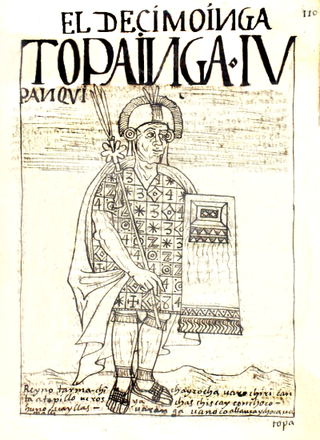
Topa Inca Yupanqui or Túpac Inca Yupanqui, also Topa Inga Yupangui, erroneously translated as "noble Inca accountant" was the tenth Sapa Inca (1471–93) of the Inca Empire, fifth of the Hanan dynasty. His father was Pachacuti, and his son was Huayna Capac. Topa Inca belonged to the Qhapaq Panaca. His quya was his older sister, Mama Ocllo.

The Sapa Inca was the monarch of the Inca Empire, as well as ruler of the earlier Kingdom of Cuzco and the later Neo-Inca State. While the origins of the position are mythical and originate from the legendary foundation of the city of Cuzco, it seems to have come into being historically around 1100 AD. Although the Inca believed the sapa Inca to be the son of Inti and often referred to him as Inti churi "solar son" or Intip churin "son of the Sun", the position eventually became hereditary, with son succeeding father. The principal wife of the Inca was known as the coya or quya. The Sapa Inca was at the top of the social hierarchy, and played a dominant role in the political and spiritual realm.

Vitcos was a residence of Inca nobles and a ceremonial center of the Neo-Inca State (1537–1572). The archaeological site of ancient Vitcos, called Rosaspata, is in the Vilcabamba District of La Convención Province, Cusco Region in Peru. The ruins are on a ridge overlooking the junction of two small rivers and the village of Pucyura. The Incas had occupied Vilcabamba, the region in which Vitcos is located, about 1450 CE, establishing major centers at Machu Picchu, Choquequirao, Vitcos, and Vilcabamba. Vitcos was often the residence of the rulers of the Neo-Inca state until the Spanish conquest of this last stronghold of the Incas in 1572.

Lluq'i Yupanki was the third Sapa Inca of the Kingdom of Cuzco and a member of the Hurin dynasty.
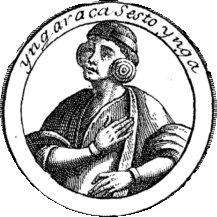
Inca Ruq'a was the sixth Sapa Inca of the Kingdom of Cusco and the first of the Hanan ("upper") Qusqu dynasty. His wife was Mama Michay, and his son was Yawar Waqaq.

Wiraqucha or Viracocha was the eighth Sapa Inka of the Kingdom of Cuzco and the third of the Hanan dynasty.
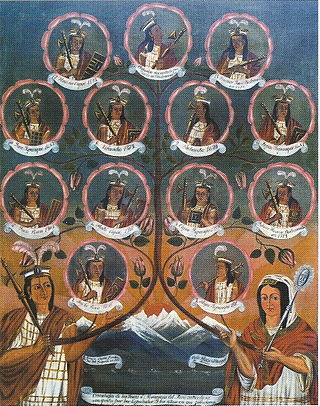
The Incas were most notable for establishing the Inca Empire which was centered in modern-day South America in Peru and Chile. It was about 4,000 kilometres (2,500 mi) from the northern to southern tip. The Inca Empire lasted from 1438 to 1533. It was the largest Empire in America throughout the Pre-Columbian era. The Inca state was known as the Kingdom of Cuzco before 1438. Over the course of the Inca Empire, the Inca used conquest and peaceful assimilation to incorporate the territory of modern-day Peru, followed by a large portion of western South America, into their empire, centered on the Andean mountain range. However, shortly after the Inca Civil War, the last Sapa Inca (emperor) of the Inca Empire was captured and killed on the orders of the conquistador Francisco Pizarro, marking the beginning of Spanish rule. The remnants of the empire retreated to the remote jungles of Vilcabamba and established the small Neo-Inca State, which was conquered by the Spanish in 1572.

Coricancha, Curicancha, Koricancha, Qoricancha or Qorikancha was the most important temple in the Inca Empire, and was described by early Spanish colonialists. It is located in Cusco, Peru, which was the capital of the empire.

The Comentarios Reales de los Incas is a book written by Inca Garcilaso de la Vega, the first published mestizo writer of colonial Andean South America. The Comentarios Reales de los Incas is considered by most to be the unquestioned masterpiece of Inca Garcilaso de la Vega, born of the first generation after the Spanish conquest.

The Kingdom of Cusco, also called the Cusco confederation, was a small kingdom based in the Andean city of Cusco that began as a small city-state founded by the Incas around the start of 13th century. In time, through warfare or peaceful assimilation, it began to grow into the Inca Empire (1438–1533).

Q'enqo, Qenko,Kenko, or Quenco is an archaeological site in the Sacred Valley of Peru located in the Cusco Region, Cusco Province, Cusco District, about 6 km north east of Cusco. The site was declared a Cultural Heritage (Patrimonio Cultural) of the Cusco Region by the National Institute of Culture.
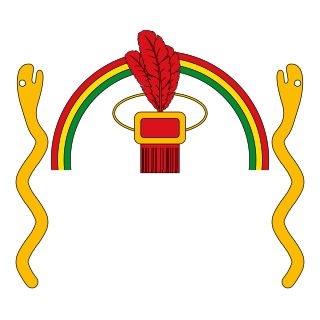
The Neo-Inca State, also known as the Neo-Inca state of Vilcabamba, was the Inca state established in 1537 at Vilcabamba by Manco Inca Yupanqui. It is considered a rump state of the Inca Empire (1438–1533), which collapsed after the Spanish conquest in the mid-1530s. The Neo-Inca State lasted until 1572, when the last Inca stronghold was conquered, and the last ruler, Túpac Amaru, was captured and executed, thus ending the political authority of the Inca state.
Cristóbal de Molina, called «el Cusqueño», was a Spanish colonial clergyman and chronicler who was very fluent in Quechua. He spent most of his life in Cusco, Peru and became a reputable reporter of the pre-Colonial Andean culture.
Auqui was the title held by the crown prince in the Inca Empire or Tahuantinsuyu. In a generic way, all the male children of the Inca were called auquis; however, the specific title was applicable only to one of them, whose choice was based on criteria different from those of the Eastern world because his capacity was taken into account, rather than his status as first-born or legitimate son.
