Related Research Articles
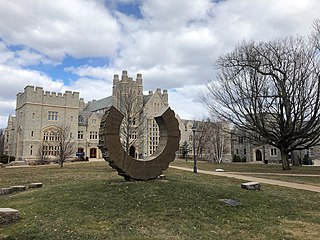
The University of Connecticut School of Law is the law school associated with the University of Connecticut and located in Hartford, Connecticut. It is the only public law school in Connecticut and one of only four in New England. As of 2020, it enrolled 488 students.

William Dawbney Nordhaus is an American economist. He was a Sterling Professor of Economics at Yale University, best known for his work in economic modeling and climate change, and a co-recipient of the 2018 Nobel Memorial Prize in Economic Sciences. Nordhaus received the prize "for integrating climate change into long-run macroeconomic analysis".
Geoffrey D. Dabelko is a professor at the George V. Voinovich School of Leadership and Public Service at Ohio University in Athens, OH. He teaches and conducts research in the School's Environmental Studies Program and Master's in Sustainability, Security, and Resilience. His recent research focuses on the conflict and cooperation potential of responses to climate change, environmental peacebuilding, climate resilience and environmental leadership.

John James Kirton is professor emeritus of political science and the director and founder of the G7 Research Group, director and founder of the G20 Research Group, founder and co-director of the Global Health Diplomacy Program, and founder and co-founder of the BRICS Research Group, based at University of Trinity College in the University of Toronto.

Mark Diesendorf is an Australian academic and environmentalist, known for his work in sustainable development and renewable energy. He currently researches at the University of New South Wales, Australia. He was formerly professor of environmental science and founding director of the Institute for Sustainable Futures at the University of Technology, Sydney and before that a principal research scientist with CSIRO, where he was involved in early research on integrating wind power into electricity grids. His most recent books are The Path to a Sustainable Civilisation (2023) and Sustainable Energy Solutions for Climate Change (2014).
David Leonard Downie is an American scholar focusing on international environmental politics and policy. He currently writes and teaches at Fairfield University.
Antonio Gabriel "Tony" Maestrado La Viña is at present Associate Director for climate policy and international relations and concurrently Head, Klima Center of Manila Observatory and a professor of law, philosophy, politics and governance in several universities in the Philippines. He is also a member of the Permanent Court of Arbitration in The Hague, the Chair of the Jurisprudence and Legal Philosophy Department of the Philippine Judicial Academy. the founding President of the Movement Against Disinformation, and the founding Chair of the Mindanao Climate Justice Resource Facility. He is also Managing Partner of La Viña Zarate, a human rights, climate justice, and general litigation law firm.

Mark Kenneth Jaccard is a Canadian energy economist and author. He develops and applies models that assess sustainability policies for energy and material. Jaccard is a professor of sustainable energy in the School of Resource and Environmental Management (REM) at Simon Fraser University.

The Institute of Development Studies (IDS) is a research and learning organisation affiliated with the University of Sussex in Brighton, England, and based on its campus in Falmer, East Sussex. It delivers research and teaching in the area of development studies.

Adil Najam is a Pakistani academic who also serves as the global President of WWF, the Worldwide Fund for Nature, and is Dean Emerıtus and Professor of International Relations and Earth and Environment at the Pardee School of Global Studies at Boston University. He was the founding Dean of the Pardee School from its creation in 2014 until 2022, when he was awarded the status of Dean Emeritus by Boston University. Previously he had served as vice-chancellor of the LUMS in Lahore, Pakistan.

Jennifer Sterling-Folker is a Professor of Political Science at the University of Connecticut. She was the Alan R. Bennett Honors Professor of Political Science. She is a specialist in International Relations theory.

Lawrence E. Susskind is a scholar of conflict resolution and consensus-building in urban planning. He is one of the founders of the field of public dispute mediation and is a practicing international mediator through the Consensus Building institute. He has taught at the Massachusetts Institute of Technology since 1971, where he is Ford Professor of Environmental Planning.

Steve Rayner was James Martin Professor of Science and Civilization at Oxford University and Director of the Institute for Science, Innovation and Society, a member of the Oxford Martin School. He described himself as an "undisciplined social scientist" having been trained in philosophy, comparative religion and political anthropology.
Xiangming Chen served as the founding dean and director of urban and global studies and director of the Center for Urban and Global Studies at Trinity College in Hartford, Connecticut, from 2007 to 2019. He is currently the Paul E. Raether Distinguished Professor of Global Urban Studies and Sociology at Trinity College. Prior to this, Chen served as assistant to full professor of sociology and adjunct professor of political science and urban planning and policy at the University of Illinois at Chicago.

Martha Alter Chen is an American academic, scholar and social worker, who is presently a lecturer in public policy at the Harvard Kennedy School and senior advisor of the global research-policy-action network WIEGO and a member of the Advisory Board of the United Nations University World Institute for Development Economics Research (UNU-WIDER). Martha is a development practitioner and scholar who has worked with the working poor in India, South Asia, and around the world. Her areas of specialization are employment, poverty alleviation, informal economy, and gender. She lived in Bangladesh working with BRAC, one of the world's largest non-governmental organizations, and in India, as field representative of Oxfam America for India and Bangladesh for 15 years.
Pamela S. Chasek is a professor in the Department of Political Science at Manhattan College, and editor of the Earth Negotiations Bulletin. She was an adjunct professor at Columbia University's School of International and Public Affairs from 1996-2000. She is widely published on the topic of international environmental policy.
Richard Ashby Wilson is an American–British social anthropologist of law and human rights. He is the Gladstein Distinguished professor of Human Rights and Professor of Anthropology and Law at the University of Connecticut. In 2021, Wilson became the Associate Dean of Faculty Development and Intellectual Life at the University of Connecticut School of Law. Wilson established the interdisciplinary Human Rights Institute at the University of Connecticut and was the Director of the Human Rights Institute from 2003 to 2013. Wilson is one of the founders of the anthropology of human rights and was editor and an author of Human Rights, Culture and Context (1997), the first edited volume in the field of the anthropology of human rights.

The contributions of women in climate change have received increasing attention in the early 21st century. Feedback from women and the issues faced by women have been described as "imperative" by the United Nations and "critical" by the Population Reference Bureau. A report by the World Health Organization concluded that incorporating gender-based analysis would "provide more effective climate change mitigation and adaptation."

Dr. Mark Terry is a Canadian scholar, explorer, and filmmaker. He is a Fellow of the Royal Society of Canada and is an adjunct professor in the Department of Communications and Media Studies, York University and the Department of Digital Media and Journalism, Wilfrid Laurier University.
Jonathan Wilkenfeld is an American political scientist and professor emeritus at University of Maryland, specialized in foreign policy, terrorism and simulation methodology in political science. He is the Founding Director of the International Communication and Negotiation Simulations Project.
References
- ↑ Connecticut Public Broadcasting
- ↑ Where We Live, WNPR. "Understanding Global Environmental Politics: Despite Environmental Conditions Worsening, We Have ‘Treaty Congestion.’” Jul 16, 2012.
- ↑ WNPR News. "What We've Learned From Superstorm Sandy," Diane Orson, October 30, 2013.
- Daily Trojan. "Professor Discusses Local Policies on Climate Change," Rebecca Cohen, December 4, 2013.
- Connecticut Public Broadcasting. "Resilient Cities: With More Severe Storms On The Horizon, How Should Cities And Towns Prepare?" October 31, 2012.
- “Adapting to Climate Change: Mapping Connecticut’s Coastal Responses to a Global Problem.” (2013) Mark A. Boyer. Sea Grant Law and Policy Journal, vol. 5, no. 1: 15-40.
- ↑ “Evolving Beyond Self-Interest? Some Experimental Findings from Simulated International Negotiations.” (2010) Co-author with Anat Niv-Solomon, Laura L. Janik, Mark A. Boyer, Natalie B. Hudson, Brian Urlacher, Scott W. Brown, Donalyn Maneggia. Simulation and Games, vol. 42, no. 6: 711-732.
- ↑ "International Studies Association" . Retrieved 2024-11-14.
- ↑ International Studies Review
- ↑ International Studies Perspectives
- ↑ Judd, Jamison (2013-07-15). "Home | The GlobalEd 2 Project". globaled.education.uconn.edu. Retrieved 2019-10-18.
- ↑ UConn Today. "Two Faculty Named 2013 Board of Trustees Distinguished Professors," Stephanie Reitz, May 13, 2013.
- ↑ International Studies Association.
- ↑ American Political Science Association.
