
Martin Schott (died 22 November 1499) was a book printer from Strasbourg. One of the earliest printers in Strasbourg, his catalog reflected the tastes of the higher classes in Germany at the time of German humanism.
Martin Schott (died 22 November 1499) was a book printer from Strasbourg. One of the earliest printers in Strasbourg, his catalog reflected the tastes of the higher classes in Germany at the time of German humanism.
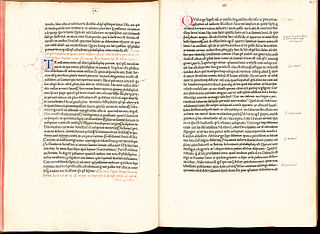
Schott hailed from a high-ranking family. He was the son of Friedrich Schott, a woodcutter and sculptor. His father's interest, and his marriage to a daughter of the printer Johannes Mentelin, may have led him to become a printer. He did not inherit his father in law's business, which went to another son in law of Mentelin's, Adolf Rusch. In contrast to Mentelin's company, Schott used a more modern (but sometimes less attractive) process. His first known printing was a plenarium, in 1481; his last was the version of Cicero's Philippicae by the early German humanist Jakob Wimpfeling, in 1498. It is sure, however, that he must have been printing works before 1480; given the paucity of the research into Strasbourg's history of printing, these chronological limits as well as the number of his books cannot be precisely determined, according to the Deutsche Biographie . Twenty-one, or perhaps twenty-five, books are known to have come from his press, but it may be that not all his books were printed under his own name, and the large number of incunables printed in Strasbourg also suggest he may have printed some of those. [1] The Lucidarius , a 12th-century summa, may have been the earliest of his books. [2] While he printed a small number of books, they were voluminous, and Schott clearly valued artistic embellishment. [1]
His catalog reflected the interest of the established classes in Strasbourg at the time of German humanism, and contained German versions of a biography of Alexander the Great, of Guido delle Colonne's Historia destructionis Troiae , and of the 11th-century encyclopedia Elucidarium (a source for the Lucidarium). He also printed Latin works. [1] His printer's mark was a tree not planted in any soil and displayed in full, with the letters "M. S.". [1] His son, Johannes Schott, was likewise a printer. [3] The first book known to be his work was printed in 1500, and he printed work from Martin Luther and other reformers throughout his career. [3]

Johannes Gensfleisch zur Laden zum Gutenberg was a German inventor and craftsman who introduced letterpress printing to Europe with his movable-type printing press. Though movable type was already in use in East Asia, Gutenberg invented the printing press, which later spread across the world. His work led to an information revolution and the unprecedented mass-spread of literature throughout Europe. It had a direct impact on the development of the Renaissance, Reformation, and humanist movements. All have been described as "unthinkable" without Gutenberg's invention.

Johannes Oporinus was a humanist printer in Basel.

Frans van Ravelingen Latinized Franciscus Raphelengius, was a Flemish-born scholar, printer and publisher, working in Antwerp and later in Leiden. During the last decade of his life he was professor of Hebrew at Leiden University. He produced an Arabic-Latin dictionary, of about 550 pages, which was published posthumously in 1613 in Leiden. This was the first publication by printing press of a book-length dictionary for the Arabic language in Latin.

Schott Music is one of the oldest German music publishers. It is also one of the largest music publishing houses in Europe, and is the second oldest music publisher after Breitkopf & Härtel. The company headquarters of Schott Music were founded by Bernhard Schott in Mainz in 1770.
Arnold Pannartz and Conrad Sweynheym were two printers of the 15th century, associated with Johannes Gutenberg and the use of his invention, the mechanical movable-type printing press.

Johannes Mentelin, sometimes also spelled Mentlin, was a pioneering German book printer and bookseller active during the period during which incunabula were printed. In 1466, he published the first printed Bible in the German language, the Mentelin Bible.

Heinrich Eggestein is considered, along with Johannes Mentelin, to be the earliest book printer in Strasbourg and therefore one of the earliest anywhere in Europe outside Mainz.

The history of printing in Poland began in the late 15th century, when following the creation of the Gutenberg Bible in 1455, printers from Western Europe spread the new craft abroad.

Hieronymus Vietor was a printer and publisher born in Silesia and active in Vienna and Kraków. Famous for the quality and quantity of his prints, he is considered one of the most important early book printers in Poland, also because he was the first to regularly print in Polish. He is also known as Hieronymus Philovallensis or Hieronymus Doliarius, or in Polish as Hieronim Wietor or Büttner.
Peter Schott the elder was a major fifteenth century Strasbourg statesman.
Adolf Rusch von Ingweiler was a notable German printer and publisher. He was the first printer north of the Alps to print in Antiqua.
Adam Petri was a printer, publisher and bookseller.

Konrad Hubert, also Konrad Huber, Konrad Huober, or Konrad Humbert, was a German Reformed theologian, hymn writer and reformer. He was for 18 years the assistant of Martin Bucer at St. Thomas, Strasbourg.

Bernhard Peter Schott was a German clarinetist and music publisher. He founded the predecessor of Schott Music, a major German music publishing company which continues to this day.
Procopius Waldvogel was a medieval printer from Avignon. It is believed that he might have invented printing before Johannes Gutenberg. He flourished in the fifteenth century.

Andreas Cratander was a Swiss printer, publisher, and book seller. Based in Basel, his workshop is estimated to have published at least 150 individual works between 1518 and 1535, predominantly Latin and Greek classics in their original languages.

Johannes (Hans) Grüninger (1455–1533) was a German printer whose career spanned from 1482 to 1533 and produced up to 500 publications. Grüninger was one of the single most prolific printers of Strasbourg, printing up to 80 books a year. While a great deal of his publications were Catholic, he managed to print a great variety of works ranging from humanist to scientific texts. His work was fairly equally representative of both Latin and the vernacular; about 39% of his works were printed in Latin and the remaining 61% in German.
Wolfgang Lachner was a bookseller and publisher in Basel. He had extensive contacts in Europe and supplied, among others, Erasmus of Rotterdam and Ulrich Zwingli.

Johann Balhorn the Younger was a German printer in Lübeck. He followed his father, Johann Balhorn the Elder in the printing trade, from whom he took over the printing house. Both used as a monogram the pictured printer's mark and a seal with a horn and three balls. In a play on their name the German word verballhornen, which means "parody", was coined.

Johannes Schott was a book printer from Strasbourg. He printed a large number of books, including tracts from Martin Luther and other Reformers. He was a well-educated man, who had relationships with some of the leading humanists of his time. His press also was one of the first to be able to print chiaroscuro woodcuts.
| International | |
|---|---|
| National | |
| People | |
| Other | |
