Ubiquitous computing is a concept in software engineering, hardware engineering and computer science where computing is made to appear seamlessly anytime and everywhere. In contrast to desktop computing, ubiquitous computing implies use on any device, in any location, and in any format. A user interacts with the computer, which can exist in many different forms, including laptop computers, tablets, smart phones and terminals in everyday objects such as a refrigerator or a pair of glasses. The underlying technologies to support ubiquitous computing include the Internet, advanced middleware, kernels, operating systems, mobile codes, sensors, microprocessors, new I/Os and user interfaces, computer networks, mobile protocols, global navigational systems, and new materials.
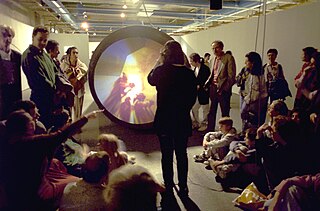
Interactive art is a form of art that involves the spectator in a way that allows the art to achieve its purpose. Some interactive art installations achieve this by letting the observer walk through, over or around them; others ask the artist or the spectators to become part of the artwork in some way.

Nicholas Negroponte is a Greek American architect. He is the founder and chairman Emeritus of Massachusetts Institute of Technology's Media Lab, and also founded the One Laptop per Child Association (OLPC). Negroponte is the author of the 1995 bestseller Being Digital translated into more than forty languages.

Lego Mindstorms is a discontinued line of educational kits for building programmable robots based on Lego bricks. It was introduced on 1 September 1998 and was discontinued on 31 December 2022.

The MIT Media Lab is a research laboratory at the Massachusetts Institute of Technology, growing out of MIT's Architecture Machine Group in the School of Architecture. Its research does not restrict to fixed academic disciplines, but draws from technology, media, science, art, and design. As of 2014, Media lab's research groups include neurobiology, biologically inspired fabrication, socially engaging robots, emotive computing, bionics, and hyperinstruments.

A dance pad, also known as a dance mat or dance platform, is a flat electronic game controller used for input in dance games. Most dance pads are divided into a 3×3 matrix of square panels for the player to stand on, with some or all of the panels corresponding to directions or actions within the game. Some dance pads also have extra buttons outside the main stepping area, such as "Start" and "Select". Pairs of dance pads often are joined, side by side, for certain gameplay modes.

The Game is a non-stop 24- to 48-hour treasure hunt, puzzlehunt or road rally that has run in the San Francisco Bay and Seattle areas. Its teams use vans rigged with power and Internet access and drive hundreds of miles from puzzle site to puzzle site, overcoming often outrageous physical and mental challenges along the way, usually with no sleep. Teams in games have been required to walk around the roof of the Space Needle, find a puzzle hidden in a live rat, and circulate a petition to ban dihydrogen monoxide from local ecosystems while dressed in superhero outfits.

Scott Fisher is the Professor and Founding Chair of the Interactive Media Division in the USC School of Cinematic Arts at the University of Southern California, and Director of the Mobile and Environmental Media Lab there. He is an artist and technologist who has worked extensively on virtual reality, including pioneering work at NASA, Atari Research Labs, MIT's Architecture Machine Group and Keio University.

Ambient intelligence (AmI) refers to electronic environments that can recognize the presence of people and adapt accordingly. This concept encompasses various technologies in consumer electronics, telecommunications, and computing, primarily focusing on enhancing user interactions through context-aware systems.
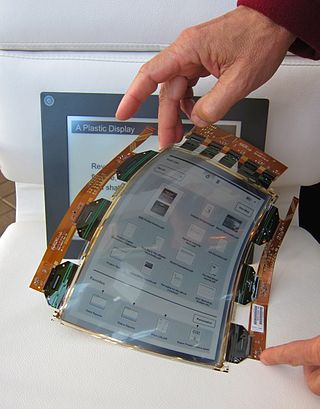
A flexible display or rollable display is an electronic visual display which is flexible in nature, as opposed to the traditional flat screen displays used in most electronic devices. In recent years there has been a growing interest from numerous consumer electronics manufacturers to apply this display technology in e-readers, mobile phones and other consumer electronics. Such screens can be rolled up like a scroll without the image or text being distorted. Technologies involved in building a rollable display include electronic ink, Gyricon, Organic LCD, and OLED.
Responsive architecture is an evolving field of architectural practice and research. Responsive architectures are those that measure actual environmental conditions to enable buildings to adapt their form, shape, color or character responsively.

Electronic textiles or e-textiles are fabrics that enable electronic components such as batteries, lights, sensors, and microcontrollers to be embedded in them. Many smart clothing, wearable technology, and wearable computing projects involve the use of e-textiles.
MetaCarta is a software company that developed one of the first search engines to use a map to find unstructured documents. The product uses natural language processing to georeference text for customers in defense, intelligence, homeland security, law enforcement, oil and gas companies, and publishing. The company was founded in 1999 and was acquired by Nokia in 2010. Nokia subsequently spun out the enterprise products division and the MetaCarta brand to Qbase, now renamed to Finch.
Glorianna Davenport is a New York-born media maker. A co-founder of the MIT Media Lab, Davenport directed the Interactive cinema research group from 1987–2004 and the Media Fabrics research group from 2004-2008. Davenport retired from the Massachusetts Institute of Technology in the Summer of 2008. From 2008 to the present, she has managed the transition of Tidmarsh Farms, a former 610 acre cranberry farm in Plymouth Massachusetts, into conservation and wetland restoration. In 2011, Davenport founded Living Observatory, a non-profit, learning collaborative that focuses on documenting and sharing the long term story of wetland restoration of former cranberry farms. In this work, Davenport returned as a visiting scientist at the MIT Media Lab where she works closely with the Responsive Environments Group.
Living labs are open innovation ecosystems in real-life environments using iterative feedback processes throughout a lifecycle approach of an innovation to create sustainable impact. They focus on co-creation, rapid prototyping & testing and scaling-up innovations & businesses, providing joint-value to the involved stakeholders. In this context, living labs operate as intermediaries/orchestrators among citizens, research organisations, companies and government agencies/levels.
Joseph Paradiso is the Alexander W. Dreyfoos (1954) Professor at MIT's Program in Media Arts and Sciences. He directs the MIT Media Lab's Responsive Environments Group, which explores how sensor networks augment and mediate human experience, interaction and perception. He received a B.S. in electrical engineering and physics summa cum laude from Tufts University, and a Ph.D. in physics from MIT with Prof. Ulrich Becker in the Nobel Prize-winning group headed by Prof. Samuel C.C. Ting at the MIT Laboratory for Nuclear Science.

Bluefin Labs was a Cambridge, MA-based social TV analytics company that used publicly available social media commentary from Twitter, Facebook and blogs to measure viewer engagement with television shows and ads at scale – historically a costly and complex problem for TV and marketing industries to solve.

Jocelyn Scheirer is an American entrepreneur, scientist, and artist who has been working in wearable technology since the late 1990s. Her research focuses on Affective Computing, which she pursued while pursuing her PhD (pending) at MIT Media's Lab Affective Computing Group with Rosalind Picard. Scheirer invented and, along with MIT, patented the Galvactivator glove which measured skin conductance through sensors on the palm and relayed the varying intensity through an LED display. She founded the intercommunication equipment and systems company Empathyx, Inc. in 2006 and co-founded the emotional analytics company Affectiva in 2009, and was their director of operations until 2010. Scheirer has also created several visual and performance art pieces that have been featured in several galleries in Massachusetts including the MIT Museum, the Galatea Fine Art Gallery, and the Bromfield Gallery. She is CEO of the wearable company Bionolux Labs, LLC.
Interactive architecture refers to the branch of architecture which deals with buildings, structures, surfaces and spaces that are designed to change, adapt and reconfigure in real-time response to people, as well as the wider environment. This is usually achieved by embedding sensors, processors and effectors as a core part of a building's nature and functioning in such a way that the form, structure, mood or program of a space can be altered in real-time. Interactive architecture encompasses building automation but goes beyond it by including forms of interaction engagements and responses that may lie in pure communication purposes as well as in the emotive and artistic realm, thus entering the field of interactive art. It is also closely related to the field of Responsive architecture and the terms are sometimes used interchangeably, but the distinction is important for some.
Nan-Wei Gong is an MIT engineer, inventor, and entrepreneur whose work focuses on wearable technology.
