
Frankfort is the capital city of the U.S. state of Kentucky and the seat of Franklin County. It is a home rule-class city. The population was 28,602 at the 2020 United States census. Located along the Kentucky River, Frankfort is the principal city of the Frankfort, Kentucky Micropolitan Statistical Area, which includes all of Franklin and Anderson counties. It is the 4th least populous state capital in the United States, and the 13th most populous city in Kentucky.

Mayfield is a home rule–class city and the county seat of Graves County, Kentucky, United States. The population was 10,017 as of the 2020 United States Census.

The University of Kentucky is a public land-grant research university in Lexington, Kentucky. Founded in 1865 by John Bryan Bowman as the Agricultural and Mechanical College of Kentucky, the university is one of the state's two land-grant universities. It is the institution with the highest enrollment in the state, with 32,710 students as of fall 2022.

Kentucky State University is a public historically black land-grant university in Frankfort, Kentucky. Founded in 1886 as the State Normal School for Colored Persons, and becoming a land-grant college in 1890, KSU is the second-oldest state-supported institution of higher learning in Kentucky. In fall 2019, total undergraduate enrollment was 2,029 with a total graduate enrollment of 142.

The Greensboro sit-ins were a series of nonviolent protests in February to July 1960, primarily in the Woolworth store—now the International Civil Rights Center and Museum—in Greensboro, North Carolina, which led to the F. W. Woolworth Company department store chain removing its policy of racial segregation in the Southern United States. While not the first sit-in of the civil rights movement, the Greensboro sit-ins were an instrumental action, and also the best-known sit-ins of the civil rights movement. They are considered a catalyst to the subsequent sit-in movement, in which 70,000 people participated. This sit-in was a contributing factor in the formation of the Student Nonviolent Coordinating Committee (SNCC).
Paul Laurence DunbarHigh School (PLD/PLDHS), also known as Dunbar High School, is a public high school located at 1600 Man o' War Boulevard on the southwest side of Lexington, Kentucky, United States. The school is one of six high schools in the Fayette County Public Schools district.

Lucien Anderson was a pro-Unionist slave owner and United States Representative from Kentucky.
The NAACP Youth Council is a branch of the NAACP in which youth are actively involved. In past years, council participants organized under the council's name to make major strides in the Civil Rights Movement. Started in 1935 by Juanita E. Jackson, special assistant to Walter White and the first NAACP Youth secretary, the NAACP National Board of Directors formally created the Youth and College Division in March 1936.
Joyce Hamilton Berry, is an American clinical psychologist with her own practice in the Washington D.C. area. She grew up during the time of segregation, attended graduate school during the height of the Civil Rights Movement, and became the first female African-American to earn a Ph.D. from the University of Kentucky in 1970. She was married to David Berry, also from Kentucky.
NAACP in Kentucky is very active with branches all over the state, largest being in Louisville and Lexington. The Kentucky State Conference of NAACP continues today to fight against injustices and for the equality of all people.

Audrey Louise Grevious became one of the central leaders in the local civil rights movement in Lexington and the Commonwealth of Kentucky.

Douglass School in Lexington, Kentucky, US, was both a primary and secondary Fayette County Public Schools from 1929 to 1971. Douglass School operated solely for African American students. The building that once housed Douglass School, located at 465 Price Road, was listed on the National Register of Historic Places in Fayette County in 1998.
Helen Fisher Frye, educator and active churchwoman, was a local leader for civil rights in her hometown of Danville, Kentucky, serving as the president of the Danville chapter of the NAACP. She was the first African American to enroll at Centre College and the first African American woman to receive a Master of Arts in Library Science from the University of Kentucky in 1960.
The Day Law mandated racial segregation in educational institutions in Kentucky. Formally designated "An Act to Prohibit White and Colored Persons from Attending the Same School," the bill was introduced in the Kentucky House of Representatives by Carl Day in January 1904, and signed into law by Governor J.C.W. Beckham in March 1904. As well as prohibiting students of color from attending the same school as white students, the law prohibited individual schools from operating separate black and white branches within 25 miles of each other.

Amanda Matthews is an American sculptor and painter from Louisville, Kentucky, United States, who lives in Lexington, Kentucky.
E. Belle Mitchell Jackson was an American educator, activist, small business owner, and abolitionist from Danville, Kentucky. Mitchell was one of the founders of the Colored Orphans Industrial Home in Lexington, Kentucky.

The Patterson Office Tower is a 250-foot (76 m) high-rise building on the University of Kentucky (UK) campus in Lexington, Kentucky. It is UK's only current high-rise following the 2020 demolition of the Kirwan–Blanding residence hall complex, which had included two 264-foot (80 m) towers.
Black Kentuckians are residents of the state of Kentucky who are of African ancestry. The history of Blacks in the US state of Kentucky starts at the same time as the history of White Americans; Black Americans settled Kentucky alongside white explorers such as Daniel Boone. As of 2019, according to the U.S. Census Bureau, African Americans make up 8.5% of Kentucky's population. Compared to the rest of the population, the African American census racial category is the 2nd largest.
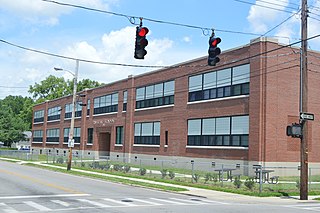
The Russell School (1895–2003) is a former public school located in the Northside neighborhood of Lexington, Kentucky. From 1895 until roughly the mid-1960s, the school was segregated and served African American students.
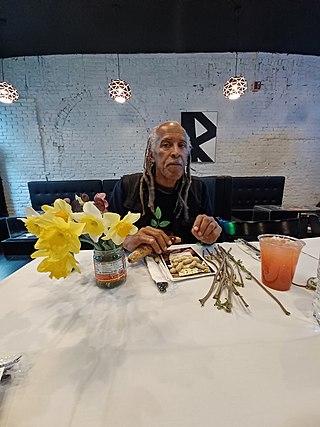
Jim Embry is a lifelong civil rights activist, eco-activist farmer, social justice advocate, educator, public speaker, photographer, scuba diver, writer. He is active in the local food and sustainable agriculture movement. In 2006, he founded the Sustainable Communities Network. Embry is the Director of the Sustainable Communities Network. He has over 50 years of experience as a social activist.
