
Mytishchi is a city and the administrative center of Mytishchinsky District in Moscow Oblast, Russia, which lies 19 km northeast of Russia's capital Moscow on the Yauza River and the Moscow–Yaroslavl railway. The city was an important waypoint for traders on the Yauza River, the Yaroslavl Highway passes through the city. Mytishchi is famous for its aqueduct, built in 1804, the first water supply pipeline to supply the growing population of Moscow. The city has a population of approximately 262,702 people as of 2022.

The January Events were a series of violent confrontations between the civilian population of Lithuania, supporting independence, and the Soviet Armed Forces. The events took place between 11 and 13 January 1991, after the restoration of independence by Lithuania. As a result of the Soviet military actions, 14 civilians were killed and over 140 were injured. 13 January, was the most violent day. The events were primarily centered in the capital city Vilnius, but Soviet military activity and confrontations also occurred elsewhere in the country, including Alytus, Šiauliai, Varėna and Kaunas.

Margarita Aleksandrovna Drobiazko is a Russian retired ice dancer. She began competing for Lithuania in 1992 when she teamed up with Povilas Vanagas. With Vanagas, she is the 2000 World bronze medalist, a three-time Grand Prix Final bronze medalist, a two-time European bronze medalist, the 1999 Skate Canada champion, and competed in five Winter Olympics, finishing as high as 5th.
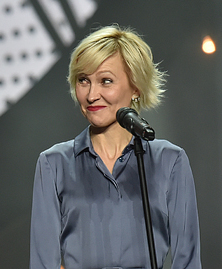
Ingeborga Edmundovna Dapkūnaitė is а Lithuanian theatre and cinema actress, who has appeared mostly in Russian films. She is known for her roles in two 1994 Russian films Burnt by the Sun, which won an Academy Award for Best Foreign Language Film, and Katya Ismailova, for which she won the Nika Award for Best Actress. She is also known for her role as Morpheus in Heavenly Court and as Irina Sidorova in the Norwegian political drama series Occupied (2015–19). More recently she plays mayor Rasa Kymantaite in the Lithuanian Nordic noir film The Generation of Evil (2022).
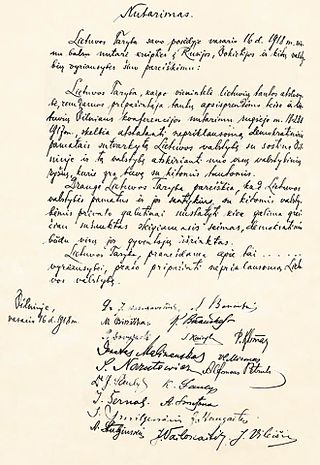
The Act of Independence of Lithuania or the Act of February 16, also the Lithuanian Resolution on Independence, was signed by the Council of Lithuania on February 16, 1918, proclaiming the restoration of an independent State of Lithuania, governed by democratic principles, with Vilnius as its capital. The Act was signed by all twenty representatives of the Council, which was chaired by Jonas Basanavičius. The Act of February 16 was the result of a series of resolutions on the issue, including one issued by the Vilnius Conference and the Act of January 8. The path to the Act was long and complex because the German Empire exerted pressure on the Council to form an alliance. The Council had to carefully maneuver between the Germans, whose troops were present in Lithuania, and the demands of the Lithuanian people.

The State Prize of the Russian Federation, officially translated in Russia as Russian Federation National Award, is a state honorary prize established in 1992 following the breakup of the Soviet Union. In 2004 the rules for selection of laureates and the status of the award were significantly changed, making them closer to such awards as the Nobel Prize or the Soviet Lenin Prize.

Dalia Grybauskaitė is a Lithuanian politician who served as the eighth president of Lithuania from 2009 to 2019. She is the first woman to hold the position and in 2014 she became the first President of Lithuania to be reelected for a second consecutive term.

Lieutenant General Arvydas Pocius is a former Chief of Defence of Lithuania. During his military career, Pocius has held various positions, including Chief of Staff of Voluntary Service of National Defence, and Commander of the Lithuanian Land Force. Pocius was Lithuanian champion of freestyle wrestling in junior, youth and adult groups.
This article is about the particular significance of the year 2011 to Lithuania and its people.

Tatyana Rostislavovna Mitkova is a Russian television journalist for NTV. She became famous in 1991 for refusing to read the official Soviet Union version of the military response to the uprising in Lithuania. In 2001, BBC News described her as one of Russia's "best-known news presenters".

Lithuania competed at the 2014 Winter Olympics in Sochi, Russia from 7 to 23 February 2014. The team consists of nine athletes competing in five different sports. The nine athletes mark the most athletes the country has ever qualified for a Winter Olympics.

Dmitry Konstantinovich Kiselyov is a Russian TV presenter and propagandist. In 2013, Kiselyov was appointed by Russian President Vladimir Putin to head Rossiya Segodnya, a Russian state-controlled media group. He also serves as deputy director of the All-Russia State Television and Radio Broadcasting Company.
Events in the year 2015 in Lithuania.

Naglis Puteikis is a Lithuanian politician and member of the Seimas.

Saulius Skvernelis is a Lithuanian politician who served as prime minister of Lithuania between 2016 and 2020. He had previously served as police commissioner, and was Minister of the Interior from 2014 to 2016. Though he was an independent politician, he was backed by the Lithuanian Farmers and Greens Union and was a member of its parliamentary group until 2022, as a result of which he became the first head of government in European history primarily backed by a green party.
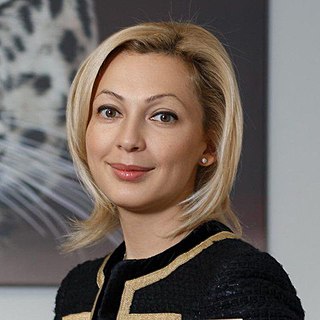
Olga Timofeeva is a deputy for the United Russia party in the 7th State Duma of the Russian Federation and former journalist. She is Deputy chairman of the State Duma since 9 October 2017. Previously she was head of the Ecology and Environmental Protection committee. Honorary citizen of the city of Stavropol (2014).

Azerbaijan—Lithuania relations refers to bilateral relations between Azerbaijan and Lithuania.

Maria Eduardovna Sittel is a Russian television presenter and an anchor on the Vesti program at Russia-1. She won the Russian TEFI award.

Jovita Neliupšienė is a Lithuanian politician, who had been the former Chief Foreign Policy Adviser to President Dalia Grybauskaitė. From September 2020, she was the Chancellor of the Ministry of Foreign Affairs. Neliupšienė had also served as the Lithuanian ambassador to the European Union from 2015 to 2020.

Bela Alekseevna Kurkova was a presenter, journalist and producer of Soviet Union and Russian television. She was also the director general of 5TV Russian TV channel. She received awards such as the Honoured Cultural Worker of the RSFSR (1985).

 Lithuania
