
A restaurant is an establishment that prepares and serves food and drinks to customers. Meals are generally served and eaten on the premises, but many restaurants also offer take-out and food delivery services. Restaurants vary greatly in appearance and offerings, including a wide variety of cuisines and service models ranging from inexpensive fast-food restaurants and cafeterias to mid-priced family restaurants, to high-priced luxury establishments.

A fast-food restaurant, also known as a quick-service restaurant (QSR) within the industry, is a specific type of restaurant that serves fast-food cuisine and has minimal table service. The food served in fast-food restaurants is typically part of a "meat-sweet diet", offered from a limited menu, cooked in bulk in advance and kept hot, finished and packaged to order, and usually available for take away, though seating may be provided. Fast-food restaurants are typically part of a restaurant chain or franchise operation that provides standardized ingredients and/or partially prepared foods and supplies to each restaurant through controlled supply channels. The term "fast food" was recognized in a dictionary by Merriam–Webster in 1951.

Pricing is the process whereby a business sets and displays the price at which it will sell its products and services and may be part of the business's marketing plan. In setting prices, the business will take into account the price at which it could acquire the goods, the manufacturing cost, the marketplace, competition, market condition, brand, and quality of the product.
Marketing management is the strategic organizational discipline that focuses on the practical application of marketing orientation, techniques and methods inside enterprises and organizations and on the management of marketing resources and activities. Compare marketology, which Aghazadeh defines in terms of "recognizing, generating and disseminating market insight to ensure better market-related decisions".

Fast food is a type of mass-produced food designed for commercial resale, with a strong priority placed on speed of service. Fast food is a commercial term, limited to food sold in a restaurant or store with frozen, preheated or precooked ingredients and served in packaging for take-out or takeaway. Fast food was created as a commercial strategy to accommodate large numbers of busy commuters, travelers and wage workers. In 2018, the fast-food industry was worth an estimated $570 billion globally.

In a restaurant, the menu is a list of food and beverages offered to customers and the prices. A menu may be à la carte – which presents a list of options from which customers choose – or table d'hôte, in which case a pre-established sequence of courses is offered. Menus may be printed on paper sheets provided to the diners, put on a large poster or display board inside the establishment, displayed outside the restaurant, or put on a digital screen. Since the late 1990s, some restaurants have put their menus online.
A loss leader is a pricing strategy where a product is sold at a price below its market cost to stimulate other sales of more profitable goods or services. With this sales promotion/marketing strategy, a "leader" is any popular article, i.e., sold at a low price to attract customers.
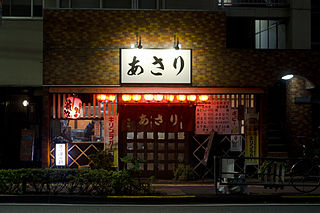
An izakaya is a type of informal Japanese bar that serves alcoholic drinks and snacks. Izakaya are casual places for after-work drinking, similar to a pub, a Spanish tapas bar, or an American saloon or tavern.

Room service or in-room dining is a hotel service enabling guests to choose items of food and drink for delivery to their hotel room for consumption. Room service is organized as a subdivision within the food and beverage department of high-end hotel and resort properties. It is uncommon for room service to be offered in hotels that are not high-end, or in motels. Room service may also be provided for guests on cruise ships. Room service may be provided on a 24-hour basis or limited to late night hours only. Due to the cost of customized orders and delivery of room service, prices charged to the patron are typically much higher than in the hotel's restaurant or tuck shop, and a gratuity is expected in some regions.
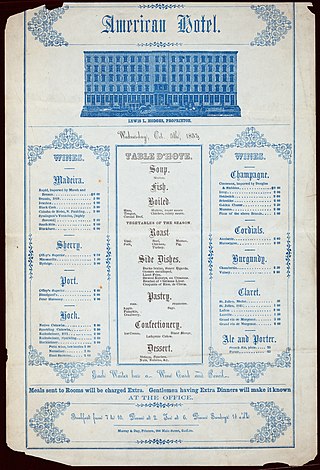
In restaurant terminology, a table d'hôte menu is a menu where multi-course meals with only a few choices are charged at a fixed total price. Such a menu may be called prix fixe. The terms set meal and set menu are also used.
In economics, the menu cost is a cost that a firm incurs due to changing its prices. It is one microeconomic explanation of the price-stickiness of the macroeconomy put by New Keynesian economists. The term originated from the cost when restaurants print new menus to change the prices of items. However economists have extended its meaning to include the costs of changing prices more generally. Menu costs can be broadly classed into costs associated with informing the consumer, the cost of planning for and deciding on a price change, and the impact of consumers' potential reluctance to buy at the new price. Examples of menu costs include updating computer systems, re-tagging items, changing signage, printing new menus, mistake costs and hiring consultants to develop new pricing strategies. At the same time, companies can reduce menu costs by developing intelligent pricing strategies, thereby reducing the need for changes.

Noodles & Company is an American fast-casual restaurant that offers international and American noodle dishes in addition to soups and salads. Noodles & Company was founded in 1995 by Aaron Kennedy and is headquartered in Broomfield, Colorado. The company went public in 2013 and recorded a $457 million revenue in 2017. In mid-2022, there were 458 Noodles & Company locations across 31 states.

A meat and three meal is one where the customer picks one meat and three side dishes as a fixed-price offering. Meats commonly include fried chicken, country ham, beef, country-fried steak, meatloaf, or pork chop; and sides span from vegetables such as potatoes, corn, and green beans, to macaroni and cheese, hush puppies, and spaghetti. A dessert, such as gelatin, is often offered. Typical accompaniments include cornbread and sweet tea.
A business can use a variety of pricing strategies when selling a product or service. To determine the most effective pricing strategy for a company, senior executives need to first identify the company's pricing position, pricing segment, pricing capability and their competitive pricing reaction strategy. Pricing strategies and tactics vary from company to company, and also differ across countries, cultures, industries and over time, with the maturing of industries and markets and changes in wider economic conditions.
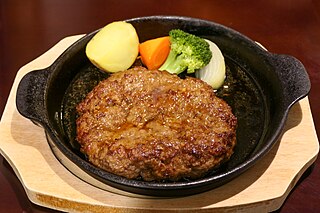
Hamburg steak is a patty of ground beef. Made popular worldwide by migrating Germans, it became a mainstream dish around the start of the 19th century. It is related to Salisbury steaks, which also use ground beef. It is considered the origin of the hamburger, when, in the early 20th century, vendors began selling the Hamburg steak as a sandwich between bread.
As far back as the 1970s, international fast food restaurant chain Burger King has attempted to introduce a premium line of burgers. These sandwiches are part of a system which eventually became known as the barbell strategy; a plan designed to expand Burger King's menu with both more sophisticated, adult-oriented fare along with products that are more value-oriented. This program is intended to bring in a larger, more affluent adult audience who will be willing to spend more on the better quality products on one side while maintaining a lower cost value menu dedicated to a more cost-conscious audience on the other. The hope is that the customers would be drawn in initially for the lower prices of the value-menu and upgrade to the more expensive products, upping overall sales.
Early bird dinner is a dinner served earlier than traditional dinner hours, particularly at a restaurant. Many establishments offer a seating prior to their main dinner seating with a reduced price menu, often more limited in selection than the standard dinner menu. Some restaurants offer specific meals or meal options which are sometimes referred to as "early bird specials". The term was first used for a clothing sale in 1904, and then in restaurants in the 1920s.
Grubhub Inc. is an American online and mobile prepared food ordering and delivery platform based in Chicago, Illinois.

Gordon Ramsay at Claridge's was a restaurant owned by Gordon Ramsay and located with Claridge's hotel in Mayfair, London. Blackstone Group had enquired about Ramsay's availability to open a restaurant after he was awarded three Michelin Stars at Restaurant Gordon Ramsay. It marked the first of a number of restaurants that Ramsay would open at hotels owned by Blackstone. It opened in 2001, and by the fourth year was making a profit of £2 million a year. Mark Sargeant was the chef de cuisine of the restaurant until 2008, during which time the restaurant was awarded a Michelin star.
Uber Eats is an online food ordering and delivery platform launched by the company Uber in 2014. The meals are delivered by couriers using various methods, including cars, scooters, bikes, or on foot. It is operational in over 6,000 cities in 45 countries as of 2021.

