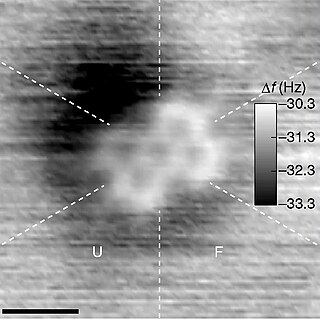
Computational chemistry is a branch of chemistry that uses computer simulation to assist in solving chemical problems. It uses methods of theoretical chemistry, incorporated into efficient computer programs, to calculate the structures and properties of molecules and solids. It is necessary because, apart from relatively recent results concerning the hydrogen molecular ion, the quantum many-body problem cannot be solved analytically, much less in closed form. While computational results normally complement the information obtained by chemical experiments, it can in some cases predict hitherto unobserved chemical phenomena. It is widely used in the design of new drugs and materials.

Theoretical chemistry is the branch of chemistry which develops theoretical generalizations that are part of the theoretical arsenal of modern chemistry: for example, the concepts of chemical bonding, chemical reaction, valence, the surface of potential energy, molecular orbitals, orbital interactions, molecule activation, etc.
GROMOS is the name of a force field for molecular dynamics simulation, and a related computer software package. Both are developed at the University of Groningen, and at the Computer-Aided Chemistry Group at the Laboratory for Physical Chemistry at the Swiss Federal Institute of Technology. At Groningen, Herman Berendsen was involved in its development.

Molecular mechanics uses classical mechanics to model molecular systems. The Born–Oppenheimer approximation is assumed valid and the potential energy of all systems is calculated as a function of the nuclear coordinates using force fields. Molecular mechanics can be used to study molecule systems ranging in size and complexity from small to large biological systems or material assemblies with many thousands to millions of atoms.
Gaussian is a general purpose computational chemistry software package initially released in 1970 by John Pople and his research group at Carnegie Mellon University as Gaussian 70. It has been continuously updated since then. The name originates from Pople's use of Gaussian orbitals to speed up molecular electronic structure calculations as opposed to using Slater-type orbitals, a choice made to improve performance on the limited computing capacities of then-current computer hardware for Hartree–Fock calculations. The current version of the program is Gaussian 16. Originally available through the Quantum Chemistry Program Exchange, it was later licensed out of Carnegie Mellon University, and since 1987 has been developed and licensed by Gaussian, Inc.
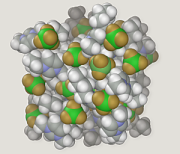
Molecular modelling encompasses all methods, theoretical and computational, used to model or mimic the behaviour of molecules. The methods are used in the fields of computational chemistry, drug design, computational biology and materials science to study molecular systems ranging from small chemical systems to large biological molecules and material assemblies. The simplest calculations can be performed by hand, but inevitably computers are required to perform molecular modelling of any reasonably sized system. The common feature of molecular modelling methods is the atomistic level description of the molecular systems. This may include treating atoms as the smallest individual unit, or explicitly modelling protons and neutrons with its quarks, anti-quarks and gluons and electrons with its photons.
Peter V. Coveney is a Professor of Physical Chemistry and Director, Centre for Computational Science (CCS) at University College London (UCL).
Amsterdam Density Functional (ADF) is a program for first-principles electronic structure calculations that makes use of density functional theory (DFT). ADF was first developed in the early seventies by the group of E. J. Baerends from the Vrije Universiteit in Amsterdam, and by the group of T. Ziegler from the University of Calgary. Nowadays many other academic groups are contributing to the software. Software for Chemistry & Materials (SCM), formerly known as Scientific Computing & Modelling is a spin-off company from the Baerends group. SCM has been coordinating the development and distribution of ADF since 1995. Together with the rise in popularity of DFT in the nineties, ADF has become a popular computational chemistry software package used in the industrial and academic research. ADF excels in spectroscopy, transition metals, and heavy elements problems. A periodic structure counterpart of ADF named BAND is available to study bulk crystals, polymers, and surfaces. The ADF Modeling Suite has expanded beyond DFT since 2010, with a GUI to Stewart's semi-empirical MOPAC code, and the Quantum_ESPRESSO plane wave code, a density-functional based tight binding (DFTB) module, a reactive force field module ReaxFF, and an implementation of Klamt's COSMO-RS method.

Michael Levitt, is an American-British-Israeli biophysicist and a professor of structural biology at Stanford University, a position he has held since 1987. Levitt received the 2013 Nobel Prize in Chemistry, together with Martin Karplus and Arieh Warshel, for "the development of multiscale models for complex chemical systems".

Spartan is a molecular modelling and computational chemistry application from Wavefunction. It contains code for molecular mechanics, semi-empirical methods, ab initio models, density functional models, post-Hartree–Fock models, and thermochemical recipes including G3(MP2) and T1.
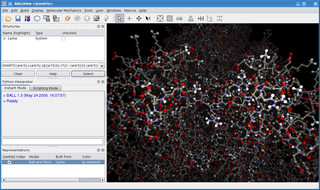
BALL is software consisting of the versatile C++ class framework Biochemical Algorithms Library (BALL), a set of algorithms and data structures for molecular modelling and computational structural bioinformatics, a Python interface to this library, and a graphical user interface to BALL, the molecule viewer BALLView.
Tinker, stylized as TINKER, is a computer software application for molecular dynamics simulation with a complete and general package for molecular mechanics and molecular dynamics, with some special features for biopolymers. The core of the package is a modular set of callable routines which allow manipulating coordinates and evaluating potential energy and derivatives via straightforward means.
This is a list of computer programs that are predominantly used for molecular mechanics calculations.

Arieh Warshel is an Israeli-American biochemist and biophysicist. He is a pioneer in computational studies on functional properties of biological molecules, Distinguished Professor of Chemistry and Biochemistry, and holds the Dana and David Dornsife Chair in Chemistry at the University of Southern California. He received the 2013 Nobel Prize in Chemistry, together with Michael Levitt and Martin Karplus for "the development of multiscale models for complex chemical systems".
Molecular design software is software for molecular modeling, that provides special support for developing molecular models de novo.

Ascalaph Designer is a computer program for general purpose molecular modelling for molecular design and simulations. It provides a graphical environment for the common programs of quantum and classical molecular modelling ORCA, NWChem, Firefly, CP2K and MDynaMix . The molecular mechanics calculations cover model building, energy optimizations and molecular dynamics. Firefly covers a wide range of quantum chemistry methods. Ascalaph Designer is free and open-source software, released under the GNU General Public License, version 2 (GPLv2).
MacroModel is a computer program for molecular modelling of organic compounds and biopolymers. It features various chemistry force fields, plus energy minimizing algorithms, to predict geometry and relative conformational energies of molecules. MacroModel is maintained by Schrödinger, LLC.
Lead Finder software is a computational chemistry application for modeling protein-ligand interactions. Lead Finder can be used in molecular docking studies and for the quantitative evaluation of ligand binding and biological activity. It is free for individual non-commercial academic users.