Related Research Articles

Thomas Alva Edison was an American inventor and businessman. He developed many devices in fields such as electric power generation, mass communication, sound recording, and motion pictures. These inventions, which include the phonograph, the motion picture camera, and early versions of the electric light bulb, have had a widespread impact on the modern industrialized world. He was one of the first inventors to apply the principles of organized science and teamwork to the process of invention, working with many researchers and employees. He established the first industrial research laboratory.

The 1880s was a decade of the Gregorian calendar that began on January 1, 1880, and ended on December 31, 1889.
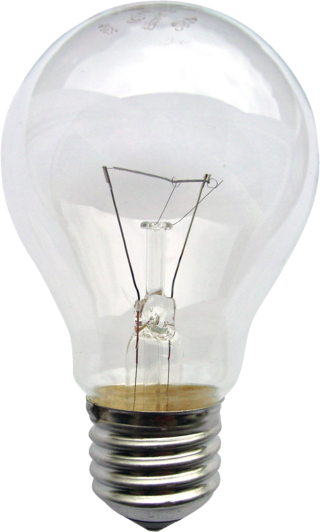
An incandescent light bulb, incandescent lamp or incandescent light globe is an electric light with a filament that is heated until it glows. The filament is enclosed in a glass bulb that is either evacuated or filled with inert gas to protect the filament from oxidation. Electric current is supplied to the filament by terminals or wires embedded in the glass. A bulb socket provides mechanical support and electrical connections.
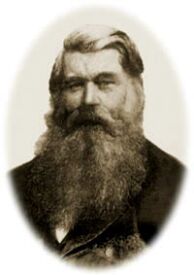
Sir Joseph Wilson Swan FRS was an English physicist, chemist, and inventor. He is known as an independent early developer of a successful incandescent light bulb, and is the person responsible for developing and supplying the first incandescent lights used to illuminate homes and public buildings, including the Savoy Theatre, London, in 1881.

A Yablochkov candle is a type of electric carbon arc lamp, invented in 1876 by the Russian electrical engineer Pavel Yablochkov.

Pavel Nikolayevich Yablochkov was a Russian electrical engineer, businessman and the inventor of the Yablochkov candle and the transformer.

Charles Francis Brush was an American engineer, inventor, entrepreneur, and philanthropist.
Camille Alphonse Faure was a French chemical engineer who in 1881 significantly improved the design of the lead-acid battery, which had been invented by Gaston Planté in 1859. Faure's improvements greatly increased the capacity of such batteries and led directly to their manufacture on an industrial scale. The patents were assigned to the Société La Force et la Lumière. The right to use these patents in the British Isles were sold to the Faure Electric Accumulator Company on 29 March 1881. Faure was a consultant engineer with William Edward Ayrton for this company.

A hydraulic power network is a system of interconnected pipes carrying pressurized liquid used to transmit mechanical power from a power source, like a pump, to hydraulic equipment like lifts or motors. The system is analogous to an electrical grid transmitting power from a generating station to end-users. Only a few hydraulic power transmission networks are still in use; modern hydraulic equipment has a pump built into the machine. In the late 19th century, a hydraulic network might have been used in a factory, with a central steam engine or water turbine driving a pump and a system of high-pressure pipes transmitting power to various machines.

A Gramme machine, Gramme ring, Gramme magneto, or Gramme dynamo is an electrical generator that produces direct current, named for its Belgian inventor, Zénobe Gramme, and was built as either a dynamo or a magneto. It was the first generator to produce power on a commercial scale for industry. Inspired by a machine invented by Antonio Pacinotti in 1860, Gramme was the developer of a new induced rotor in form of a wire-wrapped ring and demonstrated this apparatus to the Academy of Sciences in Paris in 1871. Although popular in 19th century electrical machines, the Gramme winding principle is no longer used since it makes inefficient use of the conductors. The portion of the winding on the interior of the ring cuts no flux and does not contribute to energy conversion in the machine. The winding requires twice the number of turns and twice the number of commutator bars as an equivalent drum-wound armature.
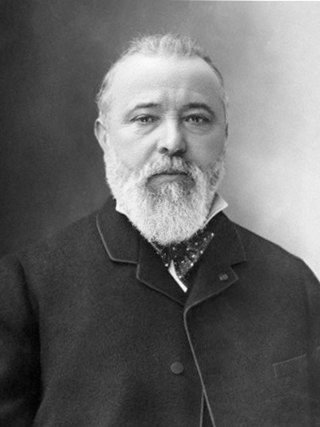
Zénobe Théophile Gramme was a Belgian electrical engineer. He was born at Jehay-Bodegnée on 4 April 1826, the sixth child of Mathieu-Joseph Gramme, and died at Bois-Colombes on 20 January 1901. He invented the Gramme machine, a type of direct current dynamo capable of generating smoother and much higher voltages than the dynamos known to that point.

Henri Owen Tudor was a Luxembourg engineer, inventor, and industrialist. He developed the first commercially usable lead-acid battery.
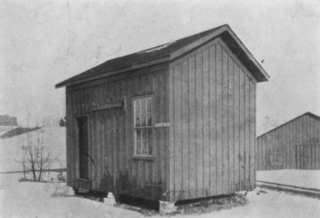
The Vulcan Street Plant was the first Edison hydroelectric central station. The plant was built on the Fox River in Appleton, Wisconsin, and put into operation on September 30, 1882. According to the American Society of Mechanical Engineers, the Vulcan Street plant is considered to be "the first hydro-electric central station to serve a system of private and commercial customers in North America". It is a National Historic Mechanical Engineering Landmark, an IEEE milestone and a National Historic Civil Engineering Landmark.

Anthony Reckenzaun was an electrical engineer who worked in the UK and the United States.
Moritz Immisch was an Electrical engineer, watchmaker and inventor.

Philip H. Diehl was a German-American mechanical engineer and inventor who held several U.S. patents, including electric incandescent lamps, electric motors for sewing machines and other uses, and ceiling fans. Diehl was a contemporary of Thomas Edison and his inventions caused Edison to reduce the price of his incandescent bulb.

Johann Sigmund Schuckert was an electrical engineer and the founder of Schuckert & Co.. He was a pioneer of industrialization in Nuremberg and for the electrical industry a pioneer of international status.
Morgan Brooks was an American inventor, engineer, and academic from Massachusetts. After studying at Brown University and the Stevens Institute of Technology, Brooks worked at the American Bell Telephone Company to implement their copper wire system. He then worked for the Electrical Accumulator Company of Philadelphia before introducing an alternating current lighting system to St. Paul, Minnesota. He founded a successful electrical engineering company, then accepted an offer of department chair at the University of Nebraska. After three years, he moved on to the University of Illinois, where he spent the rest of his career.

Sidney Howe Short was an electrical engineer, inventor, physicist, professor and businessman. He is known for the development of electric motors and electric railway equipment. His inventions were so successful that even his competitors dubbed him "The Trolley King". He also developed telephone equipment much like that of Alexander Graham Bell. As a businessman he was president, key engineer, or advisor of different companies related to electrical equipment. It is claimed that he had nearly as many electrical innovations as Thomas Edison.
The Faure Electric Accumulator Company (FEAC) was a company founded in 1881 in London to supply electric batteries suitable for lighting and other purposes. It took its name from the French chemical engineer Camille Alphonse Faure. Lord Kelvin wrote a favourable review for Faure's new battery design that appeared in The Times. However he did not play a formal role in the company.
References
- 1 2 "Radcliffe Ward - Graces Guide". www.gracesguide.co.uk. Grace's Guide Ltd. Retrieved 24 September 2020.
- 1 2 "Experiments With The Electric Light At Liverpool". The Electrician (1 March 1879). 1879.
- ↑ "The Faure Electric Accumulator Company". The Railway News . No. 4 March 1882. 1882.
 | This article about an engineer, inventor or industrial designer from England is a stub. You can help Wikipedia by expanding it. |