
The Sega CD, known as Mega-CD in most regions outside North America and Brazil, is a CD-ROM accessory for the Sega Genesis produced by Sega as part of the fourth generation of video game consoles. It was released on December 12, 1991, in Japan, October 15, 1992, in North America, and April 2, 1993, in Europe. The Sega CD plays CD games and adds hardware functionality such as a faster CPU and graphic enhancements such as sprite scaling and rotation. It can also play audio CDs and CD+G discs.

The 3DO Interactive Multiplayer, also referred to as simply 3DO, is a home video game console developed by The 3DO Company. Conceived by entrepreneur and Electronic Arts founder Trip Hawkins, the 3DO was not a console manufactured by the company itself, but a set of specifications, originally designed by Dave Needle and RJ Mical of New Technologies Group, that could be licensed by third parties. Panasonic produced the first models in 1993, and further renditions of the hardware were released afterwards by GoldStar, Sanyo, Creative Labs, and Samsung Electronics in 1997.

The Master System is an 8-bit third-generation home video game console manufactured and developed by Sega. It was originally a remodeled export version of the Sega Mark III, the third iteration of the SG-1000 series of consoles, which was released in Japan in 1985 with graphical capabilities over its predecessors. The Master System launched in North America in 1986, followed by Europe in 1987, and then in Brazil and Korea in 1989. A Japanese version of the Master System was also launched in 1987, which features a few enhancements over the export models : a built-in FM audio chip, a rapid-fire switch, and a dedicated port for the 3D glasses. The Master System II, a cheaper model, was released in 1990 in North America, Australasia and Europe.
Jaleco Ltd. was a corporate brand name that was used by two previously connected video game developers and publishers based in Japan. The original Jaleco company was founded in 1974 as Japan Leisure Company, founded by Yoshiaki Kanazawa, before being renamed to simply Jaleco in the early 1980s. This company was later acquired in 2000 by PCCW, who rebranded it as their Japanese game division, PCCW Japan, before reverting it to Jaleco in 2002. In 2006, Jaleco became independent from PCCW and renamed to Jaleco Holding, having their video game operations spun off into a new company, also called Jaleco. This new spin-off company was sold to mobile developer Game Yarou in 2009, with Jaleco Holding renaming itself to Encom Holdings shortly after.
In the history of video games, the fourth generation of video game consoles, more commonly referred to as the 16-bit era, began on October 30, 1987, with the Japanese release of NEC Home Electronics' PC Engine. Though NEC released the first console of this era, sales were mostly dominated by the rivalry between Sega and Nintendo across most markets: the Sega Mega Drive and the Super Nintendo Entertainment System. Cartridge-based handheld consoles became prominent during this time, such as the Nintendo Game Boy (1989), Atari Lynx (1989), Sega Game Gear (1990) and TurboExpress (1990).
Sega Meganet, also known as the Net Work System, was an online service for the Mega Drive in Japan and later Brazil. Utilizing dial-up Internet access, Meganet was Sega's first online multiplayer gaming service, and functioned on a pay to play basis. The system functioned through the use of a peripheral called the Mega Modem and offered several unique titles that could be downloaded, and a few could be played competitively with friends. In addition, it shared technology and equipment with more serious services such as the Mega Anser, used for banking purposes. Though the system was announced for North America under the rebranded name "Tele-Genesis", it was never released for that region. Ultimately, the Meganet service would be short-lived, lasting approximately a year before it was discontinued, but would serve as a precursor to the Sega Channel and XBAND services, as well as a predecessor to online gaming services for video game consoles. Retrospective feedback praises the attempt by Sega to introduce online gaming, but criticizes the service for its logistical issues and lack of titles.
Ocean Software Ltd was a British software development company that became one of the biggest European video game developers and publishers of the 1980s and 1990s.
1992 saw many sequels and prequels in video games, such as Dragon Quest V, Final Fantasy V, Sonic the Hedgehog 2, Street Fighter II: Champion Edition, Super Mario Land 2: 6 Golden Coins, and Super Mario Kart, along with new titles such as Art of Fighting, Lethal Enforcers, Mortal Kombat and Virtua Racing.
Technosoft was a Japanese video game developer and publisher based headquartered in Sasebo, Nagasaki. Also known as "Tecno Soft", the company was founded in February 1980 as Sasebo Microcomputer Center, before changing its name to Technosoft in 1982. The company primarily dealt with software for Japanese personal computers, including graphic toolsets and image processing software. Technosoft's first venture into the video game market was Snake & Snake, released in 1982, before seeing success with titles such as Thunder Force (1983) and Plasma Line (1984).
Sony Imagesoft Inc. was an American video game publisher that operated from 1989 to 1995 and was located in California. It was established in January 1989 in Los Angeles, California, as a subsidiary of the Japan-based CBS/Sony Group (CSG) and initially named CSG Imagesoft Inc. Their focus at the beginning was on marketing games exclusively for Nintendo consoles.

The Sega Genesis, also known as the Mega Drive outside North America, is a 16-bit fourth generation home video game console developed and sold by Sega. It was Sega's third console and the successor to the Master System. Sega released it in 1988 in Japan as the Mega Drive, and in 1989 in North America as the Genesis. In 1990, it was distributed as the Mega Drive by Virgin Mastertronic in Europe, Ozisoft in Australasia, and Tectoy in Brazil. In South Korea, it was distributed by Samsung Electronics as the Super Gam*Boy and later the Super Aladdin Boy.
ADK Corporation, formerly known as Alpha Denshi Corporation (アルファ電子株式会社), was a Japanese video game developer founded in 1980. ADK began as a developer of arcade games and is best known for their library of SNK Neo Geo titles, including for its home consoles, produced in partnership with SNK. Most notable among these are their fighting games and, in particular, the World Heroes series and Aggressors of Dark Kombat. The company closed with properties sold to SNK Playmore in 2003.
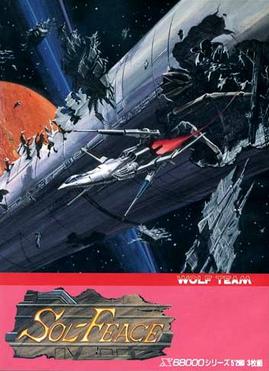
Sol-Feace is a 1990 horizontal-scrolling shooter video game developed by Wolf Team and published by Telenet Japan for the Sharp X68000 computer. Versions for the Sega CD and Sega Genesis were released later on, the latter renaming the game Sol-Deace. The player takes control of the titular starship as it must prevent a malfunctioning supercomputer from enslaving all of mankind. Gameplay involves shooting down enemies and avoiding projectiles, while collecting power capsules to increase the Sol-Feace's abilities. The Sol-Feace also has dual cannons that can fire shots diagonally.
The 1990s was the third decade in the industry's history. It was a decade of marked innovation in video gaming. It was a decade of transition from sprite-based graphics to full-fledged 3D graphics and it gave rise to several genres of video games including, but not limited to, the first-person shooter, real-time strategy, survival horror, and MMO. Arcade games, although still very popular in the early 1990s, began to decline as home consoles became more common. The fourth and fifth generation of video game consoles went on sale, including the Sega Genesis, Super Nintendo, Sega Saturn, PlayStation, Nintendo 64, and Game Boy Color. Notable games released in the 1990s included Super Mario World, Sonic the Hedgehog, Street Fighter II, Mortal Kombat, Killer Instinct, Tekken,Doom, Wolfenstein 3D, Quake, Duke Nukem 3D, Final Fantasy VII, Unreal Tournament, Star Fox, Half-Life, Grand Theft Auto, Super Mario 64, Pokémon Red and Blue, NBA Jam,Daytona USA, GoldenEye 007, System Shock 2, Civilization,Ridge Racer, Sonic Adventure, Gran Turismo, Super Mario Kart, Pokémon Gold and Silver,Castlevania: Symphony of the Night, Super Metroid, Silent Hill, The Legend of Zelda: Ocarina of Time, Crash Bandicoot, Spyro The Dragon, Fallout, Metal Gear Solid, Diablo, Virtua Fighter, Tomb Raider,Sega Rally Championship, Wing Commander,Super Smash Bros, Secret of Mana,Thief: The Dark Project, Age of Empires, Nights into Dreams, Panzer Dragoon, Gunstar Heroes, EverQuest, Chrono Trigger, Battletoads, Worms, Micro Machines, Streets of Rage 2,Baldur's Gate,Donkey Kong Country, Wipeout, The Legend of Zelda: A Link to the Past,Lemmings, EarthBound, StarCraft, Banjo-Kazooie, PaRappa the Rapper, Resident Evil, Tony Hawk's Pro Skater, Soulcalibur, Command & Conquer, and Dance Dance Revolution.
Nihon Bussan Co. Ltd. was a Japanese video game developer and publisher headquartered in Kita, Osaka. In the past they had also manufactured and sold yachts.
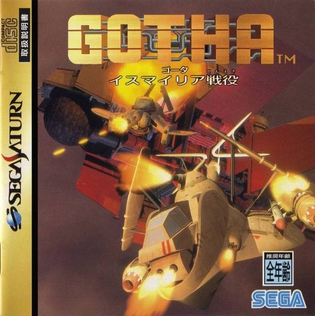
Gotha: Ismailia Seneki is a 1995 turn-based strategy video game developed by Micronet and published by Sega exclusively in Japan for the Sega Saturn. The game was followed by the sequels Heir of Zendor: The Legend and The Land in 1996 and Soukuu no Tsubasa: Gotha World in 1997.
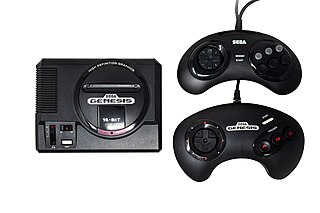
The Sega Genesis Mini, known as the Mega Drive Mini in regions outside of North America, is a dedicated console modeled on the Sega Genesis. The Mini emulates the original console's 16-bit hardware, and includes 42 games made available through emulation software by M2. It was released in North America and Japan in September 2019 and in Europe and the Middle East in October 2019. A follow-up, Sega Genesis Mini 2, was released in October 2022 and includes 60 games from the Genesis and Sega CD.
In the video game industry, a console war describes the competition between two or more video game console manufacturers in trying to achieve better consumer sales through more advanced console technology, an improved selection of video games, and general marketing around their consoles. While console manufacturers are generally always trying to out-perform other manufacturers in sales, these console wars engage in more direct tactics to compare their offerings directly against their competitors or to disparage the competition in contrast to their own, and thus the marketing efforts have tended to escalate in back-and-forth pushes.
