
Major-General Robert Clive, 1st Baron Clive,, also known as Clive of India, was the first British Governor of the Bengal Presidency. Clive has been widely credited for laying the foundation of the British East India Company rule in Bengal. He began as a writer for the East India Company (EIC) in 1744 and established Company rule in Bengal by winning the Battle of Plassey in 1757. In return for supporting the Nawab Mir Jafar as ruler of Bengal, Clive was granted a jagir of £30,000 per year which was the rent the EIC would otherwise pay to the Nawab for their tax-farming concession. When Clive left India he had a fortune of £180,000 which he remitted through the Dutch East India Company.

Lieutenant-General Sir Eyre Coote, KB was a British soldier and politician who sat in the House of Commons from 1768 to 1780. He is best known for his many years of service with the British Army in India. His victory at the Battle of Wandiwash is considered a decisive turning point in the struggle for control in India between Britain and France. He was known by his sepoy troops as Coote Bahadur.

The Battle of Plassey was a decisive victory of the British East India Company over the Nawab of Bengal and his French allies on 23 June 1757, under the leadership of Robert Clive. The victory was made possible by the defection of Mir Jafar, who was Nawab Siraj-ud-Daulah's commander in chief. The battle helped the British East India Company take control of Bengal. Over the next hundred years, they seized control of most of the rest of the Indian subcontinent, Burma, and Afghanistan.
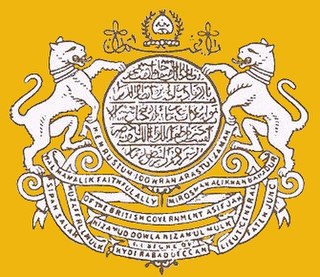
The Nizams were the rulers of Hyderabad from 18th-through-20th-century. Nizam of Hyderabad was the title of the monarch of the Hyderabad State. Nizam, shortened from Nizam-ul-Mulk, meaning Administrator of the Realm, was the title inherited by Asaf Jah I. He was the former Naib (suzerain) of the Great Mughal in the Deccan, the premier courtier of Mughal India until 1724, the founding of an independent monarchy as the "Nizam (title) of Hyderabad".

Shah Alam II, also known by his birth name Ali Gohar, was the seventeenth Mughal Emperor and the son of Alamgir II. Shah Alam II became the emperor of a crumbling Mughal empire. His power was so depleted during his reign that it led to a saying in the Persian language, Sultanat-e-Shah Alam, Az Dilli ta Palam, meaning, 'The empire of Shah Alam is from Delhi to Palam', Palam being a suburb of Delhi.

The siege of Seringapatam was the final confrontation of the Fourth Anglo-Mysore War between the British East India Company and the Kingdom of Mysore. The British, with the allied Nizam of Hyderabad and Marathas, achieved a decisive victory after breaching the walls of the fortress at Seringapatam and storming the citadel. The leader of the British troops was Major General David Baird, among the lesser known allies were the Portuguese in Goa and Damaon. Tipu Sultan, the de-facto ruler after the death of his father, who had usurped the throne of Mysore, was killed in the action. The British restored the Wodeyar dynasty back to power after the victory through a treaty of subsidiary alliance, Krishnaraja Wodeyar III was crowned the King of Mysore. However, they retained indirect control of the kingdom's external affairs.

The Qadiriyya are members of the Sunni Qadiri tariqa. The tariqa got its name from Abdul Qadir Gilani, who was a Hanbali scholar from Gilan, Iran. The order relies strongly upon adherence to the fundamentals of Sunni Islamic law.

The Battle of Miani was a battle between forces of the Bombay Army of the East India Company, under the command of Charles Napier and the Baluch army of Talpur Amirs of Sindh, led by Mir Nasir Khan Talpur. The battle took place on 17 February 1843 at Miani, Sindh, in what is now modern-day Pakistan. This battle and the subsequent battle of Hyderabad eventually led to the capture of parts of Sindh region, first territorial possession by the East India Company in what is the modern-day state of Pakistan.

Sayyid Mīr Jaʿfar ʿAlī Khān Bahādur was a military general who became the first dependent Nawab of Bengal of the British East India Company. His reign has been considered by many historians as the start of the expansion of British control of the Indian subcontinent in Indian history and a key step in the eventual British domination of vast areas of pre-partition India.

Mir Nizam Ali Khan Siddiqi, Asaf Jah II was the 2nd Nizam of Hyderabad State in South India between 1762 and 1803. He was born on 7 March 1734 as fourth son to Asaf Jah I and Umda Begum. His official name is Asaf Jah II, Nizam ul-Mulk, Nizam ud-Daula, Nawab Mir Nizam 'Ali Khan Siddiqi, Fateh Jang, Sipah Salar, Nawab Subedar of the Deccan. Sawānih-i-Deccan, a Persian work compiled by Munim Khan, a military commander during the era of Asaf Jah II gave more insight about administration of Asaf Jahis.

The State of Khairpur, also transliterated as Khayrpur, was a princely state of British India on the Indus River in northern Sindh, modern Pakistan, with its capital city at Khairpur. It was established as capital for the Sohrabani branch of the Talpur dynasty, and was established shortly after Talpur ascendency in 1783 as one of several Talpur dominions. Whereas the other Talpur dominions were conquered by the British in 1843, the Khairpur state entered into treaty with the British, thereby maintaining some of its autonomy as a princely state. The last Mir of Khairpur opted to join the new state of Pakistan in 1947, and the dominion was thus made a Princely state of Pakistan, until it was fully amalgamated into West Pakistan in 1955.

Mir Qasim was the Nawab of Bengal from 1760 to 1763. He was installed as Nawab with the support of the British East India Company, replacing Mir Jafar, his father-in-law, who had himself been supported earlier by the East India Company after his role in winning the Battle of Plassey for the British. However, Mir Jafar eventually ran into disputes with the East India Company and attempted to form an alliance with the Dutch East India Company instead. The British eventually defeated the Dutch at Chinsura and overthrew Mir Jafar, replacing him with Mir Qasim. Qasim later fell out with the British and fought against them at Buxar. His defeat has been suggested as a key reason in the British becoming the dominant power in large parts of North and East India.

Najib ad-Dawlah, also known as Najib Khan Yousafzai, was a Rohilla Yousafzai Afghan who earlier served as a Mughal serviceman but later deserted the cause of the Mughals and joined Ahmed Shah Abdali in 1757 in his attack on Delhi. He was also a House chief of Rohilkhand, and in the 1740s founded the city of Najibabad in Bijnor district, India. He was instrumental in winning the Third Battle of Panipat.

The Battle of Jersey took place on 6 January 1781 when French forces during the American Revolutionary War unsuccessfully invaded the British-ruled island of Jersey to remove the threat it posed to French and American shipping. Jersey provided a base for British privateers, and France was engaged in the war as an ally of the newly created United States.
The Asaf Jahi was a Muslim dynasty that ruled the Kingdom of Hyderabad. The family came to India in the late 17th century and became employees of the Mughal Empire. They were great patrons of Persian culture, language, and literature, the family found a ready patronage.

Mir Jumla II was a prominent subahdar of Bengal under the Mughal Emperor Aurangzeb.
The Battle of Rakshasbhuvan in India was fought on 10 August 1763. After the defeat of the Marathas at the Battle of Panipat, their rivals started seizing the opportunity to recover their losses in the past at the hands of Marathas. Particularly, the Nizam of Hyderabad wanted to recover territory he had lost at the Battle of Udgir where all of his dukes and earls were killed. He decided to launch a war on the Marathas.
The Death of Major Peirson, 6 January 1781 is a 1783 large oil painting by John Singleton Copley. It depicts the death of Major Francis Peirson at the Battle of Jersey on 6 January 1781.

Philipe Charles Félix Macquart, Baron de Rullecourt was a French soldier who became a general of the Kingdom of France. In 1781, he was mortally wounded commanding the attempted invasion of Jersey at the Battle of Jersey.
Bengal War, Campaign for the Eastern Subah's, was waged by the Mughal imperial crown Prince Ali Gauhar so as to recapture the Nawab of Bengal from the British East India Company. Hostilities began in 1756 and ended in 1765.

