
Moy or MOY may refer to:
Moy or MOY may refer to:


The Highlands is a historical region of Scotland. Culturally, the Highlands and the Lowlands diverged from the Late Middle Ages into the modern period, when Lowland Scots language replaced Scottish Gaelic throughout most of the Lowlands. The term is also used for the area north and west of the Highland Boundary Fault, although the exact boundaries are not clearly defined, particularly to the east. The Great Glen divides the Grampian Mountains to the southeast from the Northwest Highlands. The Scottish Gaelic name of A' Ghàidhealtachd literally means "the place of the Gaels" and traditionally, from a Gaelic-speaking point of view, includes both the Western Isles and the Highlands.

Inverness is a city in the Scottish Highlands, having been granted city status in 2000. It is the administrative centre for The Highland Council and is regarded as the capital of the Highlands.

Glencoe or Glencoe Village is the main settlement in Glen Coe in the Lochaber area of the Scottish Highlands. It lies at the north-west end of the glen, on the southern bank of the River Coe where it enters Loch Leven.
Calder may refer to:
Campbell may refer to:
Highland is a broad term for areas of higher elevation, such as a mountain range or mountainous plateau.
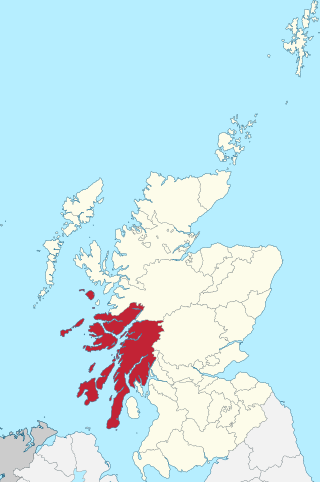
Argyll, sometimes called Argyllshire, is a historic county and registration county of western Scotland.
Ross or ROSS may refer to:
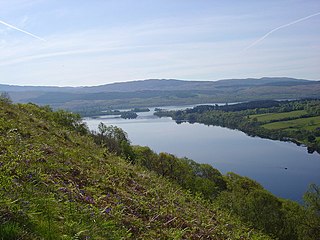
Loch Awe is a large body of freshwater in Argyll and Bute, Scottish Highlands. It has also given its name to a village on its banks, variously known as Loch Awe or Lochawe. There are islands within the loch such as Innis Chonnell and Inishail.
Glen Coe is a glen of volcanic origins, in the Highlands of Scotland. It lies in the north of the county of Argyll, close to the border with the historic province of Lochaber, within the modern council area of Highland. Glen Coe is regarded as the home of Scottish mountaineering and is popular with hillwalkers and climbers.

Clan Maclaine of Lochbuie is a Scottish Clan that inhabited lands on the southern end of the Isle of Mull in the Inner Hebrides of the western Scottish Highlands. "Maclaine" is an alternate spelling for "MacLean." Clan Maclaine of Lochbuie and Clan Maclean of Duart are two separate clans. However, the two clans share a strong family connection. The 26th clan chief is Lorne Gillean Ian Maclaine of Lochbuie, Baron of Moy. The clan is recognized by both the Standing Council of Scottish Chiefs and the Lord Lyon.

Loch Garry is a freshwater loch 25 km north of Fort William, Lochaber, Scotland. Loch Garry is 11 km long and 50 m deep. It is fed by waters from Loch Quoich 10 km upstream on the River Garry, and drains into Loch Oich in the Great Glen just 5 km downstream. Loch Garry is much photographed from the A87 for its romantic setting and also because a quirk of perspective makes it appear like a map of Scotland.
Ness or NESS may refer to:

Drumnadrochit is a village in the Highland local government council area of Scotland, lying near the west shore of Loch Ness at the foot of Glen Urquhart. The village is close to several neighbouring settlements: the villages of Milton to the west, Kilmore to the east and Lewiston to the south. The villages act as a centre for regional tourism beside Loch Ness, as well as being a local economic hub for the nearby communities.
Urquhart may refer to:

Clan MacIntyre (McIntyre) is a Highland Scottish clan. The name MacIntyre, means "son of the carpenter.” It is most commonly said to descend from Maurice Mac Neil a nephew of Somerled, the great 12th century leader of the Scottish Gaels. Through an ingenious strategy, Maurice secured the marriage of Somerled to the daughter of the King of Mann and the Isles, thus greatly increasing Somerled's territories. At an unknown date the clan journeyed from the Hebrides to the Scottish mainland where the chiefs established their home at Glen Noe, in Ardchattan Parish, on the east side of Loch Etive.
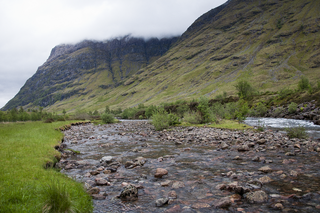
The River Coe rises at the north-eastern base of Buachaille Etive Beag in Scotland and flows west along Glen Coe. After dramatic waterfalls at the Pass of Glen Coe, it runs through the small Loch Achtriochtan before it turns north west. It then runs past the site of the Massacre of Glencoe and passes through Glencoe village, shortly before flowing into the sea loch of Loch Leven at Invercoe.

Boreraig is a deserted township in Strath Swordale on the north shore of Loch Eishort in the parish of Strath, Isle of Skye, Scotland.

Loch Ness is a large freshwater loch in the Scottish Highlands extending for approximately 37 kilometres southwest of Inverness. It takes its name from the River Ness, which flows from the northern end. Loch Ness is best known for claimed sightings of the cryptozoological Loch Ness Monster, also known affectionately as "Nessie". It is one of a series of interconnected, murky bodies of water in Scotland; its water visibility is exceptionally low due to the high peat content of the surrounding soil. The southern end connects to Loch Oich by the River Oich and a section of the Caledonian Canal. The northern end connects to Loch Dochfour via the River Ness, which then ultimately leads to the North Sea via the Moray Firth.

Clan MacPhail or the Sons of Paul is a Scottish clan of the Scottish Highlands. Known in Scottish Gaelic as Conchie Dhu or Condochy Doye, the clan is mainly associated with the confederation of Clan Chattan.