In computing, a file server is a computer attached to a network that provides a location for shared disk access, i.e. storage of computer files that can be accessed by the workstations that are able to reach the computer that shares the access through a computer network. The term server highlights the role of the machine in the traditional client–server scheme, where the clients are the workstations using the storage. A file server does not normally perform computational tasks or run programs on behalf of its client workstations.
Network File System (NFS) is a distributed file system protocol originally developed by Sun Microsystems (Sun) in 1984, allowing a user on a client computer to access files over a computer network much like local storage is accessed. NFS, like many other protocols, builds on the Open Network Computing Remote Procedure Call system. NFS is an open IETF standard defined in a Request for Comments (RFC), allowing anyone to implement the protocol.

Network-attached storage (NAS) is a file-level computer data storage server connected to a computer network providing data access to a heterogeneous group of clients. The term "NAS" can refer to both the technology and systems involved, or a specialized device built for such functionality.
NetApp, Inc. is an American hybrid cloud data services and data management company headquartered in San Jose, California. It has ranked in the Fortune 500 from 2012–2021. Founded in 1992 with an IPO in 1995, NetApp offers cloud data services for management of applications and data both online and physically.

A diskless node is a workstation or personal computer without disk drives, which employs network booting to load its operating system from a server.
EMC NetWorker is an enterprise-level data protection software product from Dell EMC that unifies and automates backup to tape, disk-based, and flash-based storage media across physical and virtual environments for granular and disaster recovery.
Gluster Inc. was a software company that provided an open source platform for scale-out public and private cloud storage. The company was privately funded and headquartered in Sunnyvale, California, with an engineering center in Bangalore, India. Gluster was funded by Nexus Venture Partners and Index Ventures. Gluster was acquired by Red Hat on October 7, 2011.

Dell EMC Isilon is a scale out network-attached storage platform offered by Dell EMC for high-volume storage, backup and archiving of unstructured data. It provides a cluster-based storage array based on industry standard hardware, and is scalable to 50 petabytes in a single filesystem using its FreeBSD-derived OneFS file system.
A clustered file system is a file system which is shared by being simultaneously mounted on multiple servers. There are several approaches to clustering, most of which do not employ a clustered file system. Clustered file systems can provide features like location-independent addressing and redundancy which improve reliability or reduce the complexity of the other parts of the cluster. Parallel file systems are a type of clustered file system that spread data across multiple storage nodes, usually for redundancy or performance.
Panasas is a data storage company that creates network-attached storage for technical computing environments.
Scale out File Services (SoFS) is a highly scalable, grid-based NAS implementation developed by IBM. It is based on IBM's high-performance shared-disk clustered file system Spectrum Scale. SoFS exports the clustered file system through industry standard protocols like SMB, NFS, FTP and HTTP. Released in 2007, SoFS is a second generation file services architecture used within IBM since 2001.
StorNext File System (SNFS), colloquially referred to as "StorNext" is a shared disk file system made by Quantum Corporation. StorNext enables multiple Windows, Linux and Apple workstations to access shared block storage over a Fibre Channel network. With the StorNext file system installed, these computers can read and write to the same storage volume at the same time enabling what is known as a "file-locking SAN." StorNext is used in environments where large files must be shared, and accessed simultaneously by users without network delays, or where a file must be available for access by multiple readers starting at different times. Common use cases include multiple video editor environments in feature film, television and general video post production.
The OneFS File System is a parallel distributed networked file system designed by Isilon Systems and is the basis for the Isilon Scale-out Storage Platform. The OneFS file system is controlled and managed by the OneFS Operating System, a FreeBSD variant.
In computer science, memory virtualization decouples volatile random access memory (RAM) resources from individual systems in the data centre, and then aggregates those resources into a virtualized memory pool available to any computer in the cluster. The memory pool is accessed by the operating system or applications running on top of the operating system. The distributed memory pool can then be utilized as a high-speed cache, a messaging layer, or a large, shared memory resource for a CPU or a GPU application.
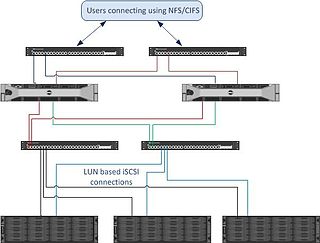
Dell Fluid File System, or FluidFS, is a shared-disk filesystem made by Dell that provides distributed file systems to clients. Customers buy an appliance: a combination of purpose-built network-attached storage (NAS) controllers with integrated primary and backup power supplies attached to block level storage via the iSCSI or Fiber Channel protocol. A single Dell FluidFS appliance consists of two controllers operating in concert connecting to the back-end storage area network (SAN). Depending on the storage capacity requirements and user preference, FluidFS version 4 NAS appliances can be used with Compellent or EqualLogic SAN arrays. The EqualLogic FS7600 and FS7610 connect to the client network and to Dell's EqualLogic arrays with either 1 Gbit/s (FS7600) or 10 Gbit/s (FS7610) iSCSI protocol. For Compellent, FluidFS is available with either 1 Gbit/s or 10 Gbit/s iSCSI connectivity to the client network and connection to the backend Compellent SAN can be either 8 Gbit/s Fibre Channel or 10 Gbit/s iSCSI.
A distributed file system for cloud is a file system that allows many clients to have access to data and supports operations on that data. Each data file may be partitioned into several parts called chunks. Each chunk may be stored on different remote machines, facilitating the parallel execution of applications. Typically, data is stored in files in a hierarchical tree, where the nodes represent directories. There are several ways to share files in a distributed architecture: each solution must be suitable for a certain type of application, depending on how complex the application is. Meanwhile, the security of the system must be ensured. Confidentiality, availability and integrity are the main keys for a secure system.

Dell Technologies PowerFlex, is a commercial software-defined storage product from Dell Technologies that creates a server-based storage area network (SAN) from local server storage using x86 servers. It converts this direct-attached storage into shared block storage than runs over an IP-based network.
Dell EMC Unity is one of Dell EMC’s mid-range storage array product lines. It was designed from the ground up as the next generation midrange unified storage array after the EMC VNX and VNXe series, which evolved out of the EMC Clariion SAN disk array.
ONTAP or Data ONTAP or Clustered Data ONTAP (cDOT) or Data ONTAP 7-Mode is NetApp's proprietary operating system used in storage disk arrays such as NetApp FAS and AFF, ONTAP Select and Cloud Volumes ONTAP. With the release of version 9.0, NetApp decided to simplify the Data ONTAP name and removed word "Data" from it and remove 7-Mode image, therefore, ONTAP 9 is successor from Clustered Data ONTAP 8.

