This article needs additional citations for verification .(February 2013) |
Introduced in 1987, the StingRay 5 (SR5) was the first all-new Music Man bass designed and built in San Luis Obispo by the Ernie Ball team. The five-string's styling is based on the classic look of the Silhouette guitar. Advanced active electronics combine the best of the four-string StingRay along with innovations from Music Man designers, such as an Alnico humbucking pickup and three-way pickup selector for series, single and parallel combinations. The tuners are placed in a 4+1 configuration and the six-bolt on maple neck has a rosewood or maple fingerboard with 22 high-profile wide frets.
In 1991, Pole pieces changed from Alnico to Ceramic
In late 1992, a hum-cancelling "phantom" coil was added for noise reduction in single coil mode of the three-way pickup selector.
In 2005, the StingRay 5 was updated with two humbuckers (HH) or a bridge humbucker paired with a neck single coil pickup (HS) and a five-way pickup switching system. The single humbucker model continues to be in production as well.
In 2006, Music Man released a Limited Edition StingRay 5 featuring a five-bolt neck plate, back-routed controls, string-through body, and an ebony fingerboard. The same year, MusicMan started using compensated nuts on all their bass and guitar models except the Classic series, after having used them for the Music Man Bongo since 2003. [1]
In March 2008, Ernie Ball switched back to AlNiCo pickups for their StingRay 5, after having used ceramic pickups for this model since 1991. The AlNiCo pickups, which are also found in their four-string counterparts, give the instrument a sound more like a StingRay 4. The phantom-coil was also removed (except for the HS model) and the Single-Coil Mode replaced by an Enhanced Parallel setting. This model is replaced by the StingRay 5 Special as of July 2018.
As of 2015 the StingRay 5 is also offered with a through-neck construction. [2]
Specifications StingRay 5
Model : StingRay 5
Size : 13-3/8" wide, 1-3/4" thick, 45-3/4" long (34.0 cm wide, 4.5 cm thick, 116.2 cm long)
Weight : 10 lbs, 0 oz (4.54 kg) - varies slightly
Body Wood : Ash
Body Finish : High gloss polyester
Bridge : Standard - Music Man® chrome plated, hardened steel bridge plate with stainless steel saddles
Scale Length : 34" (86.4 cm)
Neck Radius : 11" (27.9 cm)
Headstock Size : Only 9" (22.9 cm) long
Frets : 22 - High profile, wide
Neck Width : 1-3/4" (44.5 mm) at nut 2-3/4"" (69.9 mm) at last fret
Neck Wood : Select maple neck
Fingerboard : Fretted - maple or rosewood; Fretless - Pau Ferro with or without inlaid fretlines
Neck Finish : Gunstock oil and hand-rubbed special wax blend
Neck Colors : Standard - Natural; Optional - Matching painted headstock
Tuning Machines : Schaller BM, with tapered string posts
Truss Rod : Adjustable - no component or string removal
Neck Attachment : 6 bolts - perfect alignment with no shifting
Electronic Shielding : Graphite acrylic resin coated body cavity and aluminum lined pickguard
Controls : Single Pickup, 3-band active preamp; vol, treble, mid, bass; Dual Pickup, 3-band active preamp; vol, treble, mid, bass
Switching : Single Pickup - 3-way lever pickup selector; Dual Pickup - 5-way lever pickup selector
Pickups : Standard - Music Man® humbucking with Alnico pole pieces; Optional - Dual Humbucking with Alnico pole pieces; Optional - Humbucking/Single coil with Alnico pole pieces
Left Handed : Yes
Strings : 45w-65w-80w-100w-130w (Regular Slinky Bass #2836)

Music Man is an American guitar and bass guitar manufacturer. It is a division of the Ernie Ball corporation. The company is most well-known for its electric and bass guitars. Determined to maintain a reputation for quality, the Music Man company largely produces high-end guitars, especially after being acquired by Ernie Ball in 1984.
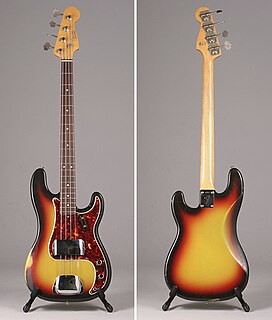
The Fender Precision Bass is a model of electric bass manufactured by Fender Musical Instruments Corporation. In its standard, post-1957 configuration, the Precision Bass is a solid body, four-stringed instrument equipped with a single split-coil humbucking pickup and a one-piece, 20-fret maple neck with rosewood or maple fingerboard.
The Fender Jazz Bass is the second model of electric bass created by Leo Fender. It is distinct from the Precision Bass in that its tone is brighter and richer in the midrange and treble with less emphasis on the fundamental frequency. The body shape is also different from the Precision Bass, in that the Precision Bass has a symmetrical lower bout on the body, designed after the Telecaster and Stratocaster lines of guitars, while the Jazz Bass has an offset lower bout, mimicking the design aesthetic of the Jaguar and Jazzmaster guitars.
The Bongo is a model of bass guitar manufactured by Music Man, a division of Ernie Ball. It was first introduced at the NAMM Show on March 21, 2003. Ernie Ball president Sterling Ball designed the instrument in conjunction with the Music Man Research and Development department and BMW's Designworks team. It is equipped with an 18-volt 4-band preamp designed by Dudley Gimpel with help from Cliff Hugo and other Music Man artists. It also sports a sleek, carved basswood body with high-gloss polyester finish and a satin-finish painted 34" scale maple neck with rosewood fingerboard featuring 24 high-profile wide frets and crescent moon-shaped position inlays. These basses are generally known for their dual humbucking pickup configuration, as they are the first twin humbucker-equipped models released by Music Man since the introduction of their Sabre and Cutlass bass guitars in the late 1970s.
The Fender Lead Series was produced by the Fender/Rogers/Rhodes Division of CBS Musical Instruments. The series comprised Lead I, Lead II, Lead III and Lead Bass models.
The Squier '51 is an electric guitar made by Squier, a subsidiary of Fender. The '51 is notable for being one of the few original designs made by Squier, which normally manufactures less expensive authorized copies of Fender's popular guitars and bass guitars.
The Jackson Dinky is a Superstrat-style double-cutaway electric guitar built by Jackson Guitars. The "Dinky" is named for its slightly smaller than normal (7/8) body size. Usually fitted with a two humbucker pickup configuration, some models also include single-coil pickups and/or just one bridge humbucker. The fretboard can be made out of ebony, rosewood and more recently maple, or rock maple, with 24 jumbo frets and is always built with a bolt-on neck. Most of the guitars have a Floyd Rose original or licensed tremolo, and a locking nut to help maintain stable tuning. Some Dinkys have hardtail, or String-Thru bridges. The Jackson Dinky is usually preferred by players of hard rock and heavy metal.
The Fender Jaguar Bass is an electric bass guitar manufactured in Japan and China by the Fender Musical Instruments Corporation.
The Gibson L9-S Ripper is a model of electric bass guitar made by Gibson Guitar Corporation.
The Fender Katana is an electric guitar built by Fender. It was designed by marketing director Dan Smith in 1985. The Katana was designed to compete with the unconventionally-shaped guitars of the era, such as the Jackson Randy Rhoads, and to satisfy Fender dealers who were suffering from the competition those instruments offered. The Katana did not sell as well as Fender hoped, and it was discontinued in 1986 before being reissued as a Masterbuilt Custom Shop model as part of the Prestige collection three decades later.
The Music Man Sterling is a model of bass guitar designed by the Music Man company. Production for the model began in July 1993 though a series of pre-launch prototype models date back as far as March, 1993. It was named after Sterling Ball, son of Ernie Ball, the founder of the parent company, and intended to be a four-string model that incorporated innovations from the highly popular StingRay 5.
The Gibson L6-S is a solid body electric guitar. It was the descendant of the L5S jazz solid-body electric guitar. It was the same shape, very much like a wide Gibson Les Paul, but with a 24-fret two-octave neck, the first Gibson guitar to have this.
The Gibson Les Paul Custom is a higher-end variation of the Gibson Les Paul guitar. It was developed in 1953 after Gibson had introduced the Les Paul model in 1952.
The Fender Bullet was an electric guitar originally designed by John Page and manufactured and marketed by the Fender Musical Instruments Corporation. It was first introduced as a line of "student" guitars to replace the outgoing Mustang and Musicmaster models.
The Fender Elite Stratocaster is an electric solid body guitar that was manufactured by Fender in 1983 and 1984. The name was revived from 2016 to 2019 with the Fender American Elite Stratocaster Series.
The Jazz Bass V is the five string (extended-range) version of the Fender Jazz Bass. It comes in several different versions, with active or passive pickups.
The Yamaha Corporation is a multinational corporation and conglomerate based in Japan with a wide range of products and services, predominantly musical instruments, motorcycles, power sports equipment and electronics.
The Fender Telecaster, colloquially known as the Tele, is the world's first mass-produced, commercially successful solid-body electric guitar. Its simple yet effective design and revolutionary sound broke ground and set trends in electric guitar manufacturing and popular music. Introduced for national distribution as the Broadcaster in the autumn of 1950 as a two-pickup version of its sister model, the single-pickup Esquire, the pair were the first guitars of their kind manufactured on a substantial scale. A trademark conflict with a rival manufacturer's led to the guitar being renamed in 1951. Initially, the Broadcaster name was simply cut off of the labels placed on the guitars and later in 1951, the final name of Telecaster was applied to the guitar to take advantage of the advent of television. The Telecaster quickly became a popular model, and has remained in continuous production since its first incarnation.
The Music Man Sabre was an electric guitar manufactured by Music Man from 1978 until 1980. It came in two versions, the I and the II, that were identical other than the necks. The neck on the I had a 12” fretboard radius and standard size frets, while the II had a 7.5” fretboard radius and smaller, vintage style frets.