Related Research Articles

The Brooklyn Historic Railway Association (BHRA) is a 501(c)(3) nonprofit organization with a shop, trolley barn and offices located in Red Hook, Brooklyn, New York, on the historic Beard Street Piers. BHRA had a fleet of 16 trolleys.
The Panama Canal Railway is a railway line linking the Atlantic Ocean to the Pacific Ocean in Central America. The route stretches 47.6 miles (76.6 km) across the Isthmus of Panama from Colón (Atlantic) to Balboa. Because of the difficult physical conditions of the route and state of technology, the construction was renowned as an international engineering achievement, one that cost US$8 million and the lives of an estimated 5,000 to 10,000 workers. Opened in 1855, the railway preceded the Panama Canal by half a century; the railway was vital in assisting the construction of the canal in the early 1900s. With the opening of the canal, the railroad's route was changed as a result of the creation of Gatun Lake, which flooded part of the original route. Following World War II, the railroad's importance declined and much of it fell into a state of neglect until 1998, when a project to rebuild the railroad to haul intermodal traffic began; the new railroad opened in 2001.

A railroad tie, crosstie, railway tie or railway sleeper is a rectangular support for the rails in railroad tracks. Generally laid perpendicular to the rails, ties transfer loads to the track ballast and subgrade, hold the rails upright and keep them spaced to the correct gauge.

A fireboat or fire-float is a specialized watercraft with pumps and nozzles designed for fighting shoreline and shipboard fires. The first fireboats, dating to the late 18th century, were tugboats, retrofitted with firefighting equipment. Older designs derived from tugboats and modern fireboats more closely resembling seafaring ships can both be found in service today. Some departments would give their multi-purpose craft the title of "fireboat" also.

The North Eastern Railway (NER) was an English railway company. It was incorporated in 1854 by the combination of several existing railway companies. Later, it was amalgamated with other railways to form the London and North Eastern Railway at the Grouping in 1923. Its main line survives to the present day as part of the East Coast Main Line between London and Edinburgh.
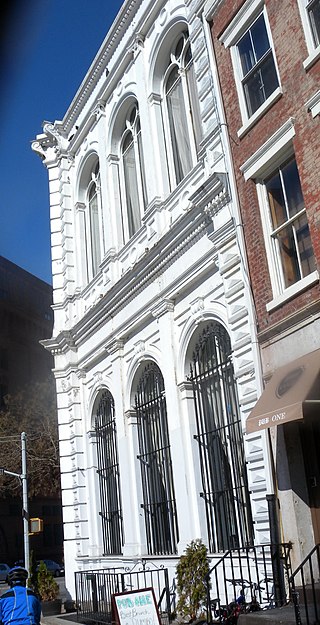
Fulton Ferry is a small area adjacent to Dumbo in the New York City borough of Brooklyn. The neighborhood is named for the Fulton Ferry, a prominent ferry line that crossed the East River between Manhattan and Brooklyn, and is also the name of the ferry slip on the Brooklyn side. The neighborhood is part of Brooklyn Community District 2.

Norris Roy ("Buck") Crump, was a Canadian businessman, who was chairman and president of the Canadian Pacific Railway (CPR). He was primarily responsible for converting the railroad to diesel locomotives, and expanded the company into non-transportation sectors.

This is a list of the earliest railroads in North America, including various railroad-like precursors to the general modern form of a company or government agency operating locomotive-drawn trains on metal tracks.

New York New Jersey Rail, LLC is a switching and terminal railroad that operates the only car float operation across Upper New York Bay between Jersey City, New Jersey and Brooklyn, New York. Since mid-November 2008, it has been owned by the Port Authority of New York and New Jersey, which acquired it for about $16 million as a step in a process that might see a Cross-Harbor Rail Tunnel completed.
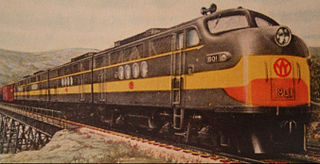
The New York, Ontario and Western Railway, commonly known as the O&W or NYO&W, was a regional railroad founded in 1868. The last train ran from Norwich, New York, to Middletown, New York, in 1957, after which it was ordered liquidated by a U.S. bankruptcy judge. It was the first Class I U.S. railroad to be abandoned in its entirety.

The United Townships of Dysart, Dudley, Harcourt, Guilford, Harburn, Bruton, Havelock, Eyre and Clyde, commonly known as the Municipality of Dysart et al, is a municipality in Haliburton County in Central Ontario, Canada. The original townships were of the Canadian Land and Emigration Company.

Streetcars or trolley(car)s were once the chief mode of public transit in hundreds of North American cities and towns. Most of the original urban streetcar systems were either dismantled in the mid-20th century or converted to other modes of operation, such as light rail. Today, only Toronto still operates a streetcar network essentially unchanged in layout and mode of operation.

Greenport is the terminus of the Main Line of the Long Island Rail Road. It is officially located at Wiggins Street and Fourth Street in the Village of Greenport, New York, although the property spans as far east as 3rd Street and the Shelter Island North Ferry terminal.

Datong–Qinhuangdao railway or Daqin railway, also known as the Daqin line, is a 653 km coal-transport railway in north China. Its name is derived from its two terminal cities, Datong, a coal mining center in Shanxi province, and Qinhuangdao in Hebei province, on the Bohai Sea.
The Brooklyn Eastern District Terminal was a shortline railroad and marine terminal with its main facilities and administrative offices located on 86–88 Kent Avenue in the Williamsburg section of Brooklyn, New York City.

Loram Maintenance of Way, Inc. is a railroad maintenance equipment and services provider. Loram provides track maintenance services to freight, passenger, and transit railroads worldwide, as well as sells and leases equipment which performs these functions.
Henry Steers was a prominent nineteenth-century American shipbuilder of English descent, and the ancestor of a line of important businessmen in various boatbuilding and maritime construction concerns.

A rail adhesion car or rail adhesion train is a modified vehicle used on a rail adhesion system where the standard equipment does not have locomotives' rail sanding ability. In particular, it may involve tanks and dispensing equipment installed in an electric subway or rail car that is run over the rails alone or in a train to dispense sand when needed. Because of space limits under the cars, the sand or gel/sand mix tanks are installed inside the passenger space.

The Farmville and Powhatan Railroad went bankrupt in 1905 and became the Tidewater and Western Railroad. The line survived until 1917 when it was pulled up and sent to France for the World War I effort. The Tidewater and Western Railroad carried freight and passengers along a route from Farmville, Virginia to Bermuda Hundred. The Tidewater and Western Railroad continued to have Western Union Telegraphs run along the rails. These connected to telegraphs on the Atlantic Coast Line along the East Coast of the US and to Europe.
References
- ↑ The Official railway equipment register. Railway Equipment and Publication Company. 1917. p. 92 . Retrieved 2011-08-06– via Internet Archive.
Nyd co. Brooklyn.
- ↑ Reports of decisions of the Public ... - Google Books. 2008-10-07. Retrieved 2011-08-06.