Related Research Articles
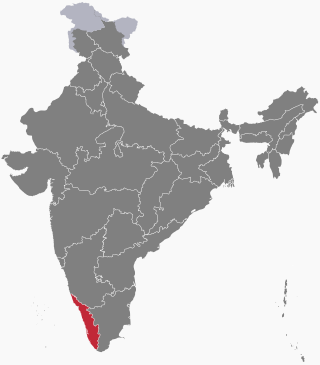
Malayalam is a Dravidian language spoken in the Indian state of Kerala and the union territories of Lakshadweep and Puducherry by the Malayali people. It is one of 22 scheduled languages of India. Malayalam was designated a "Classical Language of India" in 2013. Malayalam has official language status in Kerala and Puducherry (Mahé), and is also the primary spoken language of Lakshadweep, and is spoken by 34 million people in India. Malayalam is also spoken by linguistic minorities in the neighbouring states; with a significant number of speakers in the Kodagu and Dakshina Kannada districts of Karnataka, and Kanyakumari, district of Tamil Nadu. It is also spoken by the Malayali Diaspora worldwide, especially in the Persian Gulf countries, due to the large populations of Malayali expatriates there. They are a significant population in each city in India including Mumbai, Bengaluru, Delhi, Kolkata, Pune etc.

Kottayam, is one of 14 districts in the Indian state of Kerala. Kottayam district comprises six municipal towns: Kottayam, Changanassery, Pala, Erattupetta, Ettumanoor, and Vaikom. It is the only district in Kerala that neither borders the Arabian Sea nor any other states.

Ernakulam, IPA: [erɐɳɐːguɭɐm]; ISO: Eṟaṇākuḷaṁ, in Malayalam: എറണാകുളം), is one of the 14 districts in the Indian state of Kerala, that takes its name from the eponymous city division in Kochi. It is situated in the central part of the state, spans an area of about 3,000 square kilometres (1,200 sq mi), and is home to over 9% of Kerala's population. Its headquarters are located at Kakkanad. The district includes Kochi, also known as the commercial capital of Kerala, which is famous for its ancient Churches, Hindu temples, synagogues and mosques. The district includes the largest metropolitan region of the state: Greater Cochin. Ernakulam is the district that yields the most revenue and the largest number of industries in the state. Ernakulam is the third most populous district in Kerala, after Malappuram and Thiruvananthapuram. The district also hosts the highest number of international and domestic tourists in Kerala state.
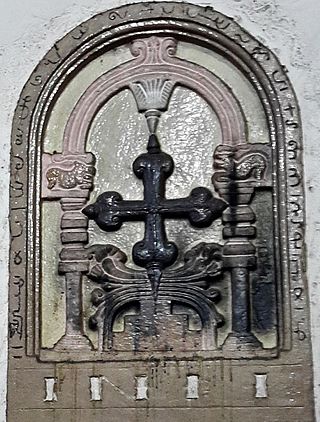
The Saint Thomas Christians, also called Syrian Christians of India, Marthoma Suriyani Nasrani, Malankara Nasrani, or Nasrani Mappila, are an ethno-religious community of Indian Christians in the state of Kerala, who, for the most part, employ the Eastern and Western liturgical rites of Syriac Christianity. They trace their origins to the evangelistic activity of Thomas the Apostle in the 1st century. The Saint Thomas Christians had been historically a part of the hierarchy of the Church of the East but are now divided into several different Eastern Catholic, Oriental Orthodox, Protestant, and independent bodies, each with their own liturgies and traditions. They are Malayalis and speak Malayalam. Nasrani or Nazarene is a Syriac term for Christians, who were among the first converts to Christianity in the Near East.

Kollam, also known by its former name Quilonpronunciation (help·info), is an ancient seaport and city on the Malabar Coast of India bordering the Laccadive Sea, which is a part of the Arabian Sea. It is 71 km (44 mi) north of the state capital Thiruvananthapuram. The city is on the banks of Ashtamudi Lake and the Kallada river. It is the headquarters of the Kollam district. Kollam is the fourth largest city in Kerala and is known for cashew processing and coir manufacturing. It is the southern gateway to the Backwaters of Kerala and is a prominent tourist destination.

The Malankara Mar Thoma Syrian Church, often shortened to Mar Thoma Church, and known also as the Reformed Syrian Church and the Mar Thoma Syrian Church of Malabar, is an autonomous Reformed Oriental church based in Kerala, India. While continuing many of the Syriac high church practices, the church is reformed in its theology and doctrines. It employs a reformed variant of the West Syriac Rite Divine Liturgy of Saint James, translated to Malayalam.

The Malayali people are a Dravidian ethnolinguistic group originating from the present-day state of Kerala in India, occupying its southwestern Malabar coast. They are predominantly native speakers of the Malayalam language, one of the six Classical languages in India. The state of Kerala was created in 1956 through the States Reorganisation Act. Prior to that, since the 1800s existed the Kingdom of Cochin, the Kingdom of Travancore, Malabar District, and South Canara of the British India. The Malabar District was annexed by the British through the Third Mysore War (1790–92) from Tipu Sultan. Before that, the Malabar District was under various kingdoms including the Zamorins of Calicut, Kingdom of Tanur, Arakkal kingdom, Kolathunadu, Valluvanad, and Palakkad Rajas.
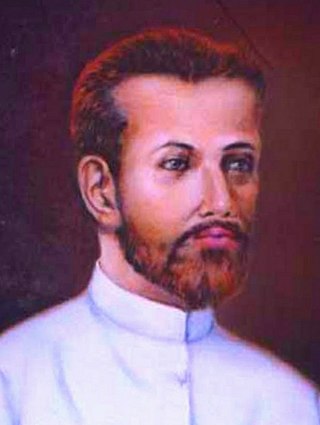
Johann Ernst Hanxleden (1681–1732), better identified as Arnos Pathiri, was a German Jesuit priest and missionary, best known for his contributions as a Malayalam and Sanskrit poet, grammarian, lexicographer, and philologist. He lived in India for most part of his life and became a scholar of Sanskrit and Malayalam languages before authoring Puthen Pana, a poem on the life of Jesus Christ, Malayalam–Portuguese Dictionary, the first dictionary in Malayalam as well as two linguistic treatises, Malayalavyaakaranam and Sidharoopam.

Angamaly (Aṅkamāli), IPA: [ɐŋgɐmɐːli], Malayalam : അങ്കമാലി Situated about 30 km (19 mi) north of the city centre, the town lies at the intersection of Main Central Road and National Highway 544. MC Road, which starts from Thiruvananthapuram ends at Angamaly at its intersection with NH 544. Cochin International Airport is less than 10KM away from the town of Angamaly.
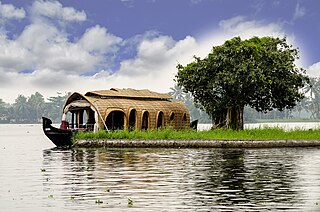
Alappuzha or Alleppey is the administrative headquarters of Alappuzha district in state of Kerala, India. The Backwaters of Alappuzha are one of the most popular tourist attractions in India which attracts millions of domestic and international tourists.

The culture of Kerala has developed over the past millennia, influences from other parts of India and abroad. It is defined by its antiquity and the organic continuity sustained by the Malayali people. Modern Kerala society took shape owing to migrations from different parts of India and abroad throughout Classical Antiquity.
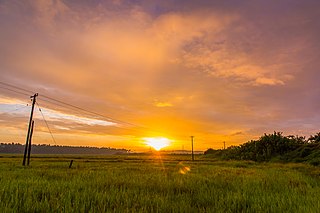
Thrissur, is one of the 14 districts in the Indian state of Kerala. It is situated in the central part the state. Spanning an area of about 3,032 km2 (1,171 sq mi), Thrissur district is home to over 9% of Kerala's population.
Kerala is a state on the Malabar Coast of India. It was formed on 1 November 1956, following the passage of the States Reorganisation Act, by combining Malayalam-speaking regions of the erstwhile regions of Cochin, Malabar, South Canara, and Thiruvithamkoor. Spread over 38,863 km2 (15,005 sq mi), Kerala is the 21st largest Indian state by area. It is bordered by Karnataka to the north and northeast, Tamil Nadu to the east and south, and the Lakshadweep Sea to the west. With 33 million inhabitants as per the 2011 census, Kerala is the 13th-largest Indian state by population. It is divided into 14 districts with the capital being Thiruvananthapuram. Malayalam is the most widely spoken language and is also the official language of the state.
O' Valley or Ouchterlony Valley is a Town Panchayat in the Gudalur Taluk of The Nilgiris district in the Indian state of Tamil Nadu. The name is a contraction of an older name after a James Ouchterlony, who established coffee plantations in the area. This panchayat area is surrounded with beautiful mountains, and the waterfalls from the mountains add to the visual treat. One can enjoy by seeing cardamom, clove, pepper, tea and coffee plantations on the way to O' Valley. The place being located between Mudumalai National Park and New Amarambalam Reserved Forest, is famous for its flora and fauna. The place is surrounded by valleys, streams and water falls of which the sound is very soothing and is a mesmeric effect.

Kerala has a reputation of being, communally, one of the most religiously diverse states in India. According to 2011 Census of India figures, 54.73% of Kerala's population are Hindus, 26.56% are Muslims, 18.38% are Christians, and the remaining 0.33% follow other religions or have no religion. Hindus represent the biggest religious group in all districts except Malappuram, where they are outnumbered by Muslims. Various tribal people in Kerala have retained the religious beliefs of their ancestors. In comparison with the rest of India, Kerala experiences relatively little sectarianism.
Translation of the Bible into Malayalam began in 1806. Church historians say Kayamkulam Philipose Ramban, a scholar from Kayamkulam, translated the Bible from Syriac into Malayalam in 1811 to help the faithful get a better understanding of the scripture. The Manjummal translation is the first Catholic version of the Bible in Malayalam. This is the direct translation from Latin. The four Gospels and the Acts of the Apostles were translated by the inmates of the Manjummal Ashram, Fr. Aloysius, Fr. Michael and Fr. Polycarp. The Pancha Granthy came out from Mannanam under the leadership of Nidhirikkal Mani Kathanar in 1924. The Catholic New Testament was published in full in 1940. and has influenced development of the modern language.
Varthamanappusthakam is a Malayalam travelogue written by Paremmakkal Thoma Kathanar, a Nasrani Mappila kathanar of the modern-day Syro-Malabar Church. It is the first ever travelogue written in an Indian Language. It was written in the 18th century (1790) but then forgotten, being re-discovered in 1935 and first printed in 1936 by Luka Mathai Plathottam at Athirampuzha St Marys Press in the year 1936.
Pallikoodam or Ezhuthupally Pally is a word in Malayalam and Tamil that denotes a school. These were mostly village schools run by individual teachers and were distinct from Kalaris that taught martial arts.

Moonnam Pralayam is a 2019 Indian Malayalam-language drama film directed by Ratheesh Raju M.R and written by S.K. Vilwan based on Kerala floods and its after effects. The film was produced by Devasia Kuriakose under the banner of Niagara Movies. It stars Ashkkar Soudaan, Sai Kumar, Bindu Panikkar, Kulappulli Leela, V. Suresh Thampanoor and Anil Murali.
Religious education in Kerala was historically influenced by traditional Indian religions like Hinduism, Buddhism and Jainism through Gurukula, an ancient education system, with Abrahamic religions becoming practiced in Kerala at early stages through ancient maritime trade. Buddhism added educational vocabulary, including Namostu Jinatam, Ezhuthu Palli and Pallikoodam to education in the Malayalam language. Madrasa institutions, coordinated by various Madarasa education boards, referred to as Othupalli or Palli Dar, since the independence of India. Modern Christian education began in the early 19th century.
References
- ↑ Sadasivan, S. N. (2000). A Social History of India, p. 114 . APH Publishing.