Last updated Ruins of Medieval Vainakh settlement.
The Nakh (or Vainakh) medieval towers were a characteristic feature of medieval architecture of the Nakh peoples in Chechenya and Ingushetia, with few parallels outside that region. Some towers were used as dwellings, others had a military purpose; some combined both functions.
The Vainakh peoples are the speakers of the Vainakh languages, chiefly the Chechen, Ingush and Kist peoples of the North Caucasus, including closely related minor or historical groups
The Republic of Ingushetia, also referred to as simply Ingushetia, is a federal subject of the Russian Federation, located in the North Caucasus region.
The roots of Nakh tower architecture seem to be very ancient. Similar dwellings were built in the 2nd and 1st millennia BC by the Hurrians and Urartians,[1][unreliable source?][2][unreliable source?] believed to be close relative to the Nakh peoples. According to a Roman author of the 1st century BC, the people of Colchis on the west shores of the Black Sea, also connected to the Nakh, lived in log towers with square foundation, tapering walls and pyramidal roofs. The invariably square floorplan of the Nakh towers contrasts with the round towers built by peoples south of the Caucasus.[1][unreliable source?]
The Hurrians were a people of the Bronze Age Near East. They spoke a Hurro-Urartian language called Hurrian and lived in Anatolia and Northern Mesopotamia. The largest and most influential Hurrian nation was the kingdom of Mitanni, the Mitanni perhaps being Indo-Iranian speakers who formed a ruling class over the Hurrians. The population of the Indo-European-speaking Hittite Empire in Anatolia included a large population of Hurrians, and there is significant Hurrian influence in Hittite mythology. By the Early Iron Age, the Hurrians had been assimilated with other peoples. Their remnants were subdued by a related people that formed the state of Urartu. According to a hypothesis by I.M. Diakonoff and S. Starostin, the Hurrian and Urartian languages shared a common ancestor and were related to the Northeast Caucasian languages, however, this theory is controversial and not universally accepted. The present-day Armenians are an amalgam of the Indo-European groups with the Hurrians and Urartians.
Urartu, which corresponds to the biblical mountains of Ararat, is the name of a geographical region commonly used as the exonym for the Iron Age kingdom also known by the modern rendition of its endonym, the Kingdom of Van, centered around Lake Van in the historic Armenian Highlands.
The oldest fortifications in the Nakh area date from the 3rd millennium BC. The oldest remains of buildings with the characteristics of Nakh towers date from the 1st century AD, and can already be distinguished into residential and military types. Construction greatly increased in the 12th and 13th centuries. Nakh tower architecture and construction techniques reached their peak in the 15th–17th centuries.[1][unreliable source?]
General features
Vovnushki tower complex.
Typical Vainakh towers were built on a square base, ranging from 6 to 12 m wide and 10 to 25 m high, depending on the function. The walls were built of stone blocks, possibly with lime, clay-lime, or lime-sandmortar. The walls were inclined inwards and their thickness decreased on higher floors. The towers were built on hard rock.
The metre or meter is the base unit of length in the International System of Units (SI). The SI unit symbol is m. The metre is defined as the length of the path travelled by light in vacuum in 1/299 792 458 of a second.
Lime is a calcium-containing inorganic mineral composed primarily of oxides, and hydroxide, usually calcium oxide and/ or calcium hydroxide. It is also the name for calcium oxide which occurs as a product of coal seam fires and in altered limestone xenoliths in volcanic ejecta. The word lime originates with its earliest use as building mortar and has the sense of sticking or adhering.
Clay is a finely-grained natural rock or soil material that combines one or more clay minerals with possible traces of quartz (SiO2), metal oxides (Al2O3, MgO etc.) and organic matter. Geologic clay deposits are mostly composed of phyllosilicate minerals containing variable amounts of water trapped in the mineral structure. Clays are plastic due to particle size and geometry as well as water content, and become hard, brittle and non–plastic upon drying or firing. Depending on the soil's content in which it is found, clay can appear in various colours from white to dull grey or brown to deep orange-red.
Vainakh towers used to be sparingly decorated with religious or good-wishing petrographs, such as solar signs or depictions of the author’s hands, animals, etc.. Defensive towers often bore a Golgopha cross.
The construction of a tower, whether residential or military, was accompanied by rituals. Songs and folk tales emphasise the role of the "master builder", who, according to tradition, would direct a group of assistants who did the actual work. Some of these masters had their names preserved—such as Diskhi, associated in the local tradition to the military tower of Vougi. Some Chechen villages, such as Bavloi, specialized in tower building. Legends ascribe to the master builder the honourable and extremely dangerous task of erecting the tsIurku stone that topped the step pyramidal roof of a military tower. A ladder was tied to a machicolation on the outside for the master to reach the roof. It cost many masters their life. In case of success, the client gave the master a bull. The construction of a family tower cost the household 50 to 60 cows.
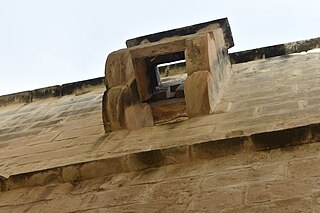
A machicolation is a floor opening between the supporting corbels of a battlement, through which stones or other material, such as boiling water or boiling cooking oil, could be dropped on attackers at the base of a defensive wall. A smaller version found on smaller structures is called a box-machicolation.
Ivan Shcheblykin claimed that the tower builders did not need any scaffolding,[3] and many researchers make that assumption. However, he may have meant that they used no scaffolding on the outside.
Cornerstones were included in the design, to join the walls together and to support the higher floors. Interior scaffolds used in erecting the walls probably rested on those cornerstones, in which corbels were made for the purpose. Stones and beams were lifted with a windlass known as chIagIarg or zerazak. Large stones—some weighing several tonnes—were brought to the site by oxdriven sleds. The builders used many stonedressing tools—the berg (pick), the varzap (a large hammer), the jau (a small hammer), the daam (chisel), etc. Mortar was made on the site. Sand or clay was admixed to it in localities where lime was expensive. One of the master builder's most critical tasks was to estimate the proper amount of mortar to ensure the seismic resistance of the tower. Joints between stones were filled in with limewash for rain not to damage mortar.
Residential towers
Ruins of Nikaroi settlement. A residential tower in foreground of the image.Central pillar (erd-bogIam) of residential tower in Haskali
Residential towers were family dwellings, which have been compared to structures seen in prehistoric mountain settlements dating back to 8000 BC.
The classic residential tower is a massive building, two to four stories high, with tapering walls and a flat shale roof. The floorplan is usually rectangular, measuring 8–10 by 8–12 meters. The tower tapered due to the walls getting thinner to the top, and due to their inward inclination. The thickness of the walls varies in different structures from 1.2–0.9 m at the bottom to 0.7–0.5 m at the top.
The walls were made of stones of varying sizes (blocks or slabs, depending on the local stone), carefully dressed on the outside, with lime or clay-lime mortar and chip stone. Dry masonry was seldom used. Large stone blocks, sometimes weighing several tons, were used in the foundation and the ground-floor walls.
The towers had a central pillar, also of thoroughly dressed stone blocks, which supported the ceiling rafters. Purlines rested on pilasters or cornerstones, and common rafters, in their turn, rested on the purlines. The upper floors consisted of wood sticks resting on the rafters, coated with punned clay. The ground floor was paved with boards or stone slabs.
Besides its structural function, the central pillar (erd-bogIam) had symbolic and religious significance in Nakh culture, since ancient times.
The two lower stories of a residential tower were intended for livestock. Cattle and horses were usually sheltered in the ground floor, part of which was fenced off for grain storage. Some towers had pits on the ground floor for that purpose, with stone-lined walls and bottom.
In towers with four stories, the first floor above ground was typically used to shelter sheep and goats. It had a separate entrance, reached by a log ramp.
The family lived in the second floor above ground (or in the first, in three-story towers). The family possessions—carpets, dishes, kitchen utensils, clothes, etc.—were kept there, in tin-lined wooden chests or on wooden shelves along the walls. The older towers had no wardrobes; instead, clothes were hung on metal hooks. Other towers had niches on the walls for that purpose. There was usually an arrangement of weaponry on the wall above the master bed. It was a dire necessity in wartime, and mere tradition in peace.
Military towers
Military tower in Chanta.
A majority of the military ("combat") towers in the Chechen mountains functioned both as watchtowers and as signalling beacons. Some served as fortified guard posts, or as safe shelters for one or two families, which lived in nearby residential towers, against raids. In some places, such as at Mount Bekhaila, several towers were enclosed in a common wall to create a small fortress. Construction of military towers began in the 10th and 11th centuries, and peaked between the 14th and the 17th centuries. Chechen and Ingush military towers are fairly similar, differing only in size and the construction time. Depending on their age, they differ also in the sophistication of construction techniques and stone dressing, and in the grace of form.
Combat towers were generally taller but narrower than residential ones: 20–25 meters high or more,[1] with four of five floors and a square base 5–6 meters wide. They were built of dressed stone with lime or lime-sand mortar.
They had blank walls, cut only by embrasures and observation slits, on the most vulnerable side. There were no wooden parts on the tower exterior lest besiegers put them on fire. Doors and windows were on the side hardest of access. In some cases it is hard to believe that the defenders themselves could enter the tower. The entrance door was on the second floor, accessed through a ladder. The defenders fired at the enemy through loopholes and the top of the tower had mashikul–overhanging small balconies without a floor. Defensive towers were usually crowned with pyramid-shaped roofing built in steps and topping with a sharpened capstone.
Beacon towers were erected on the top of cliffs to make them hard of access. The shape, size and site of a beacon was chosen so as to guarantee visual connection with the nearest beacons. Watchtowers were often built in strategic locations to control key bridges, roads and mountain passes. They were built near to a river, brook or spring, so that water could be brought into the tower through a concealed water duct.
The ground floor ceiling of the later, 15th–17th century towers was a false vault, known as nartol tkhov, with two intercrossing rows of reinforcing ribs.
Special attention was paid to the dressing and finishing of the keystones at the top of doors and windows, called kurtulg ("proud stone"). They bore the name of the owner, and were frequently decorated with petroglyphs.
Researchers differ in the functions of the various floors. Some assume that the ground floor was used for livestock, while others say it was a prison for captives. Actually it seems that the ground floor was filled in with stone and earth to reinforce the tower bottom against ramming.
Chechen legends connected to certain towers claim that ancient heroes lived in them. These legends are probably wrong, since the interior of such towers is not adequate for prolonged dwelling.
The classical combat tower was not intended to withstand long sieges. Tower defenders had only a small stock of food and extremely limited arsenals, be it arrows, stone missiles or powder and shot in later times. Due to their small size, a watchtower or a beacon could house four to six on outsentry duty. All combat tower stories were equipped for observation and fighting.
Chechen and Ingush combat towers divide in three basic groups according to the type of roof:
Flat roof towers
Flat roof towers crenellated on the corners
Step pyramidal roof towers
Mixed function towers
In the 13th–14th centuries, increased danger of aggression in certain parts of the Chechen mountains let to the reinforcement of residential towers. The result were buildings that combined the functions of residential and defensive towers; they were smaller in size than the former, but a bit wider than the latter. Like the military towers, they had loopholes and mashikiuls (mâchicoulis).
One typical tower had five stories, and three doors in the façade—one on each of the first three floors. It has mashikiuls for archers on the top floor. The tower's ground-level floorplan measures 8.0 х 9.0 m, and the building is 11 metres tall. The ground floor wall is 75 centimetres thick.
These mixed-function towers are rare in the Chechen highland, probably because tower complexes and castles had become widespread by the time this concept appeared. Whereas a tower had space for only a few cows and horses, a castle could shelter to the entire livestock in wartime.[4]
Mortar is a workable paste used to bind building blocks such as stones, bricks, and concrete masonry units, fill and seal the irregular gaps between them, and sometimes add decorative colors or patterns in masonry walls. In its broadest sense mortar includes pitch, asphalt, and soft mud or clay, such as used between mud bricks. Mortar comes from Latin mortarium meaning crushed.
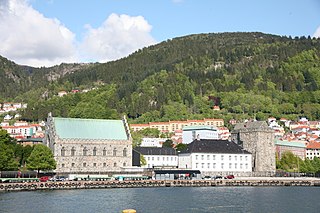
Bergenhus fortress is a fortress located in Bergen, Norway. Located at the entrance of Bergen harbour, the castle is one of the oldest and best preserved stone fortifications in Norway.
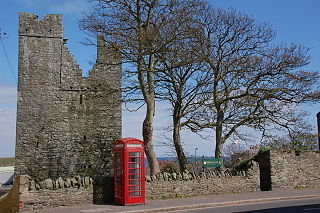
Jordan's Castle is a castle situated in Ardglass, County Down, Northern Ireland. The tower house known as Jordan's Castle is a State Care Historic Monument sited in the townland of Ardglass, in the Newry, Mourne and Down District Council area, at grid ref: J5601 3713. It stands close to the junction of Kildare and Quay Streets in Ardglass and commands the harbour.
The architecture of ancient Sri Lanka displays a rich diversity, varying in form and architectural style from the Anuradhapura Kingdom through the Kingdom of Kandy (1469–1815). Sinhalese architecture also displays many ancient North Indian influences. Buddhism had a significant influence on Sri Lankan architecture after it was introduced to the island in the 3rd century BC, and ancient Sri Lankan architecture was mainly religious, with more than 25 styles of Buddhist monasteries. Significant buildings include the stupas of Jetavanaramaya and Ruwanvelisaya in the Anuradhapura kingdom and further in the Polonnaruwa Kingdom. The palace of Sigiriya is considered a masterpiece of ancient architecture and ingenuity, and the fortress in Yapahuwa and the Temple of the tooth in Kandy are also notable for their architectural qualities. Ancient Sri Lankan architecture is also significant to sustainability, notably Sigiriya which was designed as an environmentally friendly structure.
Scottish Vernacular architecture is a form of vernacular architecture that uses local materials.
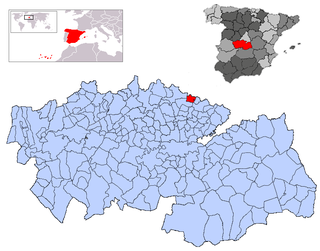
Carranque is a town in the Toledo province, Castile-La Mancha, Spain. It is located in the area of the province bordering the province of Madrid called the Alta Sagra.
The History of construction overlaps many other fields like structural engineering and relies on other branches of science like archaeology, history and architecture to investigate how the builders lived and recorded their accomplishments. Those fields allow us to analyse constructed buildings and other structures built since prehistory, the tools used and the different uses of building materials.
The Architecture of the Tarnovo Artistic School is a term for the development of architecture during the Second Bulgarian Empire (1185–1396). In the 13th and 14th centuries the capital Tarnovo determined the progress of the Bulgarian architecture with many edifices preserved or reconstructed which show the skills of the Medieval Bulgarian architects and the construction and decorative techniques they used. The builders have created a unique architectural style, known as Tarnovian Style, that influenced the architecture in many countries of Southeastern Europe and parts of Central Europe. With its diverse architecture, the Tarnovo School may be separated into several branches according to the function of the buildings.
Khirki Mosque, approached from the Khirki Village in South Delhi and close to the Satpula or the seven arched bridge on the edge of southern wall of Jahapanah, was a mosque built by Khan-i-Jahan Junan Shah, the Prime Minister of Feroz Shah Tughlaq (1351–1388) of the Tughlaq Dynasty. The word 'Khirki' prefixed to mosque is an Urdu word that means "window" and hence is also called "The Mosque of Windows".
A baserri is a traditional half-timbered or stone-built type of housebarn farmhouse found in the Basque Country in Northern Spain and Southwestern France. The baserris, with their gently sloping roofs and entrance portals, are highly characteristic of the region and form a vital part in traditional Basque societal structures. They are also seen to have played an important role in protecting the Basque language in periods of persecution by providing the language with a very dispersed but substantial speaker base.
A bergfried is a tall tower that is typically found in castles of the Middle Ages in German-speaking countries and in countries under German influence. Friar describes it as a "free-standing, fighting-tower". Its defensive function is to some extent similar to that of a keep in English or French castles. However, the characteristic difference between a bergfried and a keep is that a bergfried was typically not designed for permanent habitation.
Kerala architecture is a kind of architectural style that is mostly found in Indian state of Kerala. Kerala's style of architecture is unique in India, in its striking contrast to Dravidian architecture which is normally practiced in other parts of South India. The architecture of Kerala has been influenced by Dravidian and Indian Vedic architectural science over two millennia. The Tantrasamuchaya, Thachu-Shastra, Manushyalaya-Chandrika and Silparatna are important architectural sciences, which have had a strong impact in Kerala Architecture style. The Manushyalaya-Chandrika, a work devoted to domestic architecture is one such science which has its strong roots in Kerala.
The White Tower is a central tower, the old keep, at the Tower of London. It was built by William the Conqueror during the early 1080s, and subsequently extended. The White Tower was the castle's strongest point militarily, and provided accommodation for the king and his representatives, as well as a chapel. Henry III ordered the tower whitewashed in 1240.
Monuments of Kosovo comprise all the monuments that are located in Kosovo.
The Tour Jean-sans-Peur or Tour de Jean sans Peur, located in the 2nd arrondissement of Paris, is the last vestige of the Hôtel de Bourgogne, the residence first of the Counts of Artois and then the Dukes of Burgundy. The tower contained bed chambers and the grand stairway of the original residence, which stood next to it. It was completed between 1409–1411 by Jean sans Peur. The original hôtel occupied about a hectare of land, the boundaries of which are now marked by the rues Étienne Marcel, Montorgueil, Saint-Sauveur, and Saint-Denis. The tower itself is located at 20 rue Étienne Marcel, in the courtyard of an elementary school. It is one of the best surviving examples of medieval residential architecture in Paris. The tower is open to the public and presents changing expositions on life in the Middle Ages.
Akhmat Tower is a supertall skyscraper undergoing ground preparations in Grozny, Chechen republic of Russia. Construction started on 2 January 2016, and as of September 2016, the piling work was completed.
The Tower of Apollonia or Tower of Eleftheres stands on the coastal hill 27 kilometres (17 mi) east of the Strymon River estuary in the Thracian Sea. The small settlement of Pyrgos, some 700 m northeast of the tower, is named after it.
Svan towers refers to the tower houses built as defensive dwellings. These tower houses are common in the Georgian historical region of Svaneti and today incorporated in Samegrelo-Zemo Svaneti. The oldest are dated 8th or 9th century, the newest was built in the 18th century. A Svan tower is on average 20 to 25 meters high and has four or five, more rarely six floors. The ground floor, whose walls are up to 1.5 meters wide, usually has no doors and no windows. The entrance is usually at the level of an upper floor. The upper part of the tower is narrower than the lower one, and the width of the walls also decreases to 0.7-0.8 meters. The floors are connected by a wooden ladder. At the upper part of the tower ends in a so-called crown with roof. On each side of the tower has holes. The Svan towers are either rebuilt into residential buildings or are vacant.
References
1 2 3 4 Lecha Ilyasov. The Diversity of the Chechen Culture: From Historical Roots to the Present.ISBN9785904549022.
↑ Erol YILDIR., Kuzey Kafkasyada Vaynah Kule Mimarisi (Vaynah Kuleleri), Flaş Ajans, İstanbul 1997. pages 62-63 ISBN975-7129-01-1
↑ Щеблыкин И. П. Искусство ингушей в памятниках материальной культуры // Известия Ингушского научно-исследовательского института истории и культуры. Владикавказ, 1928. Вып. 1. Page 282.
↑ Марковин В.И. Памятники зодчества в горной Чечне. (по материалам исследований 1957–1965 гг.) // Северный Кавказ в древности и средние века. М., 1980. С.184–270.
This page is based on this Wikipedia article Text is available under the CC BY-SA 4.0 license; additional terms may apply. Images, videos and audio are available under their respective licenses.