Related Research Articles

The Anglican Communion is the third largest Christian communion after the Roman Catholic and Eastern Orthodox churches. Founded in 1867 in London, the communion has more than 85 million members within the Church of England and other autocephalous national and regional churches in full communion. The traditional origins of Anglican doctrine are summarised in the Thirty-nine Articles (1571). The archbishop of Canterbury in England acts as a focus of unity, recognised as primus inter pares, but does not exercise authority in Anglican provinces outside of the Church of England. Most, but not all, member churches of the communion are the historic national or regional Anglican churches.
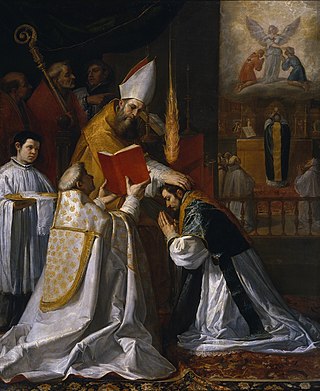
In certain Christian denominations, holy orders are the ordained ministries of bishop, priest (presbyter), and deacon, and the sacrament or rite by which candidates are ordained to those orders. Churches recognizing these orders include the Catholic Church, the Eastern Orthodox, Oriental Orthodox, Anglican, Assyrian, Old Catholic, Independent Catholic and some Lutheran churches. Except for Lutherans and some Anglicans, these churches regard ordination as a sacrament.

The Lambeth Conference is a decennial assembly of bishops of the Anglican Communion convened by the Archbishop of Canterbury. The first such conference took place at Lambeth in 1867.
Since the 1990s, the Anglican Communion has struggled with controversy regarding homosexuality in the church. In 1998, the 13th Lambeth Conference of Anglican bishops passed a resolution "rejecting homosexual practice as incompatible with Scripture". However, this is not legally binding. "Like all Lambeth Conference resolutions, it is not legally binding on all provinces of the Communion, including the Church of England, though it commends an essential and persuasive view of the attitude of the Communion." "Anglican national churches in Brazil, South Africa, South India, New Zealand and Canada have taken steps toward approving and celebrating same-sex relationships amid strong resistance among other national churches within the 80 million-member global body. The Episcopal Church in the U.S. has allowed same-sex marriage since 2015, and the Scottish Episcopal Church has allowed same-sex marriage since 2017." In 2017, clergy within the Church of England indicated their inclination towards supporting same-sex marriage by dismissing a bishops' report that explicitly asserted the exclusivity of church weddings to unions between a man and a woman. At General Synod in 2019, the Church of England announced that same-gender couples may remain recognised as married after one spouse experiences a gender transition. In 2023, the Church of England announced that it would authorise "prayers of thanksgiving, dedication and for God's blessing for same-sex couples."
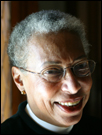
Barbara Clementine Harris was an American bishop of the Episcopal Church in the United States. She was the first woman consecrated a bishop in the Anglican Communion. She was elected suffragan bishop of the Episcopal Diocese of Massachusetts, on September 24, 1988, and was consecrated on February 11, 1989. Eight thousand people attended the service, which was held at the Hynes Convention Center in Boston, Massachusetts. She served in the role of suffragan bishop for 13 years, retiring in 2003.

The Anglican ministry is both the leadership and agency of Christian service in the Anglican Communion. Ministry commonly refers to the office of ordained clergy: the threefold order of bishops, priests and deacons. More accurately, Anglican ministry includes many laypeople who devote themselves to the ministry of the church, either individually or in lower/assisting offices such as lector, acolyte, sub-deacon, Eucharistic minister, cantor, musicians, parish secretary or assistant, warden, vestry member, etc. Ultimately, all baptized members of the church are considered to partake in the ministry of the Body of Christ.
The Anglican realignment is a movement among some Anglicans to align themselves under new or alternative oversight within or outside the Anglican Communion. This movement is primarily active in parts of the Episcopal Church in the United States and the Anglican Church of Canada. Two of the major events that contributed to the movement were the 2002 decision of the Diocese of New Westminster in Canada to authorise a rite of blessing for same-sex unions, and the nomination of two openly gay priests in 2003 to become bishops. Jeffrey John, an openly gay priest with a long-time partner, was appointed to be the next Bishop of Reading in the Church of England and the General Convention of the Episcopal Church ratified the election of Gene Robinson, an openly gay non-celibate man, as Bishop of New Hampshire. Jeffrey John ultimately declined the appointment due to pressure.
The historic or historical episcopate comprises all episcopates, that is, it is the collective body of all the bishops of a group who are in valid apostolic succession. This succession is transmitted from each bishop to their successors by the rite of Holy Orders. It is sometimes subject of episcopal genealogy.

Kay Maree Goldsworthy is an Australian bishop of the Anglican Church of Australia. She is the current archbishop of Perth in the Province of Western Australia. Upon her installation as archbishop, on 10 February 2018, she became the first female archbishop in the Anglican Church of Australia. Previously, she served as diocesan bishop of the Diocese of Gippsland in the south-eastern Australian state of Victoria.
The Global Fellowship of Confessing Anglicans is a communion of conservative Anglican churches that formed in 2008 in response to ongoing theological disputes in the worldwide Anglican Communion. Conservative Anglicans met in 2008 at the Global Anglican Future Conference, creating the Jerusalem Declaration and establishing the Fellowship of Confessing Anglicans (FCA), which was rebranded as GAFCON in 2017.
The ordination of lesbian, gay, bisexual and/or transgender (LGBT) clergy who are open about their sexuality or gender identity; are sexually active if lesbian, gay, or bisexual; or are in committed same-sex relationships is a debated practice within some contemporary Christian denominations.

The ordination of women in the Anglican Communion has been increasingly common in certain provinces since the 1970s. Several provinces, however, and certain dioceses within otherwise ordaining provinces, continue to ordain only men. Disputes over the ordination of women have contributed to the establishment and growth of progressive tendencies, such as the Anglican realignment and Continuing Anglican movements.
The Movement for the Ordination of Women (MOW) was the name used by organisations in England and Australia that campaigned for the ordination of women as deacons, priests and bishops in the Anglican Communion.
William David Hair McCall was an Australian Anglican bishop.
Carl Christopher Epting is a bishop in the Episcopal Church in the United States of America. He served the Diocese of Iowa as coadjutor bishop and diocesan bishop from 1988 to 2001, and as the Deputy for Ecumenical and Interreligious Relations for the Episcopal Church from 2001 to 2009. He then served as the Assistant Bishop of the Diocese of Chicago from November 2011 through December 2015 before retiring. Since 2021, Bishop Epting and his wife, Susanne, have resided in Englewood, Colorado.
Barry Valentine was bishop of the Diocese of Rupert's Land in the Anglican Church of Canada from 1970 to 1982. Valentine's episcopacy was "transformational and visionary."
The Philadelphia Eleven are eleven women who were the first women ordained as priests in the Episcopal Church on July 29, 1974, two years before General Convention affirmed and explicitly authorized the ordination of women to the priesthood.
Joanne Caladine Bailey Wells is a British Anglican bishop, theologian, and academic. Since January 2023, she has served at the Anglican Communion Office in London as "Bishop for Episcopal Ministry". Previously, she was a lecturer in the Old Testament and biblical theology at Ridley Hall, Cambridge, and then associate professor of Bible and Ministry at Duke Divinity School, Duke University, North Carolina; From 2013 until 2016, she had served as Chaplain to the Archbishop of Canterbury; she was then Bishop of Dorking, a suffragan bishop in the Diocese of Guildford, 2016–2023.
The Anglican Group for the Ordination of Women to the Historic Ministry of the Church existed from 1930 to 1978. By research, education, publicity, and memorials to the church, it pushed the Church of England and the whole Anglican Communion to admit women to the historic three-fold ministry. By the time the organization disbanded in 1978, women had been ordained priests in four provinces of the Anglican Communion.
Gulnar Eleanor "Guli" Francis-Dehqani is an Iranian-born British Anglican bishop who has been Bishop of Chelmsford since 2021. She served as the first Bishop of Loughborough, the suffragan bishop in the Diocese of Leicester from 2017 to 2021.
References
- 1 2 3 4 5 6 7 8 9 10 11 12 13 "Reverend Nan Arrington Peete's Biography". The HistoryMakers. Retrieved 2021-02-28.
- ↑ Peete, Nan (August 6, 1995). Not One Church. Morehouse-Gorham Company. p. 10.
{{cite book}}:|work=ignored (help) - ↑ "The Rev. Canon Nan Peete". Washington National Cathedral. Retrieved 2021-02-28.
- ↑ "Dayspring History – Dayspring Center" . Retrieved 2021-03-01.
- 1 2 "Afro-Anglicanism · Awakening · The Church Awakens: African Americans and the Struggle for Justice". www.episcopalarchives.org. Retrieved 2021-03-01.
- ↑ "Sermon: The Rev. Canon Nan Peete". Washington National Cathedral. Retrieved 2021-03-02.
- ↑ Staff, M. N. A. (2016-08-11). "Rev. Canon Nan Arrington Peete to officiate Church of the Holy Trinity services". Manistee News Advocate. Retrieved 2021-02-28.
- ↑ Newspapers, Peter Slevin, Knight-Ridder (30 July 1988). "WOMEN'S PLACE IN CHURCH DIVIDES ANGLICAN CLERGY". OrlandoSentinel.com. Retrieved 2021-03-01.
{{cite web}}: CS1 maint: multiple names: authors list (link) - 1 2 3 4 DONOVAN, MARY SUDMAN (1989). "The Dimensions of Unity: Women at Lambeth 1988". Anglican and Episcopal History. 58 (3): 353–363. ISSN 0896-8039. JSTOR 42610344.
- 1 2 3 4 5 6 "American Woman Priest Tells Bishops: We Strengthen Church". AP NEWS. Retrieved 2021-02-28.
- 1 2 3 GARRETT, SAMUEL M. (1989). "Three Weeks in Canterbury: An Interpretive Chronicle of the Twelfth Lambeth Conference, 1988". Anglican and Episcopal History. 58 (3): 291–325. ISSN 0896-8039. JSTOR 42610341.
- ↑ mmacdonald (2014-07-28). "Interactive timeline of the history of women's ordination". Episcopal News Service. Retrieved 2021-03-02.
- ↑ "Woman priest wins ovation in ordination debate". The Globe and Mail. July 23, 1988. Retrieved April 17, 2021.
- ↑ LYTLE, GUY FITCH (1989). "Concluding Thoughts After Lambeth: Reactions to the Event and Its Final Report". Anglican and Episcopal History. 58 (3): 388. ISSN 0896-8039. JSTOR 42610348.