
Antioch in Pisidia – alternatively Antiochia in Pisidia or Pisidian Antioch and in Roman Empire, Latin: Antiochia Caesareia or Antiochia Colonia Caesarea – was a city in the Turkish Lakes Region, which was at the crossroads of the Mediterranean, Aegean and Central Anatolian regions, and formerly on the border of Pisidia and Phrygia, hence also known as Antiochia in Phrygia. The site lies approximately 1 km northeast of Yalvaç, a modern town in Isparta Province. The city was on a hill with its highest point of 1236 m in the north.

The Villa of the Papyri was an ancient Roman villa in Herculaneum, in what is now Ercolano, southern Italy. It is named after its unique library of papyri scrolls, discovered in 1750. The Villa was considered to be one of the most luxurious houses in all of Herculaneum and in the Roman world. Its luxury is shown by its exquisite architecture and by the large number of outstanding works of art discovered, including frescoes, bronzes and marble sculpture which constitute the largest collection of Greek and Roman sculptures ever discovered in a single context.

Tell Halaf is an archaeological site in the Al Hasakah governorate of northeastern Syria, a few kilometers from the city of Ras al-Ayn near the Syria–Turkey border. The site, which dates to the sixth millennium BCE, was the first to be excavated from a Neolithic culture, later called the Halaf culture, characterized by glazed pottery painted with geometric and animal designs.
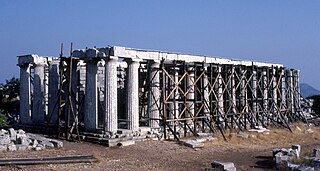
Bassae is an archaeological site in Oichalia, a municipality in the northeastern part of Messenia, Greece. In classical antiquity, it was part of Arcadia. Bassae lies near the village of Skliros, northeast of Figaleia, south of Andritsaina and west of Megalopolis. It is famous for the well-preserved mid- to late-5th century BC Temple of Apollo Epicurius.

Moundville Archaeological Site, also known as the Moundville Archaeological Park, is a Mississippian culture archaeological site on the Black Warrior River in Hale County, near the modern city of Tuscaloosa, Alabama. Extensive archaeological investigation has shown that the site was the political and ceremonial center of a regionally organized Mississippian culture chiefdom polity between the 11th and 16th centuries. The archaeological park portion of the site is administered by the University of Alabama Museums and encompasses 185 acres (75 ha), consisting of 29 platform mounds around a rectangular plaza.

The Istanbul Archaeology Museums are a group of three archaeological museums located in the Eminönü quarter of Istanbul, Turkey, near Gülhane Park and Topkapı Palace. These museums house over one million objects from nearly all periods and civilizations in world history.

Meskalamdug was an early Sumerian ruler of the First Dynasty of Ur in the 26th century BCE. He does not appear in the Sumerian King List, but is known from a royal cylinder seal found in the Royal Cemetery at Ur, a royal bead inscription found in Mari, both mentioning him as King, and possibly his tomb, grave PG 755 at the Royal Cemetery at Ur.
The Hội An wreck lies in the South China Sea 22 nautical miles off the coast of central Vietnam at approximately 16.04°N 108.6°E approximately. It was discovered by fishermen in the early 1990s. The Vietnamese government made several attempts to organise an investigation of the site but its efforts initially were confounded by the water depth of 230 feet (70 m). Between 1996 and 1999, the team, which included the Vietnamese National Salvage Corporation and Oxford University’s Marine Archaeology Research Division, recovered nearly 300,000 artifacts.

Wolf Cave is a crack in the Pyhävuori mountain in Kristinestad, near the Karijoki municipality in Finland. The upper part of the crack has been packed with soil, forming a cave. In 1996, some objects were found in the cave that brought about speculations that it could have been inhabited in the Paleolithic, between 120,000 and 130,000 years ago. These objects, if authentic, would be the only known Neanderthal artifacts in the Nordic countries.
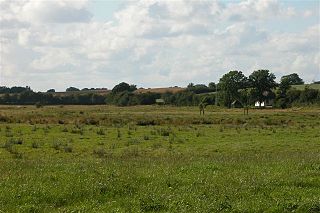
The Nydam Mose, also known as Nydam Bog, is an archaeological site located at Øster Sottrup, a town located in Sundeved, eight kilometres (5 mi) from Sønderborg, Denmark.

The Department of the Middle East, numbering some 330,000 works, forms a significant part of the collections of the British Museum, and the world's largest collection of Mesopotamian antiquities outside Iraq. The collections represent the civilisations of the ancient Near East and its adjacent areas.

Villa Torlonia is a villa and surrounding gardens in Rome, Italy, formerly belonging to the Torlonia family. It is entered from the via Nomentana.

Gatecliff Rockshelter (26NY301) is a major archaeological site in the Great Basin area of the western United States that provides remarkable stratigraphy; it has been called the "deepest archaeological rock shelter in the Americas". Located in Mill Canyon of the Toquima Range in the Monitor Valley of central Nevada, Gatecliff Rockshelter has an elevation of 7,750 feet (2,360 m). David Hurst Thomas discovered Gatecliff Rockshelter in 1970 and began excavations in 1971. Full scale excavations occurred at Gatecliff Rockshelter for about seven field seasons in which nearly 33 feet (10 m) of sediments were exposed for a well-defined stratigraphic sequence. The well-preserved artifacts and undisturbed sediments at Gatecliff Rockshelter provides data and information have been applied to a range of research topics. Based on the analysis of the artifacts at Gatecliff Rockshelter, it can be determined that it was most likely a short-term field camp throughout prehistory. The latest evidence for human usage at Gatecliff occurs between ca. 5500 B.P. to 1250 B.P.

Menhet, Menwi and Merti, also spelled Manhata, Manuwai and Maruta, were three minor foreign-born wives of Pharaoh Thutmose III of the Eighteenth Dynasty. They are known for their lavishly furnished rock-cut tomb in Wady Gabbanat el-Qurud near Luxor, Egypt. They are suggested to be Syrian, as the names all fit into Canaanite name forms, although their ultimate origin is unknown. A West Semitic origin is likely, but both West Semitic and Hurrian derivations have been suggested for Menwi. Each of the wives bear the title of "king's wife", and were likely only minor members of the royal harem. It is not known if the women were related as the faces on the lids of their canopic jars are all different.

Xihuacan is a Mesoamerican archeological site located on the Costa Grande of the Mexican state of Guerrero, near the small town of La Soledad de Maciel, and the larger towns of Zihuatanejo and Petatlán. While pieces had been found at the site earlier, including the King of La Chole stele and Mesoamerican ball court rings, formal excavations were only recently begun. The site had been occupied for over 3,000 years and by three cultures, with contact with other Mesoamerican cultures such as the Teotihuacan and Olmec. Explored areas include what may be the largest Mesoamerican ball court, a 1-hectare (2.5-acre) pyramidal base and a hill with petroglyphs and a probable sacrifice stone.

The Nimrud ivories are a large group of small carved ivory plaques and figures dating from the 9th to the 7th centuries BC that were excavated from the Assyrian city of Nimrud during the 19th and 20th centuries. The ivories mostly originated outside Mesopotamia and are thought to have been made in the Levant and Egypt, and have frequently been attributed to the Phoenicians due to a number of the ivories containing Phoenician inscriptions. They are foundational artefacts in the study of Phoenician art, together with the Phoenician metal bowls, which were discovered at the same time but identified as Phoenician a few years earlier. However, both the bowls and the ivories pose a significant challenge as no examples of either – or any other artefacts with equivalent features – have been found in Phoenicia or other major colonies.

The Street House Anglo-Saxon cemetery is an Anglo-Saxon burial ground, dating to the second half of the 7th century AD, that was discovered at Street House Farm near Loftus, in the unitary authority of Redcar and Cleveland, England. Monuments dating back as far as 3300 BC are located in the vicinity of the cemetery, which was discovered after aerial photography revealed the existence of an Iron Age rectangular enclosure. The excavations, carried out between 2005 and 2007, revealed over a hundred graves dating from the 7th century AD and the remains of several buildings. An array of jewellery and other artefacts was found, including the jewels once worn by a young high-status Anglo-Saxon woman who had been buried on a bed and covered by an earth mound.

Hounds and jackals or dogs and jackals is the modern name given to an ancient Egyptian tables game that is known from several examples of gaming boards and gaming pieces found in excavations. The modern name was invented by Howard Carter, who found one complete gaming set in a Theban tomb from the reign of ancient Egyptian pharaoh Amenemhat IV that dates to the 12th Dynasty. The latter game set is one of the best preserved examples and is today in the Metropolitan Museum of Art in New York. He called it "Hounds contra Jackals". Another, less often used modern name is "fifty-eight holes".
Saft el-Hinna, also written as Saft el-Hinneh, Saft el-Henna, Saft el-Henneh, is a village and an archaeological site in Egypt. It is located in the modern Al Sharqia Governorate, in the Nile Delta, about 7 km southeast of Zagazig.
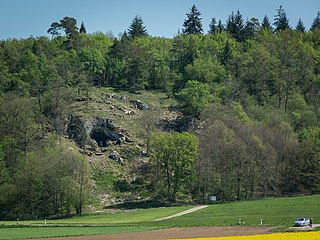
The Bockstein Cave, German: Bocksteinhöhle is part of the Bockstein complex – a White Jurassic limestone rock massif. The 15 by 20 m rock shelter, among small peripheral caves is situated around 12 m (39 ft) above the Lone River valley bottom, north of the towns of Rammingen and Öllingen, Heidenheim district in the central Swabian Jura, southern Germany. Several small openings, that are the actual entrances to the site, lead to various cave sections. The large frontal opening is of modern origin, created during the first excavation works in the late 19th century.

