Related Research Articles

Tajiks are a Persian-speaking Iranian ethnic group native to Central Asia,living primarily in Afghanistan,Tajikistan,and Uzbekistan. Tajiks are the largest ethnicity in Tajikistan,and the second-largest in Afghanistan and Uzbekistan. They speak varieties of Persian,a Western Iranian language. In Tajikistan,since the 1939 Soviet census,its small Pamiri and Yaghnobi ethnic groups are included as Tajiks. In China,the term is used to refer to its Pamiri ethnic groups,the Tajiks of Xinjiang,who speak the Eastern Iranian Pamiri languages. In Afghanistan,the Pamiris are counted as a separate ethnic group.

Tajik,also called Tajiki Persian or Tajiki,is the variety of Persian spoken in Tajikistan and Uzbekistan by Tajiks. It is closely related to neighbouring Dari of Afghanistan with which it forms a continuum of mutually intelligible varieties of the Persian language. Several scholars consider Tajik as a dialectal variety of Persian rather than a language on its own. The popularity of this conception of Tajik as a variety of Persian was such that,during the period in which Tajik intellectuals were trying to establish Tajik as a language separate from Persian,prominent intellectual Sadriddin Ayni counterargued that Tajik was not a "bastardised dialect" of Persian. The issue of whether Tajik and Persian are to be considered two dialects of a single language or two discrete languages has political sides to it.
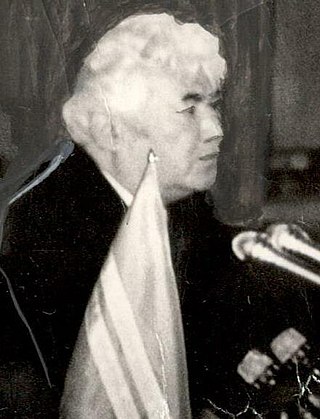
Rahmon Nabiyevich Nabiyev,also spelled Rakhmon Nabiev,was a Tajik politician who served as the First Secretary of the Communist Party of Tajikistan from 1982 to 1985 and twice as the 2nd President of Tajikistan from 23 September 1991 to 6 October 1991 and from 2 December 1991 to 7 September 1992. He was also partly responsible for the Tajik Civil War. Rising out of the regional nomenklatura,Nabiyev ascended to power in 1982 as First Secretary of the Communist Party of Tajikistan. In 1985,he was ousted in a corruption scandal.

Khujand,sometimes spelled Khodjent and known as Leninabad from 1936 to 1991,is the second-largest city of Tajikistan and the capital of Tajikistan's northernmost Sughd province.

Russian Turkestan was the western part of Turkestan within the Russian Empire’s Central Asian territories,and was administered as a Krai or Governor-Generalship. It comprised the oasis region to the south of the Kazakh Steppe,but not the protectorates of the Emirate of Bukhara and the Khanate of Khiva. It was populated by speakers of Russian,Uzbek,Kazakh,Kyrgyz,and Tajik.

The Tajikistani Civil War,also known as the Tajik Civil War,began in May 1992 and ended in 1997. Regional groups from the Garm and Gorno-Badakhshan regions of Tajikistan rose up against the newly formed government of President Rahmon Nabiyev,which was dominated by people from the Khujand and Kulob regions. The rebel groups were led by a combination of liberal democratic reformers and Islamists,who would later organize under the banner of the United Tajik Opposition. The government was supported by Russian military and border guards.

The Communist Party of Tajikistan is a communist party in Tajikistan,and the oldest political party in the country. The party was founded on 6 January 1924 and was the ruling party of the Tajik Autonomous Soviet Socialist Republic from 1924 to 1929 and the Tajik Soviet Socialist Republic from 1929 to 1990 as part of the Soviet Union as a republican branch of the Communist Party of the Soviet Union. It was banned in 1991 following the 1991 coup.

Soviet Central Asia was the part of Central Asia administered by the Soviet Union between 1918 and 1991,when the Central Asian republics declared independence. It is nearly synonymous with Russian Turkestan in the Russian Empire. Soviet Central Asia went through many territorial divisions before the current borders were created in the 1920s and 1930s.
Safarali Kenjayev was a Tajik politician who served as the Speaker of the Supreme Soviet in Tajikistan 1991–1992,Chairman of the Tajik Parliament's committee on human rights and legislation,and as head of the Socialist Party of Tajikistan,which he founded.
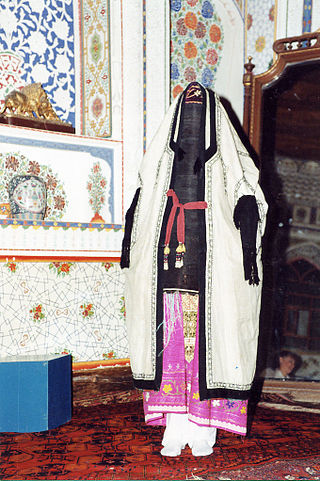
Paranja or paranji is a traditional Central Asian robe for women and girls that covers the head and body. It is also known as "burqa" in Arabic. It is similar in basic style and function to other regional styles such as the Afghan chadari. The traditional veil in Central Asia worn before modern times was the faranji. The part that covered the face,known as the chachvan,was heavy in weight and made from horsehair. It was especially prevalent among urban Uzbeks and Tajiks. The paranja was worn in Khorezm. It was also worn during the Shaybanids' rule (c.1510–1600).

Shashmaqom is a Central Asian musical genre which may have developed in the city of Bukhara. Shashmaqam means the six Maqams (modes) in the Persian language,dastgah being the name for Persian modes,and maqams being the name for modes more generally.

Vorukh is a jamoat in northern Tajikistan that forms part of the city of Isfara in Sughd Region. As of 2022,the jamoat had a total population of 45.000.
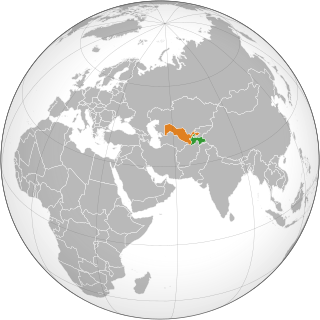
Tajikistan–Uzbekistan relations refers to the relations between the Republic of Tajikistan and the Republic of Uzbekistan.
Tajiks in Pakistan are residents of Pakistan who are of Tajik ancestry. The Tajiks are a Persian-speaking Iranian ethnic group native to Central Asia,living primarily in Afghanistan,Tajikistan,and Uzbekistan.
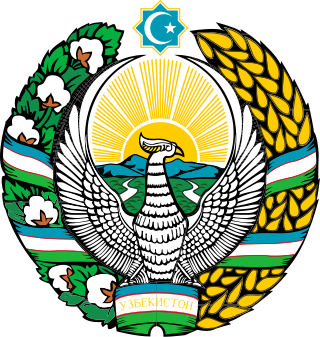
The office of Vice Prresident of Uzbekistan was a political position in Uzbekistan until it was abolished on January 8,1992. It was the title of the deputy to the President of Uzbekistan. Shukrullo Mirsaidov was the first and only holder of the office from 24 March 1990 to 8 January 1992.
The 1999 Tashkent bombings occurred on 16 February when six car bombs exploded in Tashkent,the capital of Uzbekistan. The bombs exploded over the course of an hour and a half,and targeted multiple government buildings. It is possible that five of the explosions were a distraction from the sixth,which appeared to be an attempt to assassinate President Islam Karimov. 16 were killed,and over 120 injured.
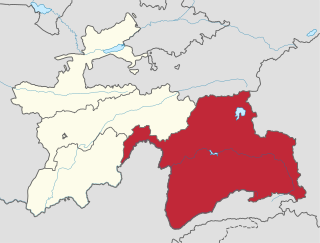
The Gorno-Badakhshan clashes consisted of fighting between Tajik government forces and an armed group led by Tolib Ayyombekov in Tajikistan's semi-autonomous Gorno-Badakhshan province in late July 2012. The Western media described the fighting as the worst in Tajikistan since 2010 or the 1992–1997 civil war.
Sarvan is a Tajik enclave of the Sughd Region surrounded by Uzbekistan. It is located in the Fergana region where Kyrgyzstan,Tajikistan and Uzbekistan meet. Sarvan is located 1.4 km from the Tajik-Uzbek border. Sarvan covers a valley with an area of about 8 km²and has a population of around 150 people. The principal economic activity is agriculture.

The office of vice president of Tajikistan was a political position in Tajikistan until it was abolished.
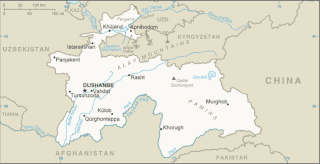
The Tajikistan–Uzbekistan border is an international border between Tajikistan and Uzbekistan. It is 1,312 kilometres (815 mi) in length and runs from the tripoint with Kyrgyzstan to the tripoint with Afghanistan.
References
- ↑ Nourzhanov, Kirill; Bleuer, Christian (2013-10-08). Tajikistan: A Political and Social History. ANU E Press. ISBN 978-1-925021-16-5.
- ↑ Tunçer-Kılavuz, Idil (2014-06-27). Power, Networks and Violent Conflict in Central Asia: A Comparison of Tajikistan and Uzbekistan. Routledge. ISBN 978-1-317-80511-3.
- ↑ Brzezinski, Zbigniew K. (1997). Russia and the Commonwealth of Independent States: Documents, Data, and Analysis. M.E. Sharpe. ISBN 978-1-56324-637-1.
- ↑ Tunçer-Kılavuz, Idil (2014-06-27). Power, Networks and Violent Conflict in Central Asia: A Comparison of Tajikistan and Uzbekistan. Routledge. ISBN 978-1-317-80510-6.
- 1 2 "Exiled Former Tajik Vice President Narzullo Dustov Dies In Tashkent At 82". Radio Free Europe/Radio Liberty . Retrieved 2022-12-07.
- ↑ Mickolus, Edward F.; Simmons, Susan L. (1997). Terrorism, 1992-1995: A Chronology of Events and a Selectively Annotated Bibliography. ABC-CLIO. ISBN 978-0-313-30468-2.
- ↑ "Ноиби собиқи президенти Тоҷикистонро дар Тошканд дафн кардаанд". Радиои Озодӣ (in Tajik). Retrieved 2022-12-07.
  | This article about a Tajikistani politician is a stub. You can help Wikipedia by expanding it. |