
The single transferable vote (STV) is a voting system designed to achieve or closely approach proportional representation through the use of multiple-member constituencies and each voter casting a single ballot on which candidates are ranked. The preferential (ranked) balloting allows transfer of votes to produce proportionality, to form consensus behind select candidates and to avoid the waste of votes prevalent under other voting systems.
The Japan Exchange and Teaching Programme, or JET Programme, is a Japanese government initiative that brings college (university) graduates—mostly native speakers of English—to Japan as Assistant Language Teachers (ALTs) and Sports Education Advisors (SEAs) in Japanese kindergartens, elementary, junior high and high schools, or as Coordinators for International Relations (CIRs) in local governments and boards of education. JET Programme participants are collectively called JETs.

A résumé or resume is a document created and used by a person to present their background, skills, and accomplishments. Résumés can be used for a variety of reasons, but most often they are used to secure new employment.

The Universities and Colleges Admissions Service is a UK-based organisation whose main role is to operate the application process for British universities. It operates as an independent charity, funded by fees charged to applicants and to universities, plus advertising income, and was formed in 1992 through the merger of the former university admissions system UCCA and the former polytechnics admissions system PCAS.
In mathematics, economics, and computer science, the stable marriage problem is the problem of finding a stable matching between two equally sized sets of elements given an ordering of preferences for each element. A matching is a bijection from the elements of one set to the elements of the other set. A matching is not stable if:
Early decision (ED) or early acceptance is a common policy used in college admissions in the United States for admitting freshmen to undergraduate programs. It is used to indicate to the university or college that the candidate considers that institution to be his or her top choice.
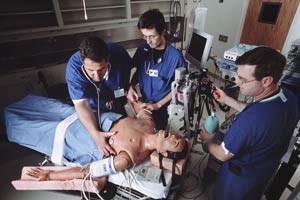
Residency or postgraduate training is specifically a stage of graduate medical education. It refers to a qualified physician, podiatrist, dentist, pharmacist, or veterinarian who practices medicine, usually in a hospital or clinic, under the direct or indirect supervision of a senior medical clinician registered in that specialty such as an attending physician or consultant. In many jurisdictions, successful completion of such training is a requirement in order to obtain an unrestricted license to practice medicine, and in particular a license to practice a chosen specialty. An individual engaged in such training may be referred to as a resident, registrar or trainee depending on the jurisdiction. Residency training may be followed by fellowship or sub-specialty training.
University admission or college admission is the process through which students enter tertiary education at universities and colleges. Systems vary widely from country to country, and sometimes from institution to institution.
Legacy preference or legacy admission is a preference given by an institution or organization to certain applicants on the basis of their familial relationship to alumni of that institution, with college admissions being the field in which legacy preferences are most controversially used. Students so admitted are referred to as legacies or legacy students. Legacy preferences in college and university admissions are particularly widespread in the United States; almost three-quarters of research universities and nearly all liberal arts colleges grant legacy preferences in admissions.
College admissions in the United States refers to the process of applying for entrance to institutions of higher education for undergraduate study at one of the nation's colleges or universities. For those who intend to attend college immediately after high school, the college search usually begins in the eleventh grade of high school with most activity taking place during the twelfth grade, although students at top high schools often begin the process during their tenth grade or earlier. In addition, there are considerable numbers of students who transfer from one college to another, as well as adults older than high school age who apply to college.
The University of the Philippines College Admission Test, commonly known as UPCAT, is part of the admission requirements of the University of the Philippines, administered to graduates of Philippine and foreign high schools.
In Canada, a medical school is a faculty or school of a university that trains future medical doctors and usually offers a three- to five-year Doctor of Medicine (M.D.) or Doctor of Medicine and Master of Surgery degree. Although presently most students enter medicine having previously earned another degree, the M.D. is technically considered an undergraduate degree in Canada. There are currently seventeen medical schools in Canada. As of 2013, approximately 3,900 students were enrolled in Canadian medical schools.
In mathematics, economics and computer science, particularly in the fields of combinatorics, game theory and algorithms, the stable-roommate problem (SRP) is the problem of finding a stable matching for an even-sized set. A matching is a separation of the set into disjoint pairs ("roommates"). The matching is stable if there are no two elements which are not roommates and which both prefer each other to their roommate under the matching. This is distinct from the stable-marriage problem in that the stable-roommates problem allows matches between any two elements, not just between classes of "men" and "women".
The National Resident Matching Program (NRMP), also called The Match, is a United States-based private non-profit non-governmental organization created in 1952 to place U.S. medical school students into residency training programs located in United States teaching hospitals. Its mission has since expanded to include the placement of U.S. citizen and non-U.S. citizen international medical school students and graduates into residency and fellowship training programs. In addition to the annual Main Residency Match that encompasses more than 43,000 applicants and 31,000 positions, the NRMP conducts Fellowship Matches for more than 60 subspecialties through its Specialties Matching Service (SMS). The NRMP is sponsored by a Board of Directors that includes medical school deans, teaching hospital executives, graduate medical education program directors, medical students and residents, and one public member.
The Ontario Graduate Scholarship(s) (OGS) program offers, merit based, annual scholarships to eligible students who will pursue graduate studies in order to complete a master's degree, PhD or doctorate at a university in Ontario, Canada.
In mathematics, economics, and computer science, the Gale–Shapley algorithm is an algorithm for finding a solution to the stable matching problem, named for David Gale and Lloyd Shapley who had described it as solving both the college admission problem and the stable marriage problem. It takes polynomial time, and the time is linear in the size of the input to the algorithm. Depending on how it is used, it can find either the solution that is optimal for the participants on one side of the matching, or for the participants on the other side. It is a truthful mechanism from the point of view of the participants for whom it provides the optimal solution.
Match Day is a term used widely in the graduate medical education community to represent the day when the National Resident Matching Program or NRMP releases results to applicants seeking residency and fellowship training positions in the United States. Match Day for the NRMP Main Residency Match is on the third Friday of March each year, and Match Day ceremonies occur at many of the 155 medical schools in the United States where those results are announced. Match Days for the NRMP Fellowship Matches occur throughout the year because each Fellowship Match has its own schedule of dates. Other national matching plans like the American Osteopathic Association (AOA), American Urological Association, and the San Francisco Match have dates on which they release their results. By participating in a national matching plan, applicants contractually agree to attend the residency, internship or fellowship programs to which they match. The same agreement applies to the programs; they are obligated to train the applicants who match to them. In 2017, Match Day hit a record-high as 35,969 U.S. and international medical school students and graduates vied for 31,757 residency positions.
A human resources management system (HRMS) or human resources information system (HRIS) or human capital management (HCM) is a form of human resources (HR) software that combines a number of systems and processes to ensure the easy management of human resources, business processes and data. Human resources software is used by businesses to combine a number of necessary HR functions, such as storing employee data, managing payroll, recruitment, benefits administration, time and attendance, employee performance management, and tracking competency and training records.
The antitrust class-action lawsuit Jung v. AAMC alleged collusion to prevent American trainee doctors from negotiating for better working conditions. The working conditions of medical residents often involved 80- to 100-hour workweeks. The suit had some early success, but failed when the U.S. Congress enacted a statute exempting matching programs from federal antitrust laws.
In mathematics, economics, and computer science, the lattice of stable matchings is a distributive lattice whose elements are stable matchings. For a given instance of the stable matching problem, this lattice provides an algebraic description of the family of all solutions to the problem. It was originally described in the 1970s by John Horton Conway and Donald Knuth.

