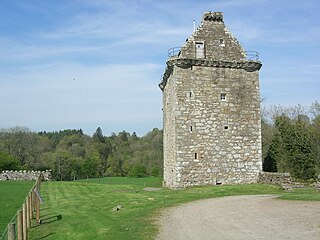
Apollo 11 was the American spaceflight that first landed humans on the Moon. Commander Neil Armstrong and Lunar Module Pilot Buzz Aldrin landed the Apollo Lunar Module Eagle on July 20, 1969, at 20:17 UTC, and Armstrong became the first person to step onto the Moon's surface six hours and 39 minutes later, on July 21 at 02:56 UTC. Aldrin joined him 19 minutes later, and they spent about two and a quarter hours together exploring the site they had named Tranquility Base upon landing. Armstrong and Aldrin collected 47.5 pounds (21.5 kg) of lunar material to bring back to Earth as pilot Michael Collins flew the Command Module Columbia in lunar orbit, and were on the Moon's surface for 21 hours, 36 minutes before lifting off to rejoin Columbia.

Maria Salomea Skłodowska-Curie, known simply as Marie Curie, was a Polish and naturalized-French physicist and chemist who conducted pioneering research on radioactivity. She was the first woman to win a Nobel Prize, the first person to win a Nobel Prize twice, and the only person to win a Nobel Prize in two scientific fields. Her husband, Pierre Curie, was a co-winner of her first Nobel Prize, making them the first-ever married couple to win the Nobel Prize and launching the Curie family legacy of five Nobel Prizes. She was, in 1906, the first woman to become a professor at the University of Paris.

Neil Alden Armstrong was an American astronaut and aeronautical engineer who in 1969 became the first person to walk on the Moon. He was also a naval aviator, test pilot, and university professor.
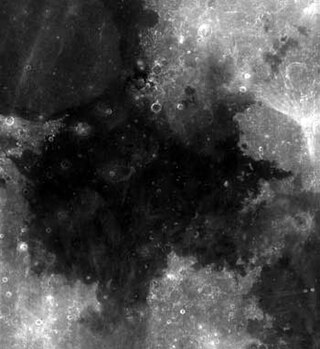
Mare Tranquillitatis is a lunar mare that sits within the Tranquillitatis basin on the Moon. It is the first location on another celestial body to be visited by humans.

The NASA Neil A. Armstrong Flight Research Center (AFRC) is an aeronautical research center operated by NASA. Its primary campus is located inside Edwards Air Force Base in California and is considered NASA's premier site for aeronautical research. AFRC operates some of the most advanced aircraft in the world and is known for many aviation firsts, including supporting the first crewed airplane to exceed the speed of sound in level flight, highest speed by a crewed, powered aircraft, the first pure digital fly-by-wire aircraft, and many others. AFRC operates a second site next to Air Force Plant 42 in Palmdale, California, known as Building 703, once the former Rockwell International/North American Aviation production facility. There, AFRC houses and operates several of NASA's Science Mission Directorate aircraft including SOFIA, a DC-8 Flying Laboratory, a Gulfstream C-20A UAVSAR and ER-2 High Altitude Platform. As of 2023, Bradley Flick is the center's director.

Morehead Planetarium and Science Center is located on the campus of the University of North Carolina at Chapel Hill. As a unit of the university, Morehead receives about one-third of its funding through state sources, one-third through ticket and gift sales, and one-third through gifts and grants.

Armstrong is a small lunar impact crater located in the southern part of the Mare Tranquillitatis. It lies about 50 kilometers to the northeast of the Apollo 11 landing site, Tranquility Base. Named after American astronaut Neil Armstrong, the crater is the easternmost of the row of three craters named in honor of the Apollo 11 crew members. To the north is the Ranger 8 impact site.

Curie is a large lunar impact crater, much of which lies on the far side of the Moon as seen from the Earth. The western rim projects into the near side of the Moon, as defined by the selenographic coordinate system. However the visibility of this formation depends on the effects of libration, so that it can be brought fully into view or completely hidden depending on the orientation of the Moon. When visible, however, it is seen nearly from the side, limiting the amount of detail that can be observed.
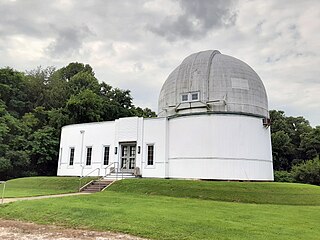
The Goethe Link Observatory, observatory code 760, is an astronomical observatory near Brooklyn, Indiana, United States. It is owned by Indiana University and operated by the Indiana Astronomical Society https://iasindy.org/about.html, which efforts are dedicated to the pursuit of amateur astronomy.

The Armstrong Air & Space Museum is a museum in Wapakoneta, Ohio, the hometown of aviator and astronaut Neil Armstrong, the first man to set foot on the Moon. Opened in 1972, the museum chronicles Ohio's contributions to the history of aeronautics and space flight. The museum is home to the original Gemini 8 spacecraft piloted by Armstrong to perform the world's first space docking, two of Armstrong's space suits, multiple items from the Apollo Program missions, a Moon rock brought back during the Apollo 11 mission, and an F5D Skylancer. The museum has several main galleries that cover the early beginnings of the Space Race, all the way to the end of the Space Shuttle Era. In the museum's Astro-theater, multimedia presentations and documentaries are cast upon the interior of the dome.
Texas A&M Astronomical Observatory is an astronomical observatory owned and operated by Texas A&M University's Department of Physics. It is located in College Station, Texas, USA.
Anderson Mesa Station is an astronomical observatory established in 1959 as a dark-sky observing site for Lowell Observatory. It is located at Anderson Mesa in Coconino County, Arizona, about 12 miles (19 km) southeast of Lowell's main campus on Mars Hill in Flagstaff, Arizona.

The Sir Thomas Brisbane Planetarium is located on the grounds of the Brisbane Botanic Gardens in the suburb of Mount Coot-tha, Brisbane, Queensland, Australia. The Planetarium was officially opened on 24 May 1978.

Tranquility Park is a municipal park in Houston, Texas.
Il était une fois... les Découvreurs is a French animated TV series from 1994, as part of the Once Upon a Time... franchise. It was directed by Albert Barillé. The show aired in the United States on the History Channel starting in April 1995.
Castle Lime Works Quarry is a 1.6 hectares geological Site of Special Scientific Interest near South Mimms in Hertfordshire. The site was notified in 1986 under the Wildlife and Countryside Act 1981. The site is a disused chalk quarry and according to Natural England:

Jericho Health Centre is a health centre on Walton Street in Oxford, England. It is named after the district of Jericho, just northwest of central Oxford. It is part of the United Kingdom's National Health Service (NHS).

The Astronaut Monument is a monument commemorating the training of Apollo astronauts in northern Iceland in 1965 and 1967. It is located outside the Exploration Museum in Húsavík, and contains the names of 32 Apollo astronauts who were sent to Iceland for training in geology for crewed lunar missions. Fourteen of the trainee astronauts later flew to the Moon, and seven of those conducted geology work on the lunar surface.