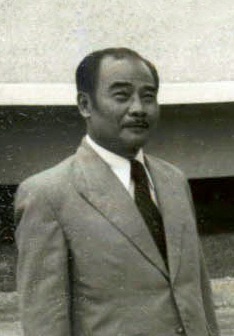
Prince Souphanouvong, nicknamed the Red Prince, was along with his half-brother Prince Souvanna Phouma and Prince Boun Oum of Champasak, one of the "Three Princes" who represented respectively the communist (pro-Vietnam), neutralist and royalist political factions in Laos. He was the President of Laos from December 1975 to October 1986.
The Royal Lao Air Force, best known to the Americans by its English acronym RLAF, was the air force component of the Royal Lao Armed Forces (FAR), the official military of the Royal Lao Government and the Kingdom of Laos during the Laotian Civil War between 1960 and 1975.
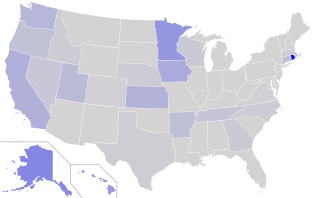
Laotian Americans are Americans who trace their ancestry to Laos. Laotian Americans are included in the larger category of Asian Americans. The major immigrant generation were generally refugees who escaped Laos during the warfare and disruption of the 1970s, and entered refugee camps in Thailand across the Mekong River. They emigrated to the United States during the late 1970s and throughout the 1980s.

Laos developed its culture and customs as the inland crossroads of trade and migration in Southeast Asia over millennia. As of 2012 Laos has a population of roughly 6.4 million spread over 236,800 km2, yielding one of the lowest population densities in Asia. Yet the country of Laos has an official count of over forty-seven ethnicities divided into 149 sub-groups and 80 different languages. The Lao Loum have throughout the country's history comprised the ethnic and linguistic majority. In Southeast Asia, traditional Lao culture is considered one of the Indic cultures.
Mai Neng Moua is a Hmong-American writer and a founder of the Paj Ntaub Voice, a Hmong literary magazine. She is also the editor of the first anthology of Hmong American writers, Bamboo Among the Oaks.

Bryan Thao Worra is a Laotian American writer and poet.
The Science Fiction & Fantasy Poetry Association (SFPA) is a society based in the United States with the aim of fostering an international community of writers and readers interested in poetry pertaining to the genres of science fiction, fantasy, and/or horror. The SFPA oversees the quarterly production of literary journals dedicated to speculative poetry and the annual publication of anthologies associated with awards administered by the organization, i.e. the Rhysling Awards for year's best speculative poems in two length categories and the Dwarf Stars Award for year's best very short speculative poem. Every year since 2013, the SFPA has additionally administered the Elgin Awards for best full-length speculative poetry collection and best speculative chapbook.
The insurgency in Laos is a low-intensity conflict between the Laotian government on one side and former members of the Secret Army, Laotian royalists, and rebels from the Hmong and lowland Lao ethnic minorities on the other. These groups have faced reprisals from the Lao People's Army and Vietnam People's Army for their support of the United States-led, anti-communist military campaigns in Laos during the Laotian Civil War, which the insurgency is an extension of itself. The North Vietnamese invaded Laos in 1958 and supported the communist Pathet Lao. The Vietnamese communists continued to support the Pathet Lao after the end of the Laotian Civil War and the establishment of the Lao People's Democratic Republic. At least 100,000 Hmong civilians were killed as the result of Laotian governmental policies, in what has sometimes been referred to as the Hmong genocide.
Diversicon is an annual speculative fiction convention held in July or August in the Minneapolis-Saint Paul, Minnesota area. Diversicon provides programming and social opportunities to encourage the multicultural, multimedia exploration and celebration of SF by those within and outside of the traditional SF community. Diversicon includes both live and posthumous guests. It is sponsored by SF Minnesota.
Bryan Collier is an American writer and illustrator known best for illustrating children's books. He won both the Coretta Scott King Award as an illustrator and the Ezra Jack Keats New Illustrator Award for Uptown, the first book he both wrote and illustrated. He has won six Coretta Scott King Awards as illustrator and he is a four-time Caldecott Honor recipient.

Big Brother Mouse is a not-for-profit publishing project in Laos.
The people of Laos have a rich literary tradition dating back at least six hundred years, with the oral and storytelling traditions of its peoples dating back much earlier. Lao literature refers to the written productions of Laotian peoples, its émigrés, and to Lao-language works. In Laos today there are over forty-seven recognized ethnic groups, with the Lao Loum comprising the majority group. Lao is officially recognized as the national language, but owing to the ethnic diversity of the country the literature of Laos can generally be grouped according to four ethnolinguistic families: Lao-Tai (Tai-Kadai); Mon-Khmer (Austroasiatic); Hmong-Mien (Miao-Yao), and Sino-Tibetan. As an inland crossroads of Southeast Asia the political history of Laos has been complicated by frequent warfare and colonial conquests by European and regional rivals.

Ketmani Kouanchao is a Lao American educator and writer.
Chanida Phaengdara Potter is a Lao American writer, activist and community development strategist in the Lao American and Southeast Asian diaspora communities. She is well known for her work as the founding editor of the internationally acclaimed online publication, Little Laos on the Prairie where voice and visibility of the Lao diaspora experience are amplified. She is the executive director of The SEAD Project , an organization based in Minnesota and Laos aimed at empowering Southeast Asian diaspora communities by bridging the access gap to community, storytelling, languages, heritages and cross-cultural connections and knowledge-sharing through creative workshops and communication tools. She has worked in the nonprofit field on organizing, public affairs, community development, and human rights advocacy.
Krysada Panusith Phounsiri is a Lao-American artist and engineer based in San Diego, California.
Chay Douangphouxay is a Lao-Khmer American artist and activist from Minneapolis. Douangphouxay is a spoken word artist known for covering topics such as race and gender. Through her art, she has sought to redefine the image of Asian-Americans.

Kou Voravong was a Laotian politician. He was part of the anti-Japanese resistance leading group during the Second World War and then anti-Lao Issara (ລາວອິດສລະ) in the post-war period. Throughout his career, from 1941 to 1954, he has been District Chief, Province Governor, member of the Lao National Assembly, and Royal Lao Government Minister.

Ban Phou Pheung Noi is a Laotian village located at the peak of Phou Pheung mountain in the Xieng Khouang province of Laos. Phou Pheung mountain is approximately 916 m (3,005 ft). During the Vietnam War, combat between the American allies, the Hmong, and the Pathet Lao, The Laos Marxist government, and the Communist North Vietnamese People's Army took place on the mountain. Phou Pheung mountain runs from east to west and is rocky, and is covered in tropical forests. It is south of Muang Soui - Nongtang-Nato, and west of Phou Douk, Muang Phuan, Phonsavan and Plain of Jars. To the east, about 10 miles from Ban Phou Pheung Noi, is the Num Ngum 4 hydroelectric dam.


