The Kavango people, also known as the vaKavango or haKavango, are a Bantu ethnic group that resides on the Namibian side of the Namibian–Angolan border along the Kavango River. They are mainly riverine living people, but about 20% reside in the dry inland. Their livelihood is based on fishery, livestock-keeping and cropping. The Kavango Region of Namibia is named after the people.

The culture of Angola is influenced by the Portuguese. Portugal occupied the coastal enclave Luanda, and later also Benguela, since the 16th/17th centuries, and expanded into the territory of what is now Angola in the 19th/20th centuries, ruling it until 1975. Both countries share cultural aspects: language (Portuguese) and main religion. However, present-day Angolan culture is mostly NATIVE Bantu, which was mixed with Portuguese culture. The diverse ethnic communities with their own cultural traits, traditions and native languages or dialects include the Ovimbundu, Ambundu, Bakongo, Chokwe, Avambo and other peoples.

The Caprivi Strip, also known simply as Caprivi, is a geographic salient protruding from the northeastern corner of Namibia. It is surrounded by Botswana to the south and Angola and Zambia to the north. Namibia, Botswana and Zambia meet at a single point at the eastern tip of the Strip, which also comes within 150 m of Zimbabwe thus nearly forming a quadripoint. Botswana and Zambia share a 150 meter border at the crossing of Kazungula. The territory was acquired by the then German South West Africa in order to provide access to the Zambezi River and consequently a route to the east coast of the continent and German East Africa. The route was later found not to be navigable because about 65 kilometres east of the Caprivi Strip is Victoria Falls, one of the world's largest waterfalls.

Kavango was one of the thirteen regions of Namibia until it was split into the Kavango East and Kavango West Regions in 2013. Its capital was Rundu.
Sekele is the northern language of the ǃKung dialect continuum. It was widespread in southern Angola before the Angolan Civil War, but those varieties are now spoken principally among a diaspora in northern Namibia. There are also a number of dialects spoken in far northern Namibia.
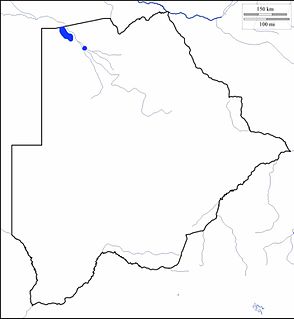
Khwe is a dialect continuum of the Khoe family of Namibia, Angola, Botswana, South Africa, and parts of Zambia, with some 8,000 speakers.
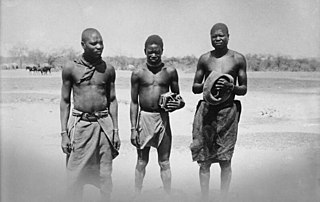
The Ovambo people, also called Aawambo, Ambo, Aawambo, or Ovawambo (Kwanyama) the biggest of the Aawambo sub-tribes are a Bantu ethnic group native to Southern Africa, primarily modern Namibia. They are the single largest ethnic group in Namibia, accounting for about half of the population and one of Namibia’s most vibrant tribes. They have retained many aspects of their cultural practices, despite concerted efforts from Christian missionaries to wipe out what was believed to be ‘pagan practices’. They are also found in southern Angolan province of Cunene where they are more commonly referred to as "Ambo". The Ovambo consist of a number of kindred Bantu ethnic tribes who inhabit what was formerly called Ovamboland. In Angola, they are a minority, accounting for about two percent of the total Angolan population.
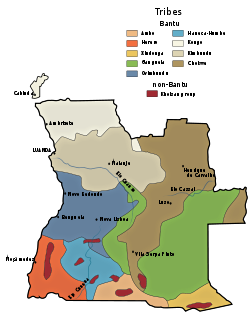
The Ovimbundu, also known as the Southern Mbundu, are a Bantu ethnic group who live on the Bié Plateau of central Angola and in the coastal strip west of these highlands. As the largest ethnic group in Angola, they make up 38 percent of the country's population. Overwhelmingly the Ovimbundu follow Christianity, mainly the Igreja Evangélica Congregacional de Angola (IECA), founded by American missionaries, and the Catholic Church. However, some still retain beliefs and practices from African traditional religions.
ǃKung (ǃXun), also known as Ju, is a dialect continuum spoken in Namibia, Botswana, and Angola by the ǃKung people, constituting two or three languages. Together with the ǂʼAmkoe language, ǃKung forms the Kxʼa language family. ǃKung constituted one of the branches of the putative Khoisan language family, and was called Northern Khoisan in that scenario, but the unity of Khoisan has never been demonstrated and is now regarded as spurious. Nonetheless, the anthropological term "Khoisan" has been retained as an umbrella term for click languages in general.

Rundu is the capital and largest city of the Kavango-East Region in northern Namibia. It lies on the border with Angola on the banks of the Kavango River about 1,000 metres above sea level. Rundu's population is growing rapidly. The 2001 census counted 36,964 inhabitants; and for the 2011 census it has climbed to 63,430.

Portuguese is the only official language of Angola, but 46 other languages are spoken in the country, mostly Bantu languages. Ethnologue considers six languages to benefit of an institutional status in Angola: (Angolan) Portuguese, Umbundu, Kimbundu, Kikongo, Chokwe, Ngangela and Kwanyama.
Kwangali, or RuKwangali, is a Bantu language spoken by 85,000 people along the Kavango River in Namibia, where it is a national language, and in Angola. It is one of several Bantu languages of the Kavango which have click consonants; these are the dental clicks c and gc, along with prenasalization and aspiration.
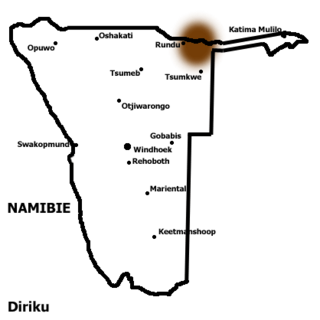
Gciriku or Dciriku (Diriku) or Dirico, also known as Manyo or Rumanyo, is a Bantu language spoken by 305,000 people along the Okavango River in Namibia, Botswana and Angola. 24,000 people speak Gciriku in Angola, according to Ethnologue. It was first known in the west via the Vagciriku, who had migrated from the main Vamanyo area and spoke Rugciriku, a dialect of Rumanyo. The name Gciriku remains common in the literature, but within Namibia the name Rumanyo has been revived. The Mbogedu dialect is extinct; Maho (2009) lists it as a distinct language, and notes that the names 'Manyo' and 'Rumanyo' are inappropriate for it.
Namibia, despite its scant population, is home to a wide diversity of languages, from multiple language families: Germanic, Bantu, and the various Khoisan families. When Namibia was administered by South Africa, Afrikaans, German, and English enjoyed an equal status as official languages. Upon Namibian independence in 1990, English was enshrined as the nation's sole official language in the constitution of Namibia. German and Afrikaans were stigmatised as having colonial overtones, while the rising of Mandela's Youth League and the 1951 Defiance Campaign spread English among the masses as the language of the campaign against apartheid.
Nkurenkuru is a town on the south-western banks of the Kavango River. It is the capital of the Kavango West Region of northern Namibia, located 140 kilometres (87 mi) west of Rundu. It is also a former mission station of the Finnish Missionary Society.
There are various communities of Angolans in Namibia.
Gciriku is a traditional Kavango kingdom in what is today Namibia. Its people speak the Gciriku language.
Ganguela or Nganguela is the name of a small ethnic group living in Angola, but since colonial times the term has been applied to a number of peoples East of the Bié Plateau. In addition to the Nganguela proper, this ethnographic category includes the Lwena (Luena), the Luvale, the Mbunda, the Lwimbi, the Camachi and others.
Ekoka ǃKung or Western ǃXuun is a variety of the ǃKung dialect cluster, spoken originally in the area of the central Namibian–Angolan border, west of the Okavango River, but since the Angolan Civil War also in South Africa.
The Vambunda are a Bantu people who, during the Bantu migrations, came from the north to south-eastern Angola and finally Barotseland, now part of Zambia. Their core is at present found in the south-east of Angola from the Lunguevungu river in Moxico to the Cuando Cubango Province.

