Darnytsia is a station on the Kiev Metro's Sviatoshynsko-Brovarska Line. The station was opened on November 5, 1965 as part of the westwards eastwards expansion of the Brovary radius and is the second one to be fully on the left bank of the Dnieper River. It takes its name from the historic neighborhood of Kiev, Darnytsia.

Lisova is the terminus station of the Sviatoshynsko-Brovarska Line on the Kiev Metro. Opened on December 5, 1979 it was also the last surface station in Kiev.

Politekhnichnyi Instytut is a station on Kiev Metro's Sviatoshynsko-Brovarska Line. The station was opened on November 5, 1963, and is named after Kiev's Polytechnic Institute located near the station. It was designed by G.V. Golovko, B.V. Dzbanovsky, E.L. Ivanov, and M.M. Syrkin.

Shuliavska is a station on Kiev Metro's Sviatoshynsko-Brovarska Line. The station was opened on November 5, 1963, and is named after Kiev's Shuliavka neighbourhood. It was designed by A.V. Dobrovolskyi, B.I. Pryimak, A.I. Malynovskyi, and A.I. Cherkasskyi. The station was formerly known as the Zavod Bolshevik station.

Nyvky is a station on Kiev Metro's Sviatoshynsko-Brovarska Line. The station was opened on November 5, 1971, and is named after Kiev's Nyvky neighbourhood. It was designed by Boris Pryimak, I.L. Maslenkov, V.C. Bohdanovskyi, and T.A. Tselikovska.

Sviatoshyn is a station on Kiev Metro's Sviatoshynsko-Brovarska Line. The station was opened on 5 November 1971, and is named after Kiev's Sviatoshyn neighborhood. It was designed by H.V. Holovko, N.S. Kolomiiets, and M.M. Syrkin. The station was formerly known as Sviatoshyno.

Maidan Nezalezhnosti is a station on Kiev Metro's Obolonsko–Teremkivska line. The station was opened on December 17, 1976, and is named after Kiev's Maidan Nezalezhnosti on the Khreschatyk street. It was designed by N. Kolomiiets, I. Maslenkov, M. Syrkyn, and F. Zaremba.

Poshtova Ploshcha is a station on Kiev Metro's Obolonsko–Teremkivska Line. The station was opened on December 17, 1976, and is named after Kiev's Poshtova Square near the Dnieper's embankment in the historic Podil neighbourhood. It was designed by A.S. Krushynskyi, T.A. Tselykovska, I.L. Maslenkov, and V.S. Bohdanovskyi.

Kontraktova Ploshcha is a station on Kiev Metro's Obolonsko–Teremkivska Line. The station was opened on December 17, 1976, and is named after Kiev's Kontraktova Square in the historic Podil neighborhood. It was designed by B.I. Pryimak, I.K. Maslenynkov, and F.M. Zaremba. The station was formerly known as Chervona Ploscha until 1990.
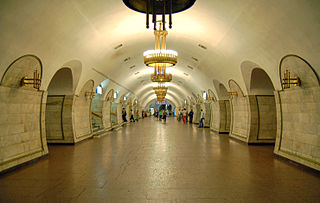
Ploshcha Lva Tolstoho is a station on Kiev Metro's Obolonsko–Teremkivska Line. The station was opened on December 19, 1981, and is named after the writer Leo Tolstoy. It was designed by N.A. Levchuk and V.B. Zhezheryn.

Olimpiiska is a station on the Kiev Metro's Obolonsko–Teremkivska Line. It was opened on December 19, 1981, and was originally named after Kiev's Republican Stadium as Respublikansky Stadion. It was designed by A.S. Krushynskyi, T.A. Tselikovska, A.S. Andriienko, and Y.M. Sharanevych.

Tarasa Shevchenka is a station on Kiev Metro's Obolonsko–Teremkivska Line. The station was opened on December 19, 1980 in the northern part of the historic Podil neighbourhood and is named after the famous Ukrainian poet, writer, and painter, Taras Shevchenko. It was designed by T.A. Tselikovska, A.S. Krushynskyi, and A. Pratsiuk.
Pochaina is a station on Kiev Metro's Obolonsko–Teremkivska line. The station was opened on December 19, 1980 in the Petrivka neighborhood of the Podilskyi Raion of Kiev near Pochaina Railway Station. It was designed by I.L. Maslenkov, T.A. Tselikovska, A.S. Krushynskyi, and F.M. Zaremba.

Minska is a station on Kiev Metro's Obolonsko–Teremkivska Line. The station was opened on November 6, 1982 in the Obolonskyi Raion of Kiev. It was designed by I.L. Maslenkov, T.A. Tselikovska, and F.M. Zaremba. The station takes its name from the Minskyi Raion in which it is situated.
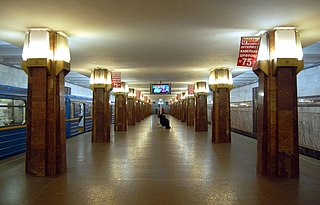
Heroiv Dnipra is a station on Kiev Metro's Obolonsko–Teremkivska line. The station was opened on November 6, 1982 in the Obolonskyi Raion of Kiev and was designed by G.D. Andreev. The Metro station is named after the street directly above it.

Palats "Ukrayina" is a station on Kiev Metro's Obolonsko–Teremkivska Line. The station was opened on December 30, 1984, and is named after Ukraine biggest concert hall located near it. The architecture was designed by A.S. Krushynskyi, T.A. Tselikovska, N. Alyoskin, with other design by S. Kirichenko and R. Kirichenko.

Klovska — is a station on Kiev Metro's Syretsko-Pecherska Line. Originally the station was a temporary terminus of the line between its opening date December 31, 1989 and prior to the expansion of the line to Vydubichy in December 1991.

Druzhby Narodiv or Friendship of Peoples is a station of Kiev Metro's Syretsko-Pecherska Line. It is situated between Pecherska and Vydubychi stations. This station was opened on December 30, 1991.

Vydubychi is a station of Kiev Metro's Syretsko-Pecherska Line. It is situated between Druzhby Narodiv and Slavutych stations. This station was opened on December 30, 1991.

Kharkivska is a station of Kiev Metro's Syretsko-Pecherska Line. It is between the Pozniaky and Vyrlytsia stations. This station was opened on December 28, 1994.